That was a question I received during a job interview recently.
At first, it seemed like a simple question.
But the more I thought about it, the more I realized how important it is.

Not only for interviews.
For life.
Because we all have things that drain our energy.
Sometimes it’s a difficult project.
Sometimes it’s uncertainty.
Sometimes it’s a personal challenge.
And sometimes it’s people.
For me, one of the biggest energy drains in professional environments has always been dealing with rude behavior.
Not disagreement.
Not conflict.
Rudeness.
The kind of interaction where people stop treating each other with basic respect.
Early in my career, this affected me more than I would like to admit.
Whenever I encountered this behavior, it could ruin my day.
Today, it still bothers me.
But I have learned something important: I cannot control how other people behave, I can only control how I respond.
And that realization changed everything.
The mistake many of us make
When something triggers a strong emotional reaction, our first instinct is often to suppress it.
We tell ourselves things like:
- “I shouldn’t feel this way.”
- “I need to be stronger.”
- “This shouldn’t affect me.”
But emotions don’t work that way.
The more we deny them, the more influence they tend to have.
One of the most valuable ideas I learned comes from Marc Brackett’s book Permission to Feel.
His central argument is simple: Emotions are not the problem, ignoring them is.
Being human means feeling things.
You don’t get to opt out of that part of the experience.
The real skill is learning how to understand and manage those emotions effectively.
The framework I use when emotions run high
One tool that has been particularly helpful for me is Brackett’s RULER framework.
Whenever I find myself in a difficult situation, I try to walk through five steps.
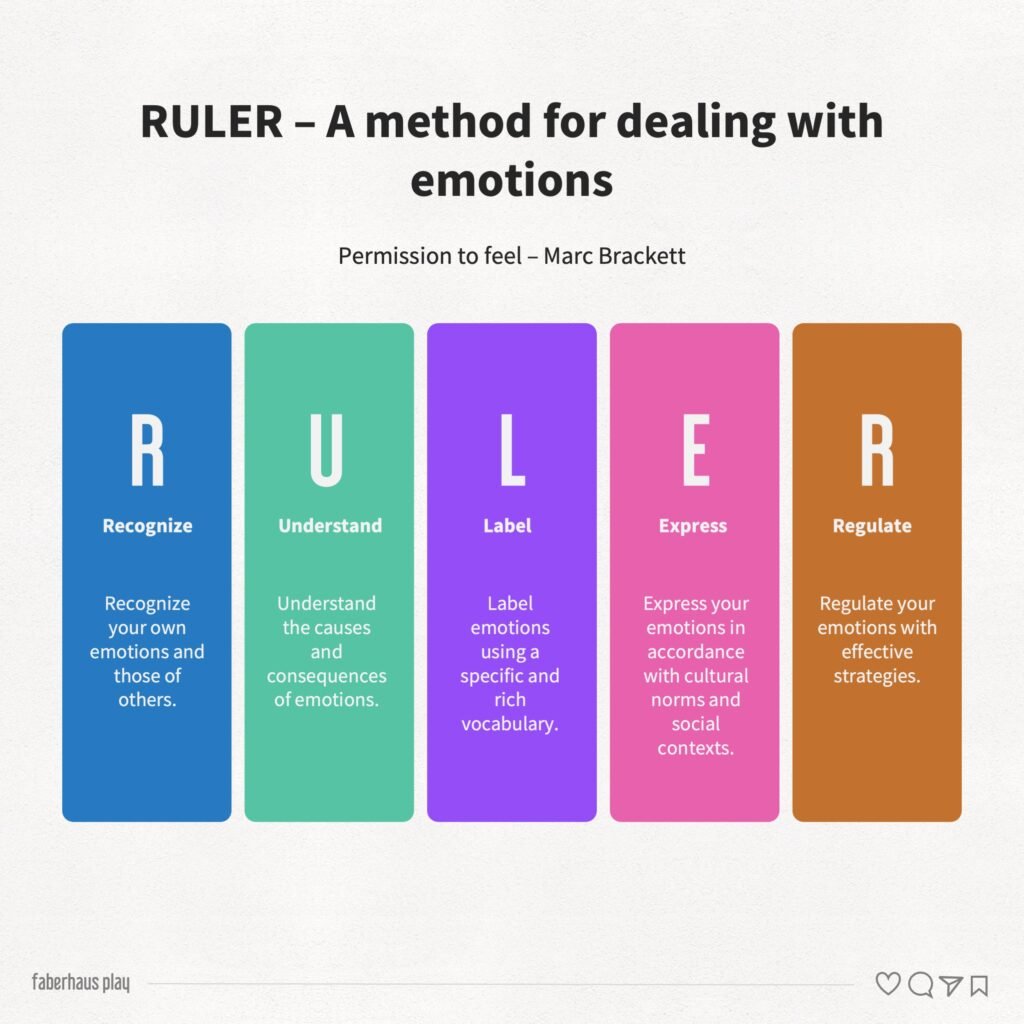
Recognize
The first step is simply noticing what is happening.
Many people move through their day carrying frustration, anxiety, or anger without consciously acknowledging it.
I try to pause and ask: What am I feeling right now?
Sometimes awareness alone creates enough distance to prevent a poor reaction.
Understand
The next step is identifying what caused the emotion.
What happened?
What triggered it?
Was it a comment? A situation? A misunderstanding?
Understanding the source often reduces the intensity of the feeling.
Label
This is harder than most people think.
Many of us only use a handful of emotional labels:
- Angry
- Dad
- Happy
- Stressed
But emotions are much more nuanced than that.
The more accurately we can name what we’re feeling, the easier it becomes to work with it.
Express
Expression does not mean reacting impulsively.
It means acknowledging and articulating what is happening.
Sometimes this is a conversation with another person.
Sometimes it’s simply writing down your thoughts.
The act of expressing emotions often transforms something vague and overwhelming into something clearer and more manageable.
Regulate
This is where choice enters the process.
I cannot always control what I feel.
But I can influence what I do next.
That distinction is incredibly important.
Professional maturity is not the absence of emotion.
It’s the ability to respond thoughtfully instead of reacting automatically.
Five strategies that help me regulate emotions
Over the years, I have found the five approaches from Marc Brackett particularly useful.
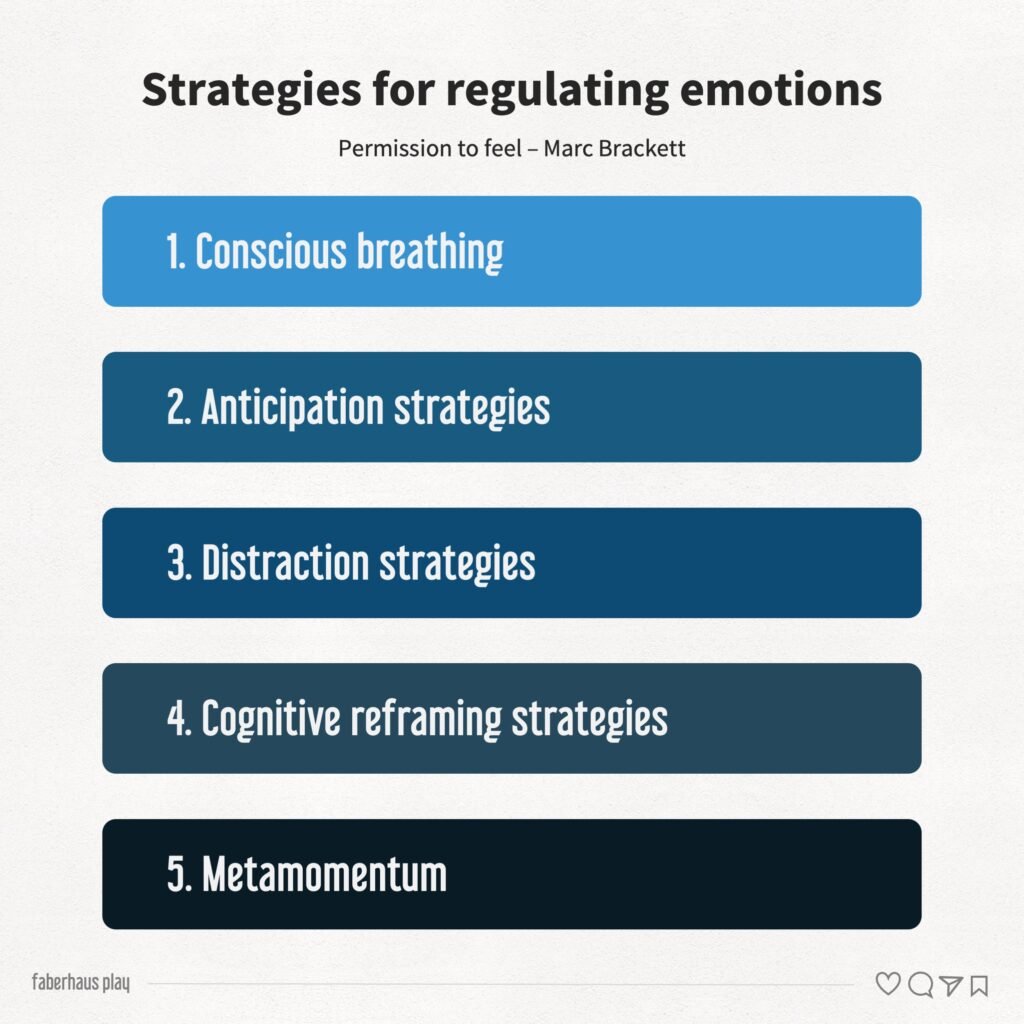
1. Conscious breathing
Simple.
Remarkably effective.
When emotions become intense, slowing down and focusing on breathing can create enough space for better decisions.
2. Anticipation strategies
Sometimes we know difficult situations are coming.
Preparing thoughtful responses beforehand can reduce emotional overload when the moment arrives.
The challenge is not letting imagination create problems that don’t actually exist.
I use this strategy carefully.
3. Distraction strategies
Sometimes the best thing to do is step away temporarily.
Go for a walk.
Read something unrelated.
Focus on a different task.
Not as avoidance.
As recovery.
4. Cognitive reframing
This means intentionally looking at a situation from another perspective.
For example:
A failed interview can be interpreted as rejection.
Or it can be interpreted as feedback and learning.
The event is the same.
The interpretation changes.
And interpretation often shapes emotional impact.
5. Metamomentum
This may be the most powerful strategy of all.
Instead of reacting immediately, create space.
Pause.
Reflect.
Respond later.
Sometimes the best response is:
“Let me think about this and get back to you tomorrow.”
Not every situation allows for this.
But when it does, it can dramatically improve decision quality.
Emotional regulation is a skill, not a personality trait
One thing I have learned is that emotional regulation is not something people simply have or don’t have.
It’s a skill.
And like every skill, it improves with practice.
Understanding emotions does not eliminate them.
Knowing the theory does not automatically change behavior.
The work happens through repetition.
Through awareness.
Through practice.
Again and again.
Because we can`t eliminate every difficult situation from our lives.
There will always be rude people.
Unexpected setbacks.
Stressful moments.
Disappointments.
The goal is not controlling the world around us.
The goal is learning how to navigate it more skillfully.
For me, emotional regulation has become one of the most valuable professional skills I’ve ever developed.
Not because it removes difficult emotions.
But because it helps me choose what happens next.
References
Marc Brackett. (2019). Permission to Feel: Unlocking the Power of Emotions to Help Our Kids, Ourselves, and Our Society Thrive. New York: Celadon Books.