Every new job requires adaptation.
You learn new processes.
You understand the company’s culture.
You meet new people.
You follow new rules.
None of that is a problem.
In fact, it’s necessary.
The problem begins when adaptation stops being a skill and becomes the goal itself.
Because that’s where something subtle can happen.
Instead of becoming part of the organization, we slowly become another version of it.
The tree that grows straight
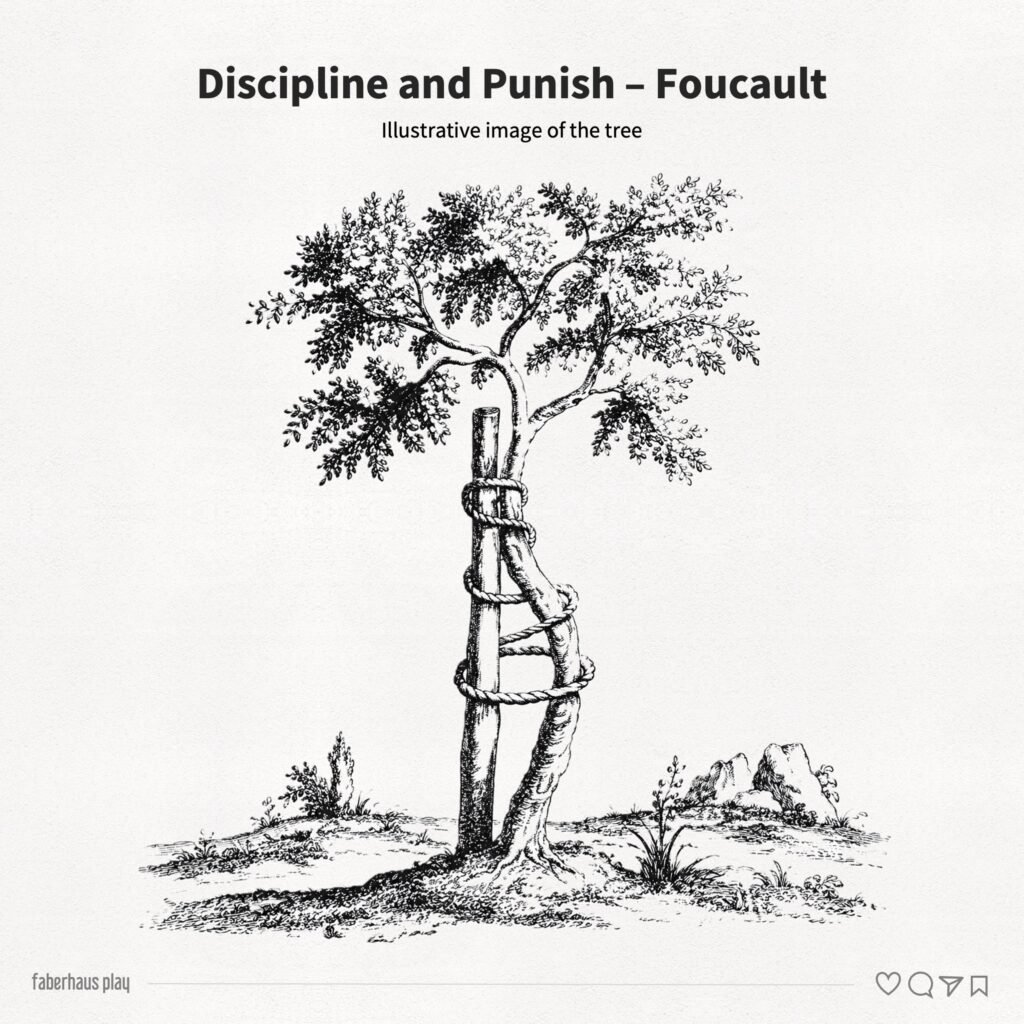
There is a well-known image often associated with discussions inspired by Michel Foucault’s Discipline and Punish.
A young tree is tied to a perfectly straight wooden stake.
The purpose is simple.
To make sure it grows straight.
It’s a powerful metaphor.
The tree already has its own movement.
Its own rhythm.
Its own way of growing.
But once it is continuously guided by an external structure, it begins to grow according to that structure instead of its own nature.
And this often happen inside the organizations.
Organizations can shape us in the same way
When we join a company, we naturally observe how things are done.
How people communicate.
How decisions are made.
How ideas are presented.
How problems are solved.
That process is healthy.
No organization can function without some degree of alignment.
But there is an important difference between learning a culture and allowing that culture to replace your own way of thinking.
The second often happens so gradually that we barely notice it.
Creativity rarely grows in straight lines
Product Designers are not hired simply to execute predefined solutions.
We are hired to see possibilities that don’t exist yet.
To question assumptions.
To connect seemingly unrelated ideas.
To explore alternatives.
To reduce uncertainty.
None of that follows a perfectly straight path.
Creativity is full of detours.
Experiments.
Failed attempts.
Unexpected connections.
It looks far more like nature than a spreadsheet.
The more we try to eliminate those curves in order to perfectly fit an existing model, the greater the risk of losing the very thing that allows innovation to emerge.
The danger of becoming average
One idea has always resonated with me:
Systems naturally tend to preserve themselves.
Every organization develops patterns.
Some are excellent.
Others simply exist because they’ve always existed.
If our only goal is to adapt as quickly as possible, we may end up reproducing those patterns without ever questioning them.
Little by little, we stop bringing new perspectives.
We repeat familiar decisions.
We defend existing processes.
We start thinking exactly like everyone else.
Eventually, our creativity no longer changes the system.
It simply helps maintain it.
Alignment and originality are not opposites
This isn’t an argument against processes.
Or collaboration.
Or consistency.
Strong product teams need all three.
But they also need people who are willing to ask uncomfortable questions.
To challenge an assumption.
To propose an alternative.
To test a different direction.
Innovation rarely emerges from perfect repetition.
More often, it begins when someone notices that another path is possible.
A question worth asking
After spending some time inside any organization, it may be worth asking yourself one simple question:
Am I adapting so I can contribute more effectively, or am I adapting so much that I’ve stopped contributing what made me different in the first place?
There is a fine line between professional maturity and quiet conformity.
The more experienced we become, the more important it is to recognize that difference.
Because creativity rarely disappears all at once.
It usually leaves one small decision at a time.
One idea left unsaid.
One question never asked.
One hypothesis never tested.
Until one day we realize we’ve become perfectly straight.
But we’ve stopped growing in the direction we were capable of growing.
References
Foucault, M. (1977). Discipline and Punish: The Birth of the Prison.
Foucault, M. (1980). Power/Knowledge: Selected Interviews and Other Writings.
Deleuze, G. (1992). Postscript on the Societies of Control, in Negotiations 1972–1990.
Norman, D. A. (2013). The Design of Everyday Things.