One of the biggest challenges in product development is maintaining alignment over time.
Teams often know what they need to deliver next, but struggle to connect those activities with:
- Long-term goals
- Customer needs
- Business objectives
- Strategic priorities
This is where the 3H Panel becomes useful.

Built upon the Three Horizons framework, the 3H panel brings together objectives, customer insights, business expectations, and next steps into a single shared view.
Its purpose is simple: Help teams align where they are, where they want to go, and what they need to do next.
What is the 3H panel?
The 3H panel is structured around four main areas:
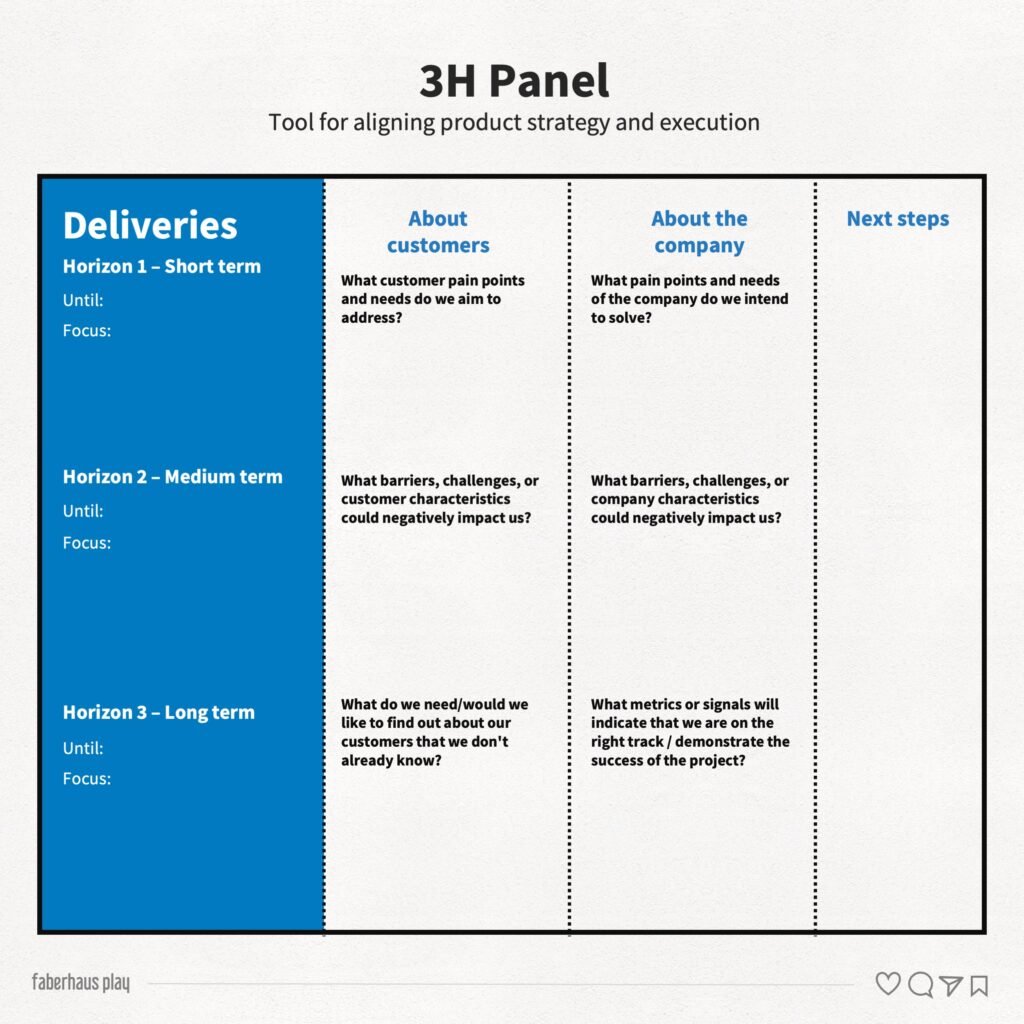
1. Horizons
A view of short-, medium-, and long-term expectations.
These horizons help teams think beyond immediate deliveries and connect today’s decisions with future outcomes.
2. Customer perspective
A shared understanding of:
- Customer needs
- Customer pain points
- Opportunities
- Unanswered questions
This section helps ensure the team remains focused on the people they are designing for.
3. Business perspective
A view of:
- Business objectives
- Organizational priorities
- Internal challenges
- Constraints
- Success metrics
This helps teams balance customer value with business viability.
4. Next steps
A summary of the actions required to move the initiative forward.
This includes:
- Priorities
- Owners
- Deadlines
- Immediate focus areas
Without this section, strategic conversations often remain theoretical.
The next steps section transforms strategy into action.
What is the 3H panel typically used for?
The 3H panel is commonly used to define major priorities and strategic directions for:
- New products
- Product evolution
- Service design initiatives
- Digital transformation projects
- Innovation programs
It is particularly useful when multiple disciplines need to align around a shared vision.
For example:
- Product
- Engineering
- Design
- Research
- Operations
- Leadership teams
By making expectations visible, the framework helps reduce misunderstandings and conflicting priorities.
Why the 3H panel is valuable
Many planning activities focus heavily on delivery.
The problem is that delivery without direction creates activity without progress.
The 3H panel encourages teams to connect:
What customers need
with
What the business wants to achieve
and
What the team should do next
This creates a more balanced conversation between:
- Desirability
- Viability
- Feasibility
- Strategy
In practice, it helps teams move from tactical thinking toward strategic thinking.
When to use the 3H panel
The 3H panel is most used:
- At the beginning of a project
- At the start of a new product phase
- During strategic planning cycles
- Before defining roadmaps
- During portfolio reviews
- When teams need alignment around priorities
It can also be revisited periodically to assess whether the initiative is still moving in the right direction.
As conditions change, the panel evolves with them.
A simple step-by-step process
Step 1
Define the time horizons.
The team determines what short-, medium-, and long-term mean within their context.
For some organizations, this might be:
- 3 months
- 12 months
- 3 years
For others, the timelines may be completely different.
The important thing is creating a shared understanding.
Step 2
Define expected outcomes for each horizon.
The team discusses:
- What should be delivered
- What success looks like
- Whether the proposed timelines are realistic
If necessary, adjustments can be made to:
- Scope
- Priorities
- Timelines
- Expectations
Once alignment is reached, the team summarizes the strategic focus of each horizon.
Step 3
Map the customer perspective.
The team discusses three key areas:
Customer needs
What problems are customers trying to solve?
Barriers
What prevents customers from achieving their goals?
Unknowns
What still needs to be discovered, researched, or validated?
This section often generates valuable research questions.
Step 4
Map the business perspective.
The team discusses:
Business needs
What outcomes does the organization expect?
Internal barriers
What organizational constraints may affect success?
Success metrics
How will progress and performance be measured?
This ensures strategic alignment between customer value and business objectives.
Step 5
Define next steps.
Once the major themes have been identified, the team determines:
- Priorities
- Owners
- Timelines
- Immediate actions
This turns discussion into execution.
Without clear next steps, even the best strategy remains only an intention.
Why this matters for product and design teams
One of the most valuable aspects of the 3H panel is that it forces teams to look beyond immediate delivery.
Many organizations spend most of their time discussing:
- Features
- Deadlines
- Execution
Very few spend enough time discussing:
- Long-term direction
- Customer evolution
- Strategic opportunities
- Future positioning
The 3H panel helps create that conversation.
Reference
Faberhaus. Design strategist. Retrieved from
Design strategist article