
Service design is often misunderstood.
Many people assume it is simply about improving customer service or making support processes more efficient.
It’s much broader than that.
Service design is about understanding the entire ecosystem that surrounds a service and intentionally designing how people experience it.
And in a world increasingly shaped by digital products, connected experiences, and rising customer expectations, that capability has become more important than ever.
What is service design?
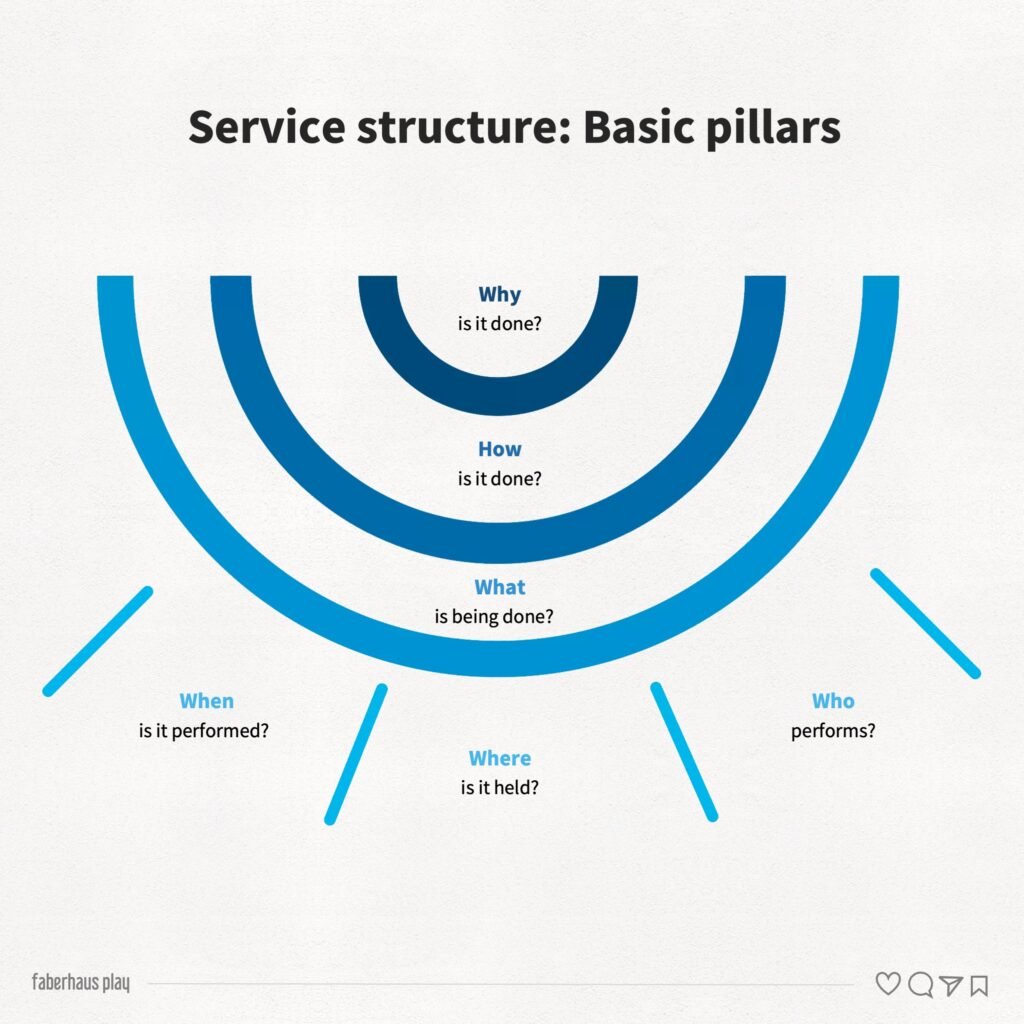
Service design is the application of design principles, methods, and approaches to the creation, evolution, and management of services.
Its purpose is to design how people interact with a service and how that service is delivered to customers.
Unlike many design disciplines that focus on a specific artifact, service design looks at the entire ecosystem surrounding an experience.
This includes:
- Customers
- Employees
- Processes
- Technology
- Communication
- Touchpoints
- Operational systems
- And others
The goal is to identify:
- Pain points
- Opportunities
- Strengths
- Weaknesses
- Moments that shape the customer experience.
Service design is not a new discipline.
Organizations have always had to design and improve services.
What has changed is the growing recognition of service design as a professional field, with dedicated methodologies, books, courses, and practitioners.
It is also important to understand that service design is not separate from design itself.
Rather, it is one application of design principles focused specifically on services.
How is service design different from product design and graphic design?
To understand service design, it helps to understand where design originally came from.
The roots of design are closely tied to product development.
During the Industrial Revolution, manufacturing processes became increasingly standardized, making products technically similar across different companies.
Design emerged to:
- Understand people
- Improve products
- Differentiate offerings
- Create competitive advantage
Over time, the methods developed by designers began to be applied to other contexts.
This led to the emergence of specialized disciplines such as:
- Graphic design
- Digital product design
- Interaction design
- Service design
The main difference between these disciplines is their primary focus.
Product design
Focuses on:
- Physical or digital products
- Product functionality
- Usability
- Production systems
Graphic design
Focuses on:
- Visual communication
- Branding
- Typography
- Imagery
- Visual language
Service design
Focuses on:
- The entire service ecosystem
- Customer journeys
- Operational processes
- Organizational interactions
- Cross-channel experiences
Because of its broader perspective, service design often incorporates aspects of both product and graphic design but examines them through the lens of the overall service experience.
And in this context two major shifts have made service design increasingly important:
- The growing complexity of modern services
- The rise of on-demand expectations
Digital experiences have made services more complex
One of the biggest challenges organizations face today is the growing number of touchpoints customers have with a service.
In the past, many services were delivered locally and could be observed and managed within a relatively controlled environment.
Today, customer experiences often begin long before a direct interaction takes place.
A customer might:
- Search on Google or AI platforms
- Read reviews
- Compare alternatives
- Interact with social media content
- Form expectations before ever becoming a customer.
And the experience continues after the transaction through:
- Digital reviews
- Support channels
- Social media conversations
- Loyalty programs
- Ongoing engagement
Digital products face similar challenges.
Streaming platforms, e-commerce services, mobile applications, and online communities must create coherent experiences without necessarily involving a human interaction at all.
This complexity makes service design essential.
Competition is no longer local
The internet fundamentally changed competition.
Organizations no longer compete only with nearby businesses.
A local bookstore now competes with:
- Amazon
- Online marketplaces
- Digital libraries
- Global retailers
Customers compare experiences across industries and geographies.
This raises expectations dramatically.
People no longer compare a bank only with another bank, they compare it with the best digital experiences they have anywhere.
Customers increasingly expect personalized experiences
Digital technologies have also transformed customer expectations.
Smartphones have become extensions of the individual.
Customers increasingly expect services to adapt to:
- Their needs
- Their preferences
- Their context
- Their behavior.
This shift makes experience design a strategic differentiator.
Organizations that understand their customers deeply can create stronger competitive advantages than those focused solely on features or price.
The rise of on-demand behavior
The internet and mobile devices have accelerated a new expectation: People want what they need exactly when they need it.
Consider music consumption.
Years ago, downloading songs and manually transferring them to devices was acceptable.
Today, people expect instant access to millions of songs at any moment through streaming services.
The same expectation now exists across industries:
- Transportation
- Entertainment
- Education
- Banking
- Healthcare
- Shopping
- Communication
As our lives become more connected and time becomes increasingly scarce, customers become less tolerant of friction.
Even a short delay can motivate someone to switch to a competing service.
Service design helps organizations understand:
- When people need a service
- Why they need it
- How to deliver it in the most relevant and satisfying way possible
What does design thinking have to do with service design?
Design thinking is built on the belief that the professional methods developed by designers can help anyone solve complex problems.
Over time, frameworks and processes were developed to help people approach challenges more systematically.
One of the most widely recognized models is the Double Diamond framework created by the Design Council.
The framework suggests that solving problems involves four broad phases:
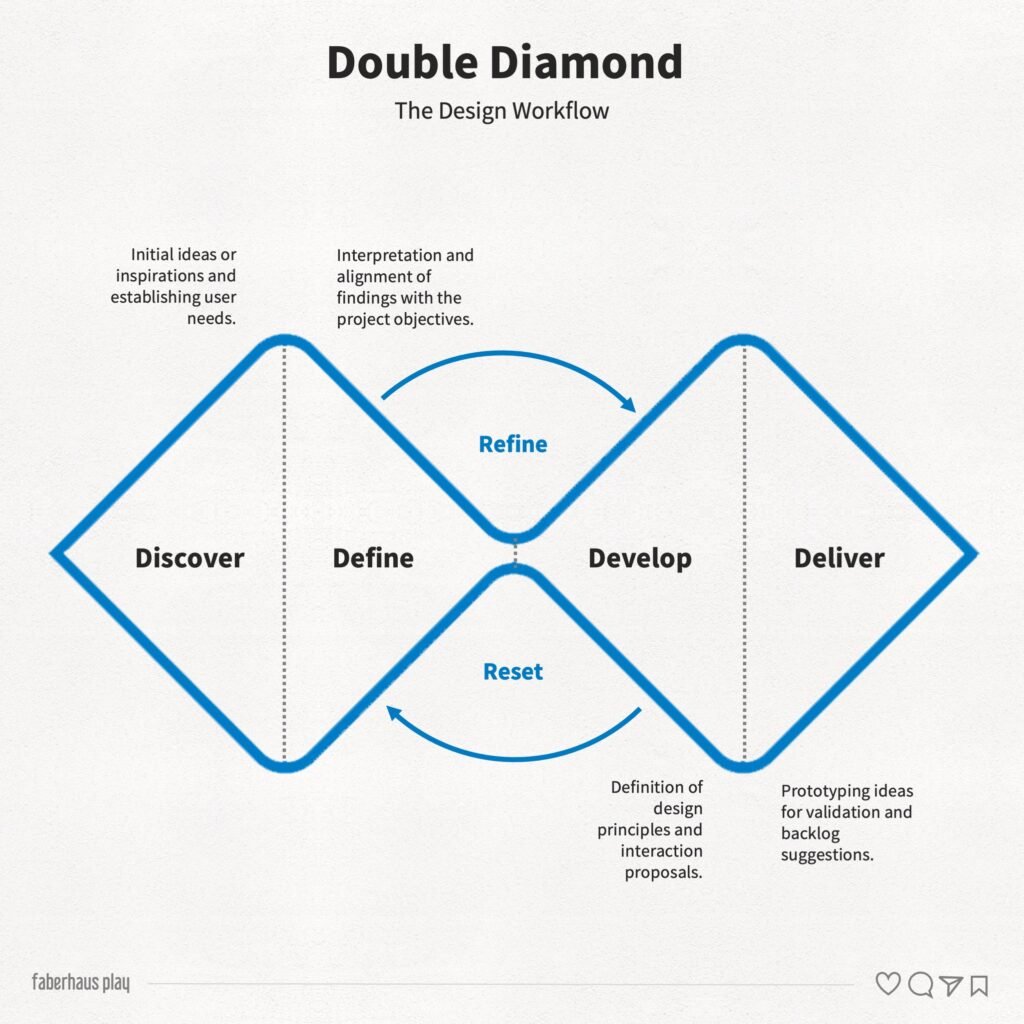
1. Discover
Understand:
- People
- Context
- Behaviors
- The problem itself
2. Define
Clarify the challenge and explore multiple possible directions.
3. Develop
Select promising ideas and transform them into prototypes.
4. Deliver
Test solutions with customers, learn from feedback, and implement or iterate accordingly.
Service design draws heavily from these structured approaches.
It uses design thinking principles to:
- Uncover insights
- Facilitate collaboration
- Align stakeholders
- Improve services through continuous learning
Importantly, service design does not rely on a single methodology.
It combines methods from:
- Design
- Psychology
- Business
- Research
- Systems thinking
- Operations
- Strategy
The service designer’s role is to select and orchestrate the right methods for the challenge at hand.
Service design as a tool for the complexity of actual society
Service design has become increasingly relevant because services have become increasingly complex.
Customers interact with organizations through dozens of touchpoints.
Expectations continue to rise.
Competition continues to expand.
And digital experiences continue to blur the boundaries between products, services, and relationships.
In this environment, designing isolated touchpoints is no longer enough.
Organizations must understand and design the entire service ecosystem.
That is the role of service design.
And that is why it has become one of the most valuable disciplines for organizations trying to create meaningful, competitive, and human-centered experiences.
References
Design Council. Retrieved from
Design Council website