
Artificial intelligence has changed the way we work.
Today, anyone can generate:
- ideas
- summaries
- reports
- images
- presentations
- code
In a matter of seconds.
As a result, many professionals are asking a new question:
If AI can generate answers so quickly, what becomes valuable?
One possible answer comes from a book written more than fifty years ago.
In Lateral Thinking, Edward de Bono argued that solving problems requires two complementary modes of thought:
- generating possibilities
- evaluating possibilities
The first expands the field.
The second narrows it.
The first creates options.
The second selects options.
In today’s AI-driven world, that distinction may be more relevant than ever.
The difference between lateral and vertical thinking
De Bono described two different approaches to thinking.
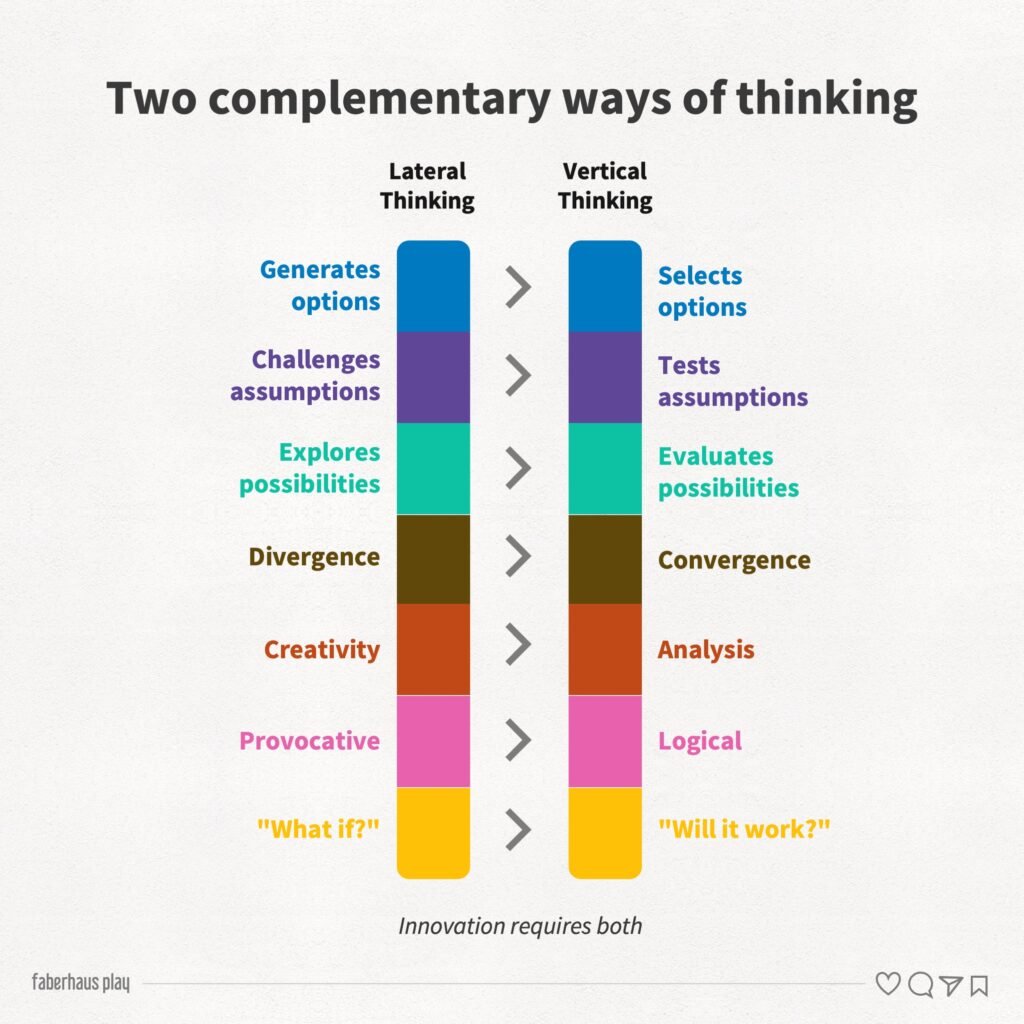
Lateral thinking
Lateral thinking is generative.
Its purpose is to create alternatives.
It challenges assumptions, reorganizes information, and explores possibilities that may not seem obvious at first.
Its goal is not necessarily to be correct immediately.
Its goal is to discover new ways of looking at a situation.
Vertical thinking
Vertical thinking is analytical.
Its purpose is to evaluate, refine, and select.
It follows logic, tests assumptions, and determines which alternatives are most viable.
Its goal is efficiency and precision.
Neither approach is better.
They solve different problems.
And the most effective teams use both.
Why AI changes the conversation
When De Bono first wrote about lateral thinking, generating ideas was often the difficult part.
Today, that is no longer true.
AI can generate hundreds of ideas in seconds.
But generating ideas and creating insight are not the same thing.
Most AI systems are exceptionally good at producing variations of existing patterns.
What they are less effective at is questioning the assumptions behind those patterns.
This is where lateral thinking becomes valuable.
The challenge is no longer:
Can we generate ideas?
The challenge is:
Can we generate ideas worth exploring?
That requires human judgment, curiosity, and the ability to reframe problems.
Creativity is often a problem of perception
One of De Bono’s central arguments is that creativity is not magic.
It is often the result of changing how we organize information.
We become trapped by familiar interpretations.
We assume the current way of looking at a situation is the only possible way.
But many breakthroughs happen when someone reorganizes the same information and sees something different.
This is why innovation often feels obvious in retrospect.
Once the new pattern appears, it seems natural. Before that moment, it was invisible.
This remains true whether we are designing products, creating businesses, or developing AI systems.
The danger of finding the first good answer
One of the most interesting observations from De Bono’s work is that people tend to stop searching once they find a plausible solution.
The problem is that the first good answer is rarely the only answer. And it is not always the best answer.
This is particularly relevant when working with AI.
Many professionals now interact with language models in a way that looks like this:
- ask a question
- receive an answer
- accept the answer
The process feels productive.
But it often skips the most valuable stage: Exploring alternatives.
A useful mindset is to treat AI less like an oracle and more like a thinking partner.
Instead of asking:
What is the answer?
Ask:
What are ten different ways to frame this problem?
That simple shift often produces better results.
Why assumptions matter
Many problems are difficult not because they lack information.
They are difficult because they contain hidden assumptions.
De Bono repeatedly emphasized the importance of challenging assumptions.
This remains one of the most powerful design skills today.
For example:
Instead of asking:
How can we improve customer support?
A team might ask:
Why does customer support need to exist in its current form?
Instead of asking:
How can we make onboarding faster?
They might ask:
Why does onboarding require these steps at all?
The goal is not to reject existing solutions.
The goal is to reveal possibilities that conventional thinking ignores.
What this means for designers
Designers often work between divergence and convergence.
The design process itself reflects the relationship between lateral and vertical thinking.
Discovery requires expansion.
Delivery requires focus.
Ideation requires possibility.
Execution requires decision.
This is why design thinking, double diamond processes, design sprints, and many innovation frameworks still rely on the same principle:
- first explore
- then select
The sequence matters.
When teams evaluate too early, they kill ideas before they have a chance to evolve.
When teams generate endlessly without selecting, they create chaos.
The balance between both modes is where progress happens.
What this means for leaders
Many organizations unintentionally reward vertical thinking.
They reward:
- certainty
- predictability
- efficiency
- execution
These are important.
But they are not enough.
Organizations also need people who can:
- question assumptions
- imagine alternatives
- identify opportunities
- challenge established patterns
As De Bono observed decades ago, the need to be right all the time often becomes a barrier to creativity.
Innovation requires temporary uncertainty.
Not because uncertainty is desirable.
Because new ideas rarely arrive fully formed.
Leaders who understand this create environments where exploration is possible before evaluation begins.
AI makes creativity more important, not less
There is a growing fear that AI will make creativity less valuable.
The opposite may be true:
- As information becomes abundant, differentiation becomes more important.
- As answers become cheaper, questions become more valuable.
- As execution becomes automated, reframing becomes strategic.
The professionals who thrive will not necessarily be the ones who can generate the most ideas.
They will be the ones who can see possibilities others fail to notice.
That is exactly what De Bono was teaching decades ago.
Creativity starts before innovation
One of the most enduring lessons from lateral thinking is that creativity is not about finding the right answer immediately.
It is about creating the conditions for better answers to emerge.
- Sometimes that means generating alternatives.
- Sometimes it means questioning assumptions.
- Sometimes it means deliberately exploring ideas that seem wrong at first.
In an era where AI can generate almost unlimited outputs, the ability to rethink the problem itself may become one of the most valuable skills a designer, leader, or strategist can develop.
So, the future may belong less to those who have the fastest answers and more to those who can discover better questions.
References
De Bono, E. (2012). Lateral Thinking: Creativity Step by Step. Elsevier.
Additional insights adapted from notes and excerpts based on Edward de Bono’s work on lateral and vertical thinking.