
More than twenty years after the Agile Manifesto was published, many teams still confuse agility with ceremonies.
Daily standups.
Sprint planning.

Backlog refinement.
Retrospectives.
These practices can be useful.
But they were never the goal.
They were simply mechanisms designed to support something much more important:
Learning faster.
Today, with AI accelerating software development, research synthesis, prototyping, and content creation, this distinction matters more than ever.
Because agility has never been about moving faster.
It has always been about learning faster.
The original promise of Agile
The Agile Manifesto was published in 2001 by seventeen software practitioners looking for a better way to build software.
At the time, many organizations relied on heavily sequential processes where months of planning happened before customers saw any value.
The manifesto proposed a different approach built around four core values:
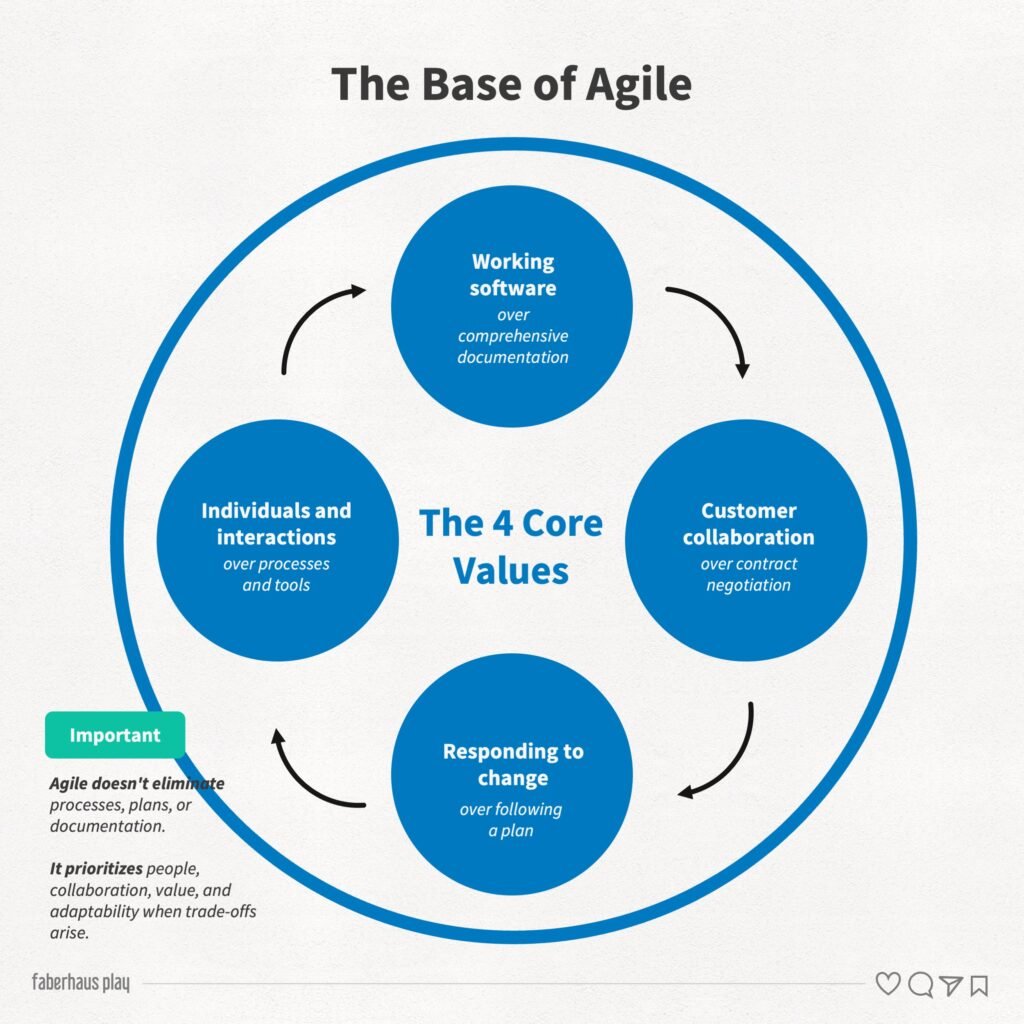
- Individuals and interactions over processes and tools
- Working software over comprehensive documentation
- Customer collaboration over contract negotiation
- Responding to change over following a plan
One detail is often forgotten.
The manifesto never says that processes, documentation, contracts, or plans are unimportant.
It simply argues that when trade-offs exist, people, collaboration, value delivery, and adaptation should receive greater attention.
That idea remains surprisingly relevant.
Agile was never about speed
One of the biggest misconceptions about Agile is that it means doing things quickly.
Agility is not speed. Agility is the ability to adapt.
A team can move extremely fast and still build the wrong thing.
Likewise, a team can spend months optimizing delivery while learning very little about customer needs.
Real agility combines:
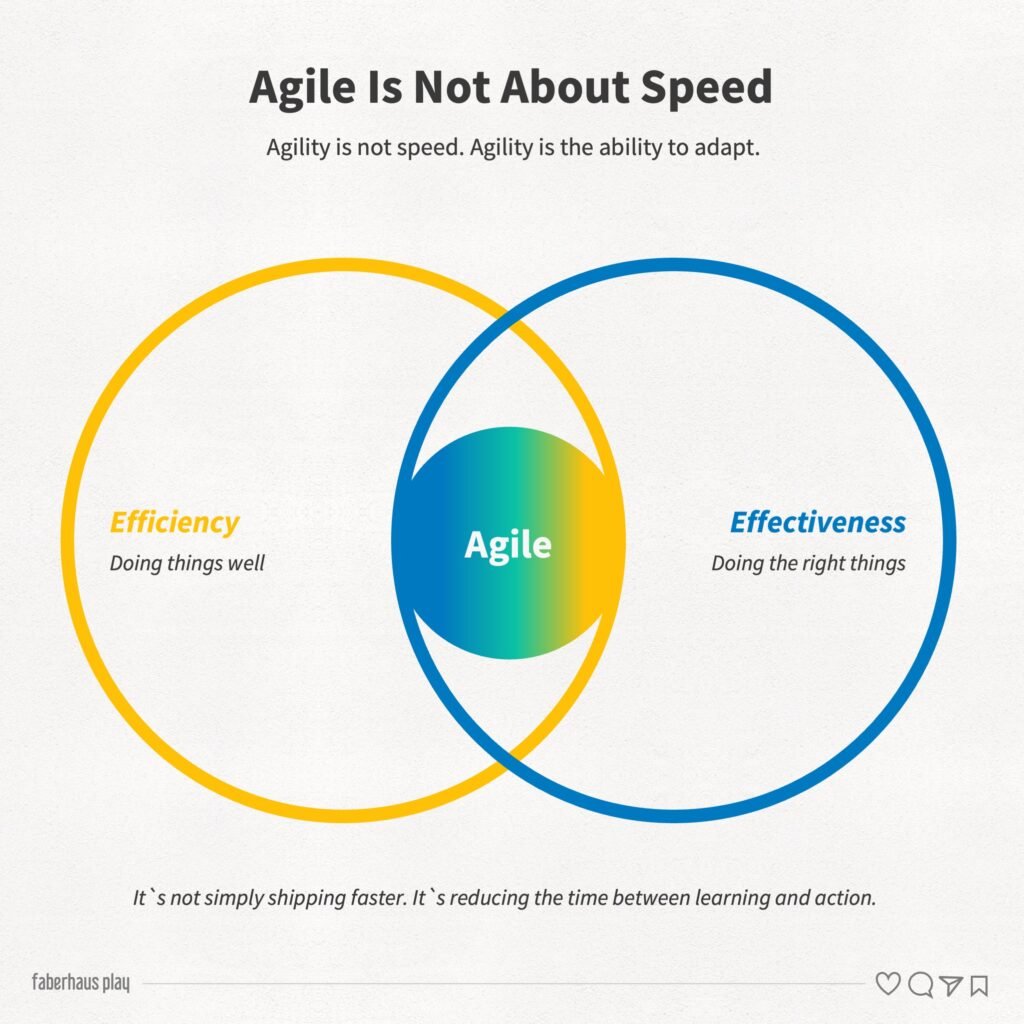
- Efficiency (doing things well)
- Effectiveness (doing the right things)
The best teams are not simply shipping faster.
They are reducing the time between learning and action.
Why many teams struggle with Agile
Over the years, many organizations adopted Agile practices without fully embracing Agile thinking.
As a result, teams often become excellent at performing ceremonies while remaining slow to learn.
You can find teams that:
- Run daily standups every day
- Complete every Scrum event
- Maintain perfectly organized backlogs
And still struggle to understand customers.
The problem is not the framework.
The problem is treating the framework as the objective.
Agility is not a checklist. It is a learning system.
Scrum is a framework, not the destination
Scrum remains one of the most popular Agile frameworks.
It introduced concepts such as:
- Product Backlog
- Sprints
- Sprint Planning
- Daily Scrum
- Sprint Review
- Retrospectives
These practices help create visibility and alignment.
But Scrum itself is not agility.
It is one possible implementation of Agile principles.
Today many successful product organizations operate with:
- Scrum
- Kanban
- Shape Up
- Continuous Discovery
- Continuous Delivery
- Hybrid operating models
The framework matters less than the team’s ability to learn and adapt.
Where design fits into Agile
For many years, organizations struggled to integrate design into Agile environments.
One common mistake was expecting designers and developers to work on exactly the same problems at exactly the same time.
In practice, design and engineering often operate on different horizons.
Engineering tends to focus on building.
Design often focuses on understanding.
A healthy product team needs both.
Design contributes by reducing uncertainty before development begins.
Activities such as:
- User research
- Discovery
- Journey mapping
- Prototyping
- Usability testing
- Service design
Help teams avoid building the wrong solution efficiently.
This is why modern product teams increasingly view design as a learning function rather than a production function.
From design sprint to continuous discovery
When Agile became popular, many organizations used Design Sprints as a way to define an initial backlog before development started.
That approach still works.
But today’s teams increasingly operate through continuous discovery.
Instead of separating discovery and delivery into large phases, they continuously learn while building.
- Research happens regularly.
- Ideas are tested earlier.
- Prototypes evolve faster.
- Feedback loops become shorter.
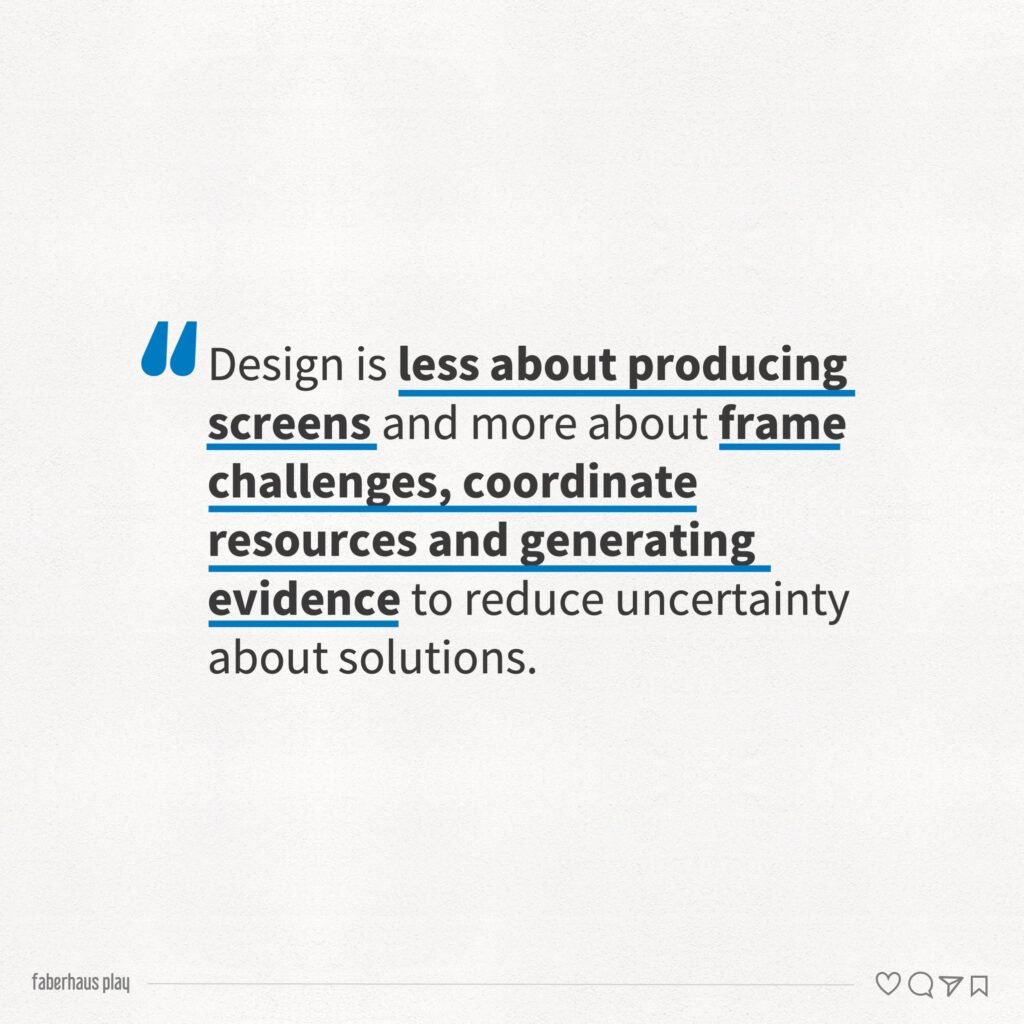
So, design is less about producing screens and more about frame challenges, coordinate resources and generating evidence to reduce uncertainty about solutions.
Again, the objective shifts from:
Designing the solution
to
Reducing uncertainty about the solution.
How AI is changing Agile
Artificial intelligence is transforming nearly every stage of product development.
Teams now use AI to:
- Generate user stories
- Summarize research
- Analyze feedback
- Create prototypes
- Generate code
- Draft documentation
- Explore product ideas
This changes the economics of product development.
Many tasks that once required days can now happen in minutes.
But AI creates a new challenge.
When execution becomes cheaper, decision-making becomes more important.
Teams can build faster than ever.
They can also build the wrong thing faster than ever.
This makes discovery even more valuable.
AI accelerates delivery.
It does not eliminate the need for understanding.
The future of Agile is learning
The most successful product teams today are not necessarily the ones with the best Scrum implementation.
They are the ones that learn the fastest.
They reduce the distance between:
- Observation and insight
- Insight and decision
- Decision and validation
Agile, design, product management, engineering, and AI all contribute to the same goal:
Helping teams learn what creates value and delivering that value with less waste.
That was the spirit of the Agile Manifesto in 2001.
And despite all the technological changes since then, it remains one of the most useful ideas in product development today.
References
Agile Alliance. Agile Manifesto. Retrieved from https://agilemanifesto.org
Schwaber, K., & Sutherland, J. The Scrum Guide.