
Product teams today have access to more tools, data, and technology than ever before.
We can analyze user behavior in real time, generate prototypes in minutes, and launch experiments at a scale that would have been impossible a decade ago.
Yet many teams still struggle with a surprisingly common problem:

They move too quickly toward solutions.
Long before concepts like Product Discovery, Design Thinking, Lean Startup, or Continuous Discovery became popular, Bruno Munari proposed a structured approach to problem-solving that addressed exactly this challenge.
Originally developed for industrial design, Munari’s method remains remarkably relevant for modern product teams because it focuses on something fundamental:
Understanding problems before rushing into solutions.
Every product begins with a problem
Munari starts with an important observation:
Every design project originates from a human need.
Not from aesthetics.
Not from technology.
Not from trends.
From a problem that needs to be solved.
This idea remains fundamental today.
Whether we are designing:
- Physical products
- Digital platforms
- Services
- AI-powered experiences
The starting point should still be understanding what problem exists and for whom.
Technology may change.
Human needs remain surprisingly consistent.
The twelve steps of Munari’s design process
Munari proposed a structured process for transforming a problem into a solution.
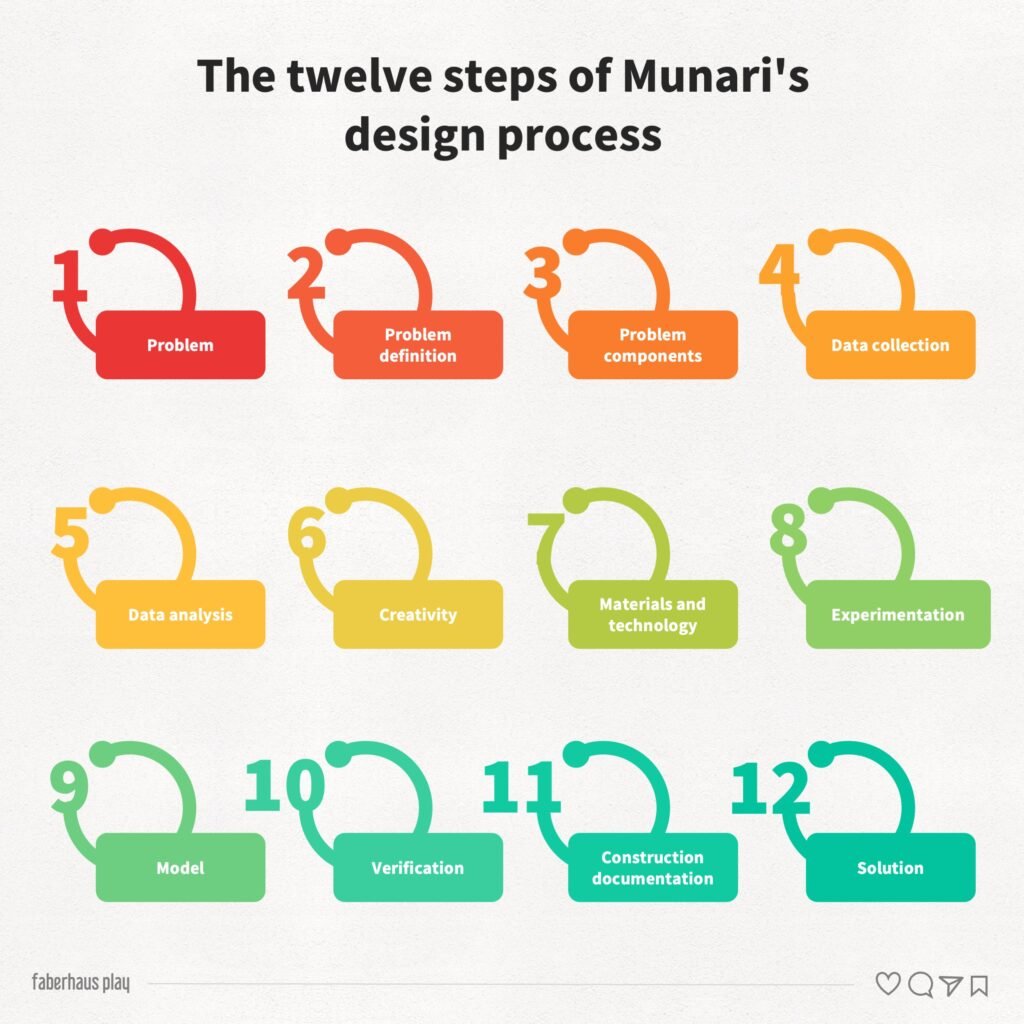
1. Problem
Every project begins with a need or challenge.
Example: Green rice.
2. Problem definition
Define the scope and constraints of the challenge.
Example: Spinach rice for four people.
3. Problem components
Break the problem into smaller parts.
Example: Rice, spinach, onion, olive oil, seasoning, and preparation process.
4. Data collection
Gather existing knowledge, references, and previous solutions.
Example: Recipes, videos, articles, and cooking techniques.
5. Data analysis
Review collected information and identify what is useful.
Questions include:
- What can be reused?
- What works well?
- What should be avoided?
6. Creativity
Generate possible solutions using the knowledge collected.
Creativity is not random inspiration.
It operates within the constraints of the problem.
7. Materials and technology
Identify available resources.
In product design today, this might include:
- Technologies
- Platforms
- Development capabilities
- AI tools
- Budgets
8. Experimentation
Build and test ideas.
This is where concepts become tangible.
9. Model
Refine the most promising solution based on what was learned.
10. Verification
Test the solution with real users.
Does it solve the problem?
Does it meet expectations?
11. Construction documentation
Document the solution so it can be consistently reproduced and implemented.
12. Solution
The final result.
Not simply a product.
A response to the original problem.
What product teams can learn from Munari
Modern product organizations often talk about:
- Discovery
- Experimentation
- Customer centricity
- Evidence-based decision making
Interestingly, all of these ideas are present in Munari’s framework.
His method reminds us that:
Problems deserve investigation
Teams frequently debate solutions before fully understanding the problem.
Munari starts in the opposite direction.
Research is not optional
Data collection and analysis are explicit steps in the process rather than activities that happen only when time allows.
Experimentation reduces risk
Before committing to a final solution, Munari encourages testing, learning, and refinement.
Simplicity is hard work
One of his most enduring lessons is that simplification is often the result of significant effort, not the absence of it.
Why product teams still struggle with the same problem
Looking at Munari’s framework today, many of its steps may seem obvious.
- Research.
- Analysis.
- Experimentation.
- Validation.
Most product teams would agree with these principles.
The challenge is that agreeing with them and consistently applying them are very different things.
Under pressure to deliver, teams often jump from a perceived problem directly into implementation.
Munari’s process creates a deliberate pause between those two moments.
It encourages teams to understand before building.
To investigate before deciding.
And to validate before scaling.
These ideas sound simple.
But they remain surprisingly difficult to practice consistently.
Creativity is not chaos
One of Munari’s most important contributions was his view of creativity.
Many people associate creativity with spontaneity.
Munari saw it differently.
Creativity was not the absence of method.
Creativity was what happened inside the method.
The process creates boundaries.
Creativity explores possibilities within those boundaries.
This distinction is particularly useful in modern product development.
The best teams are rarely the ones generating endless ideas.
They are the ones generating meaningful alternatives within a specific context.
The hidden value of simplicity
One of the strongest themes throughout Munari’s work is simplification.
He repeatedly argues that progress happens through simplification rather than complication.
One of his most famous observations states:
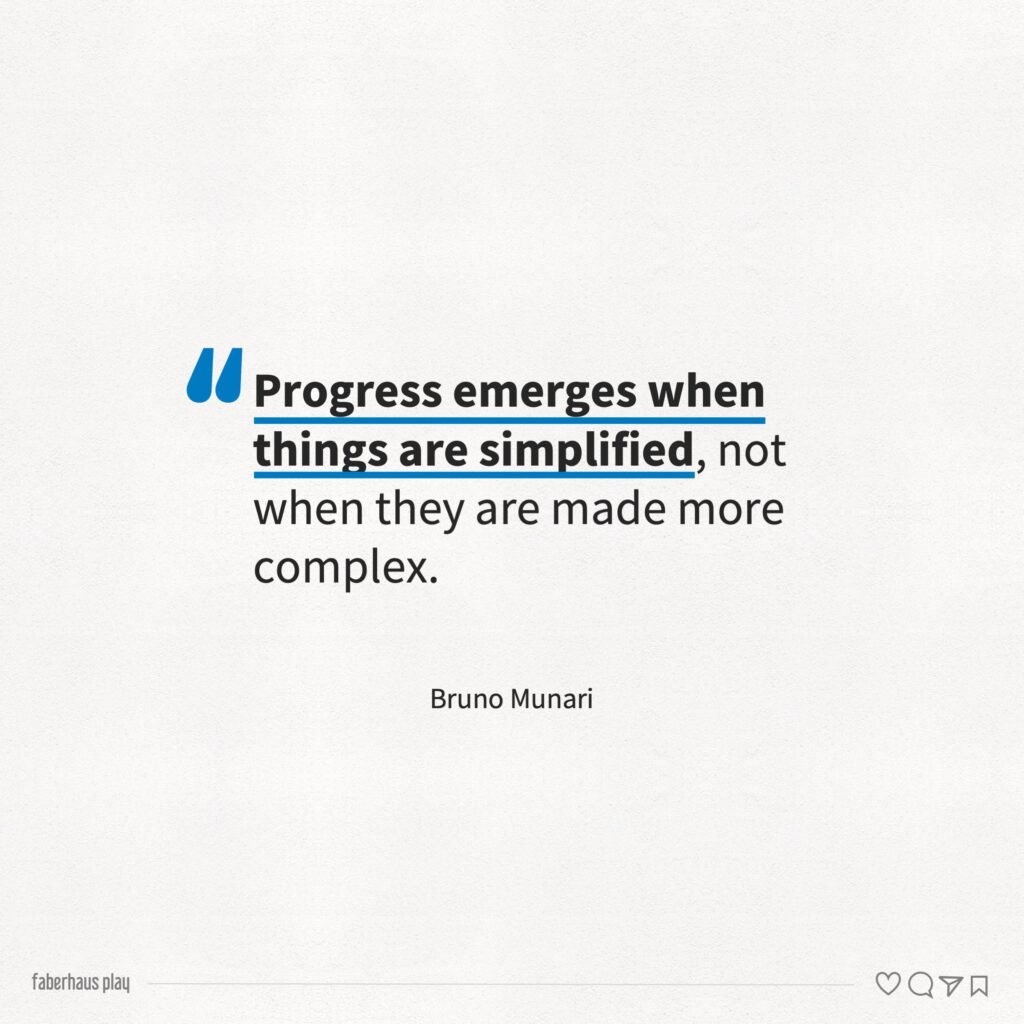
“Progress emerges when things are simplified, not when they are made more complex.”
This idea feels increasingly relevant today.
Modern products often accumulate:
- Features
- Options
- Settings
- Workflows
- Notifications
The result is frequently complexity rather than value.
The role of product teams is not merely to add. It is to remove what is unnecessary.
As Munari argued, simplicity often requires far more effort than complexity.
The challenge is that users usually only see the final result.
They rarely see the thinking that made it possible.
Product development is still about solving problems
Despite the rise of AI, advanced analytics, product operating models, and increasingly sophisticated tools, Munari’s central lesson remains unchanged.
The goal is not to produce more features.
The goal is to solve meaningful problems.
The tools have changed dramatically.
The underlying challenge has not.
The teams that create the most value are rarely those that move fastest toward implementation.
The teams that create the most value are the ones who understand the problem deeply enough to know what should be built in the first place.
That lesson sits at the heart of modern product development.
And it is exactly what makes Bruno Munari’s work still relevant today.
References
Munari, B. (2008). From Things Are Born Things (Das coisas nascem coisas). São Paulo: Martins Fontes.
Processo Criativo. Retrieved from http://www.processocriativo.com/das-coisas-nascem-coisas/