
What architect Christopher Alexander’s distrust of imposed forms can teach product designers in the age of artificial intelligence.
Imagine two applications.
The first is impeccable.

Correct typography, consistent spacing, aligned components, smooth animations, and every pattern expected from a contemporary interface.
You could replace its logo with that of twenty other companies and almost nothing would seem out of place.
This is the result of something completely designed and forced to function in the real world.
The second may have a few oddities.
Its organization emerged from the routines of a specific community.
Some features exist because users demanded them; others were transformed after uses that no one had anticipated.
It carries traces of negotiation, memory, and appropriation.
It is not perfect, but it seems to belong to the people who use it.
This is the result of the emergent: something born from people’s living interaction.
Which one is more alive?
That question runs throughout Christopher Alexander’s work, and it may be more urgent today than when he first began to formulate it.
Alexander was an architect, mathematician, professor, and one of the twentieth century’s most influential design thinkers.
His work changed architecture, urbanism, software development, and interaction design.
Yet his legacy often reaches digital professionals in a greatly reduced form: he invented the pattern languages that later inspired design patterns.
That is true, but it is simply not the whole truth.
Alexander was not interested only in cataloging reusable solutions.
He investigated something much more difficult: why do some human constructions seem to welcome life, while others seem to drive it away?
Why do some streets, houses, squares, and cities acquire wholeness over time, while others remain artificial even when they have been meticulously planned?
And, above all, what kind of process allows living things to be created?
For product designers surrounded by component libraries, conversion metrics, global platforms, and systems capable of generating interfaces in seconds, returning to Alexander’s question can be uncomfortable.
That is exactly why we need it.
A Mathematician in Search of Life
Christopher Alexander was born in Vienna in 1936, grew up in England, and studied mathematics and architecture at Cambridge before earning a doctorate in architecture at Harvard.
He later became a professor at the University of California, Berkeley, where he founded the Center for Environmental Structure in 1967.
Over the course of his career, he designed and built more than two hundred buildings on five continents.
His influence, however, extended far beyond architectural production.
According to UC Berkeley, his theories of human-centered design reached fields including urban design, software, and sociology.
Alexander died in 2022 at the age of eighty-five.
His investigation began with a dissatisfaction with modern design.
He perceived a difference between places gradually produced by cultures and communities and those conceived all at once by specialists.
Traditional villages, markets, houses adapted over generations, and streets transformed through use often possessed a coherence that large planned projects could not reproduce.
Not because they were old, nor because they followed a particular style.
The difference lay in the process.
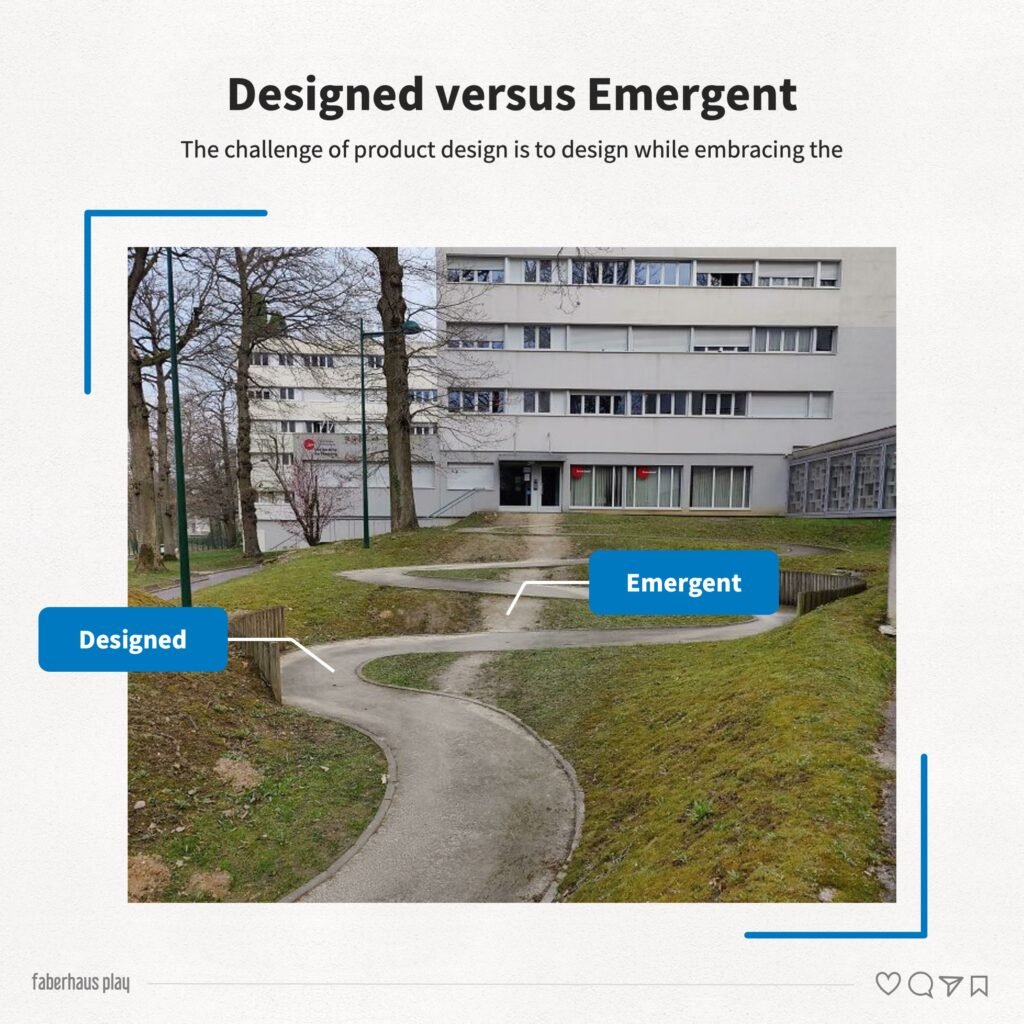
Traditional environments could grow through thousands of local decisions.
Each change responded to existing conditions and had to coexist with what was already there.
A step appeared where feet needed it, a window was opened to reach the light, and a bench emerged where people already stopped to talk.
Form was the consequence of a continuous relationship among people, needs, materials, climate, memory, and place.
Centralized planning often followed the opposite path: first it defined a total image; then it forced reality to fit inside it.
Any resemblance to certain product processes is not a coincidence.
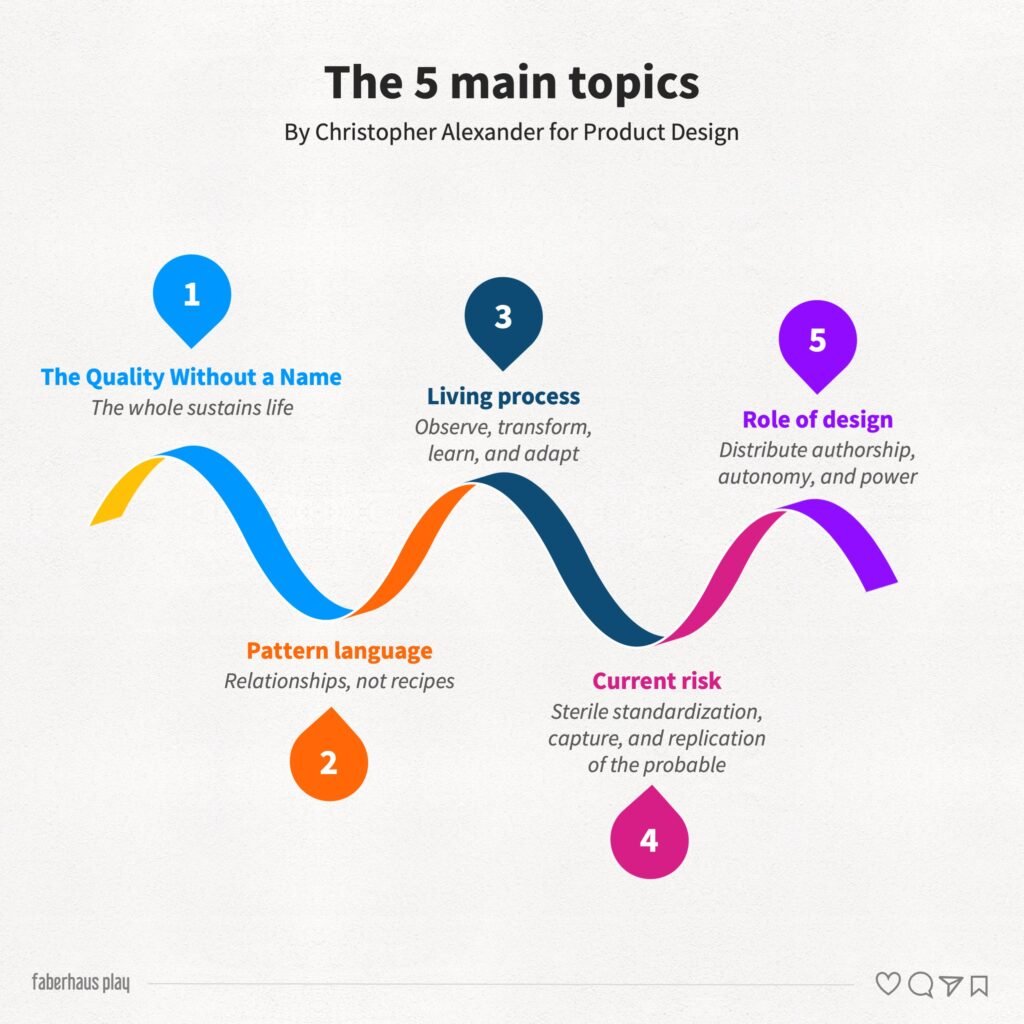
The Quality Without a Name
In The Timeless Way of Building, published in 1979, Alexander tries to describe a quality found in environments that sustain life.
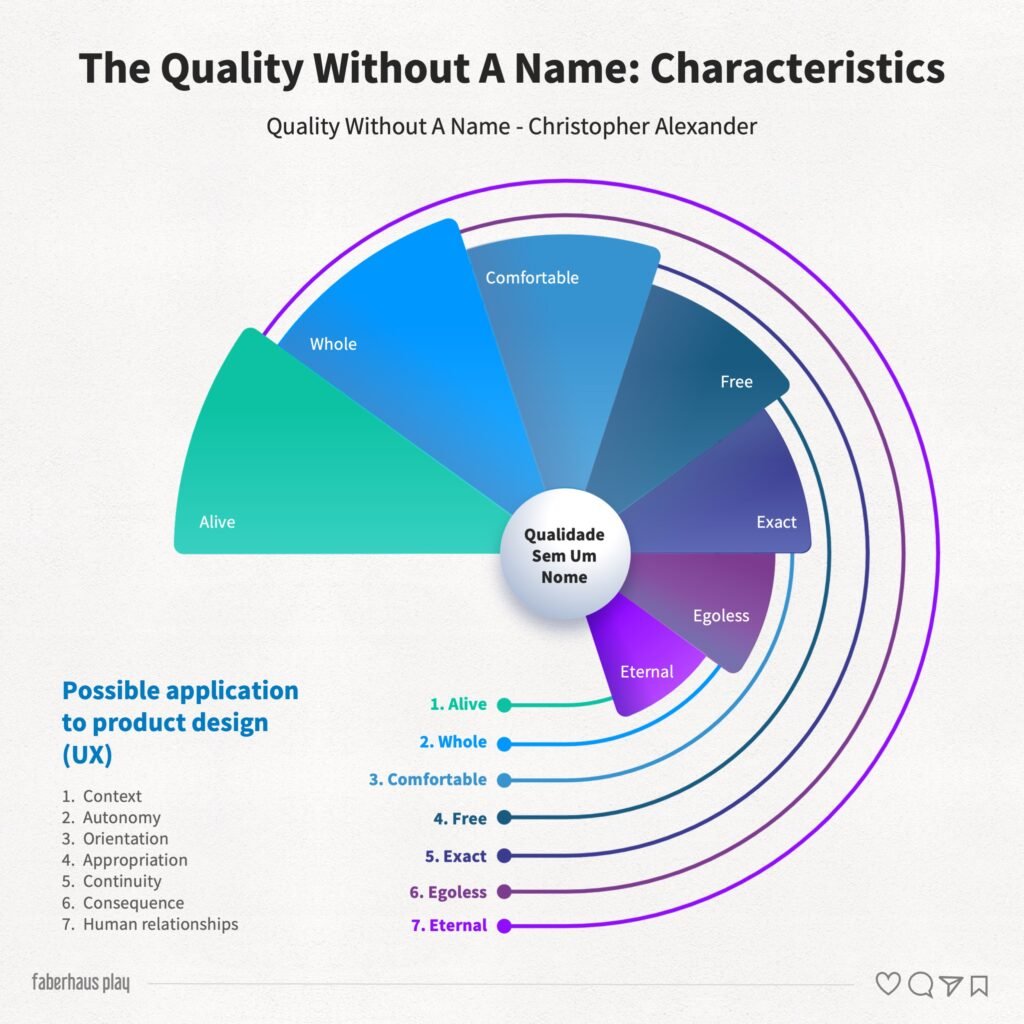
He calls it the quality without a name.
It is not simply beauty.
A place can be visually beautiful and still feel like a stage set.
It is not merely functionality.
An environment can fulfill its functions and remain oppressive.
Nor is it simply comfort, naturalness, freedom, harmony, or wholeness, although each of those words approaches one part of the phenomenon.
The quality without a name appears when something corresponds deeply to the life unfolding there.
Its parts strengthen one another and, at the same time, strengthen the whole.
Nothing feels arbitrary.
Order exists, but it does not suffocate.
There is regularity, but also variation.
There is form, but it is not imposed as a demonstration of the designer’s ego.
Think of a kitchen where conversation continues while someone makes coffee.
Think of a shaded square, with inhabitable edges and paths that follow people’s actual movement.
Think of a house whose imperfections tell the story of those who live there.
Now think of an application.
Can you remember a digital product that feels genuinely hospitable?
A system that respects your pace, preserves your sense of orientation, explains what is happening, and gives you room to act without trying to direct every gesture?
You probably can, but you may need a moment to think.
That effort already says something about our time.
A Language for Producing Wholeness
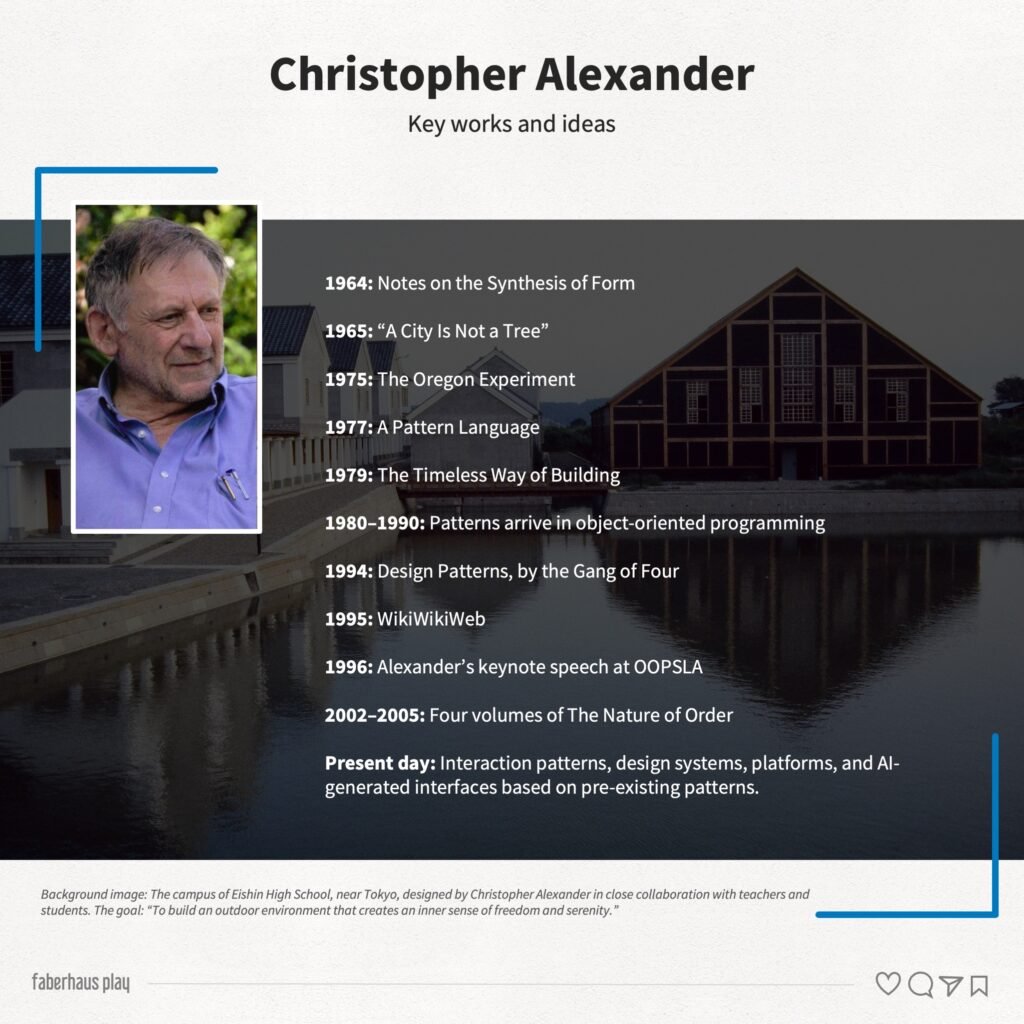
Alexander’s best-known work, written with Sara Ishikawa, Murray Silverstein, and other collaborators, is A Pattern Language, published in 1977.
The book presents 253 patterns that move across different scales, from the distribution of cities to construction details.
They include identifiable neighborhoods, green streets, transitions between public and private space, window seats, and natural light entering a room from more than one side.
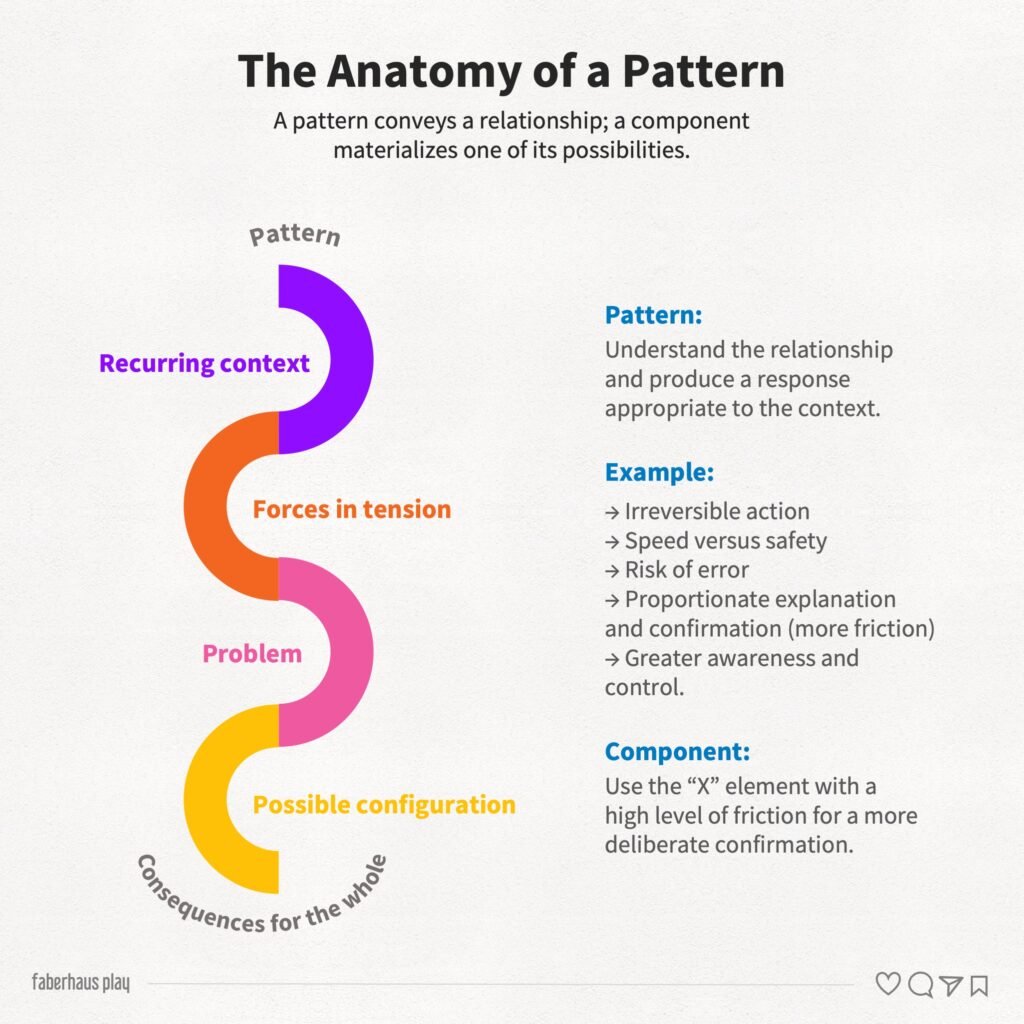
A pattern is not a finished form.
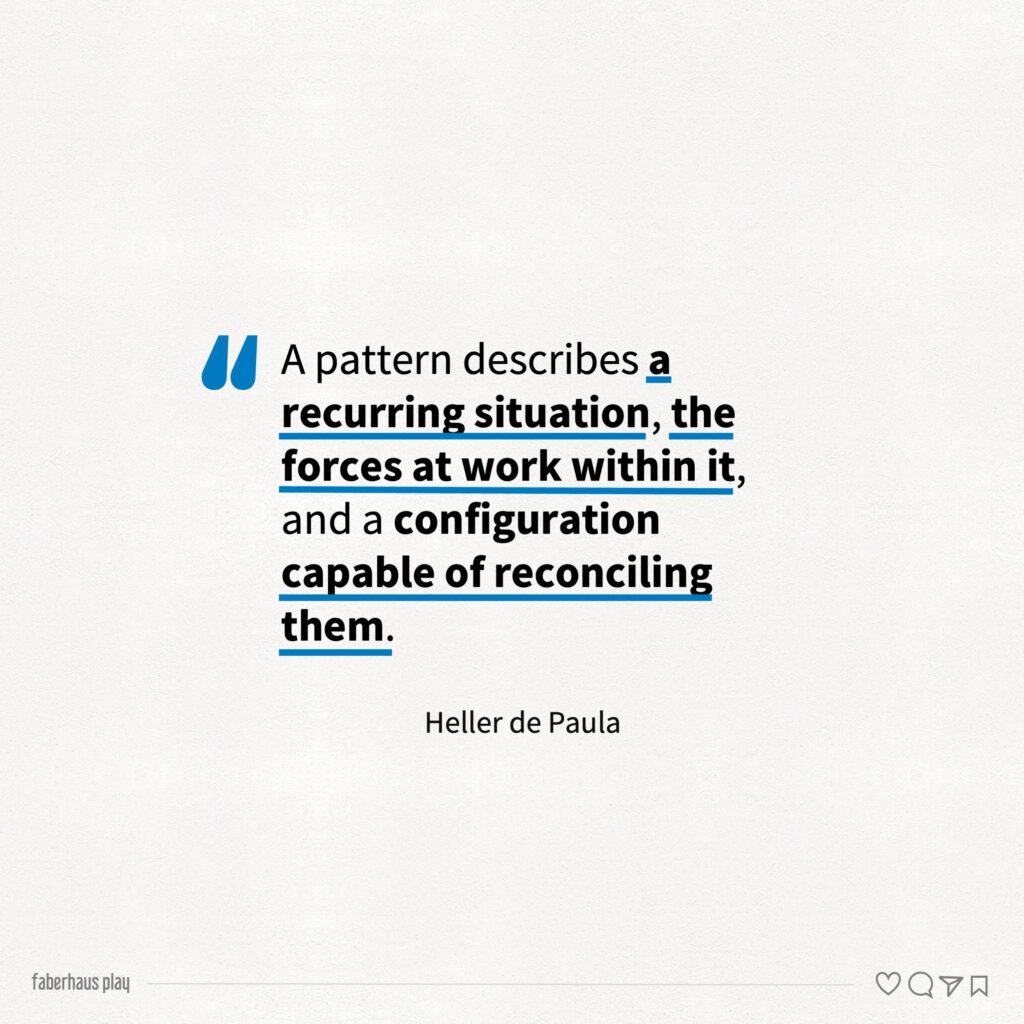
A pattern describes a recurring situation, the forces at work within it, and a configuration capable of reconciling them.
That distinction is decisive.
“Place a blue button in the right-hand corner” is a prescription.
“When a person is about to perform an irreversible action, help them understand the consequence and offer a proportionate opportunity to reconsider” is closer to a pattern.
The first reproduces a solution. The second transmits knowledge about a human relationship.
Alexander’s patterns were not meant to operate in isolation.
Each connected to others, forming a language.
Just as words gain their full meaning in sentences, patterns gain strength when they take part in a coherent composition.
More importantly, the language was meant to be available to the people who would inhabit the result.
Alexander wanted to return to citizens some of the power monopolized by architects, planners, developers, and bureaucracies.
The book presents itself as an instrument through which families and communities could participate in shaping their homes, streets, and cities.
Alexander’s social contribution lies precisely in this shift in authorship.
The environment should not merely be delivered to people. It should be produced and continuously transformed by them.
In contemporary terms, we might say that he proposed participatory, situated, and generative design.
But even those terms risk diminishing the radical nature of his idea.
Alexander did not merely want to consult users.
He wanted to redistribute the power to make the world.
How Alexander Entered the World of Computers
In the late 1980s and throughout the 1990s, software professionals realized that pattern language could help them record and transmit recurring programming solutions.
Kent Beck and Ward Cunningham were among the pioneers of this exchange.
In 1994, Design Patterns: Elements of Reusable Object-Oriented Software, by Erich Gamma, Richard Helm, Ralph Johnson, and John Vlissides—the Gang of Four—popularized patterns such as Observer, Composite, and Factory Method.
The influence expanded.
It reached software-pattern communities, object-oriented programming, agile practices, and interaction design.
Ward Cunningham’s first wiki was itself created as a place to discuss and develop patterns collectively.
In 1996, Alexander was invited to speak at OOPSLA, one of the main gatherings of the object-oriented programming community.
The episode is revealing.
Before that audience, he acknowledged that his ideas had traveled into a field he barely knew, but he also offered a criticism.
The software community had understood the usefulness of patterns, yet had not fully reached the question that motivated them: producing whole systems capable of improving life.
The adoption had privileged the vocabulary of solutions while leaving in the background the quality of the world those solutions produced.
In the introduction preserved with the lecture, Jim Coplien describes exactly this challenge: moving from individual patterns to languages that generate systems thinking and assuming the moral responsibility to build systems that contribute to quality of life.
That criticism reaches us almost intact.
From Pattern to Component, and What Was Lost Along the Way
It is easy to see Alexander’s influence on today’s digital products.
We have interaction patterns, heuristics, reusable components, design systems, and conventions that allow consistent interfaces to be created at scale.
We do not need to reinvent a text field, date picker, or navigation system for every project.
This inheritance has brought real benefits.
• Consistency reduces cognitive effort.
• Reuse accelerates development.
• Familiar conventions can improve accessibility and reduce the learning curve.
The problem begins when we confuse the standardization of means with the quality of ends.
A design system is not, in itself, a pattern language in Alexander’s sense.
It is often merely an inventory of decisions already made: buttons, cards, colors, spacing, icons, and composition rules.
It tells us how the organization wants its products to look.
It rarely helps us understand how people live.
The component asks, “Which variation should I use?”
An Alexandrian pattern would ask, “What human forces are present here? What conflict needs to be resolved? How does this intervention transform the whole? Does it increase or diminish life?”
When the library takes the place of thought, the designer becomes an assembler of interfaces.
Visual consistency begins to disguise the absence of social understanding.
Everything is visually aligned, nothing is truly situated.
Digital Sterilization
Our digital lives have become strangely uniform.
Banks, social networks, education platforms, healthcare systems, shops, and work tools now share the same structures.
Cards, feeds, notifications, bottom navigation, circular avatars, progress indicators, and reward mechanisms appear in completely different contexts.
Part of this convergence is natural: conventions make products easier to use.
But part of it results from a concentration of tools, references, business models, and measures of success.
So we have,
• The same design systems inspire thousands of products.
• The same platforms distribute references.
• The same growth patterns guide decisions.
• The same tests reward what produces measurable short-term outcomes.
• And now the same generative AI models are beginning to participate in research, writing, ideation, visual creation, and interface production.
The result can be competent, fast, and recognizable.
It can also be profoundly sterile.
Here, sterile does not mean minimalist or technologically advanced.
It means incapable of generating bonds, appropriation, and difference.
A sterile system can function perfectly while still reducing people to predicted flows.
It has already decided what deserves attention, what action should come next, how success will be measured, and what behavior will be rewarded.
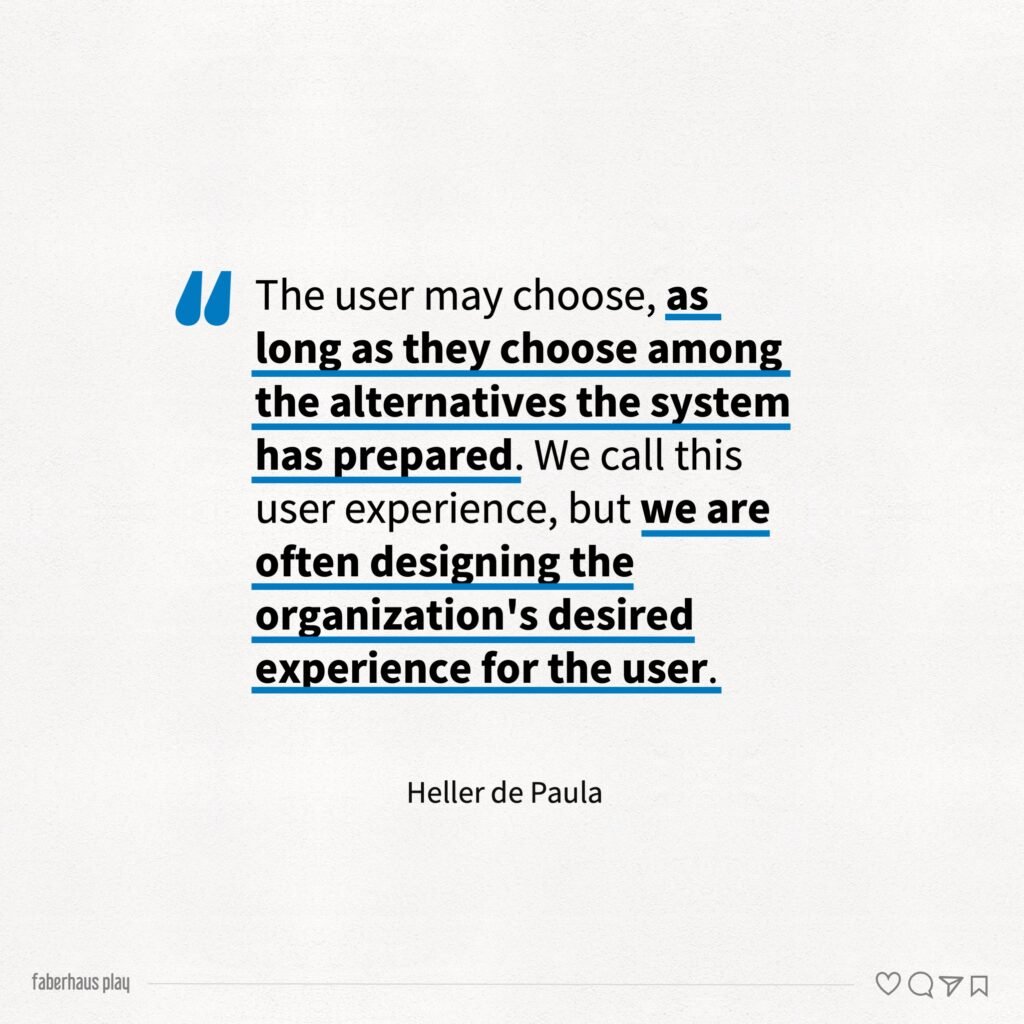
The user may choose, as long as they choose among the alternatives the system has prepared. We call this user experience, but we are often designing the organization’s desired experience for the user.
It is a small difference in wording and an enormous difference in practice.
The Arbitrarily Designed versus the Socially Emergent
Digital products are usually celebrated for their capacity to scale.
A decision made by one team can reach millions of people in the next release.
But scale is also the ability to multiply an error without requiring it to encounter reality again.
In social environments, meaningful forms emerge from the bottom up.
People invent vocabularies, rituals, shortcuts, informal rules, and unexpected ways of using tools.
A community is not simply a collection of individuals with similar needs.
It produces meanings that did not exist before the relationship.
Many products, however, treat this emergent behavior as noise.
If people use a feature in an unexpected way, the flow must be “corrected.”
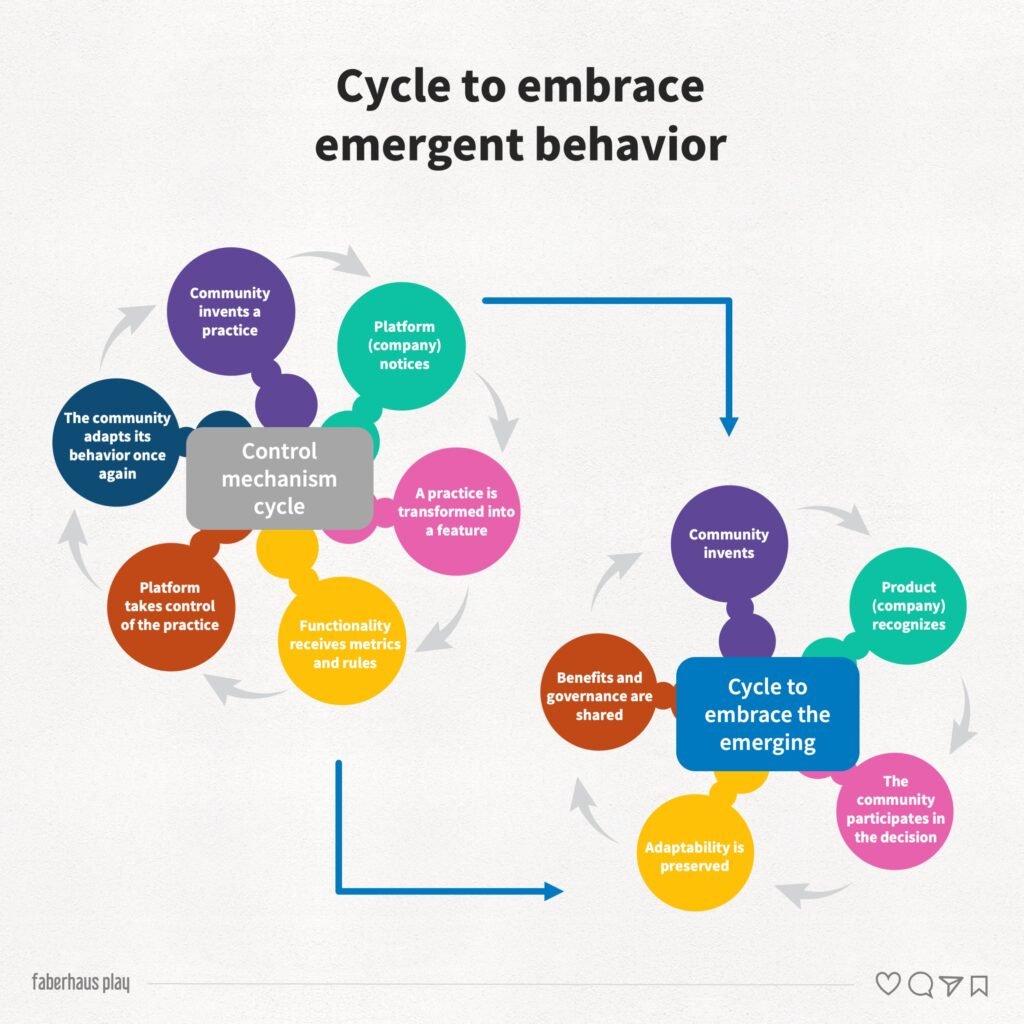
If they create a local convention, the platform tries to transform it into a feature.
If they find a space of freedom, it soon receives a taxonomy, metrics, automated moderation, and a monetization strategy.
The product absorbs the collective invention, removes it from its context, and returns it as an official resource.
Alexander helps us see the problem: observing what emerges is not the same as allowing the emergent to remain alive.
Design can recognize a social practice and strengthen it.
But it can also capture it, freeze it, and convert it into a mechanism of control.
The ethical question is not only, “Did this come from users?”
It is also, “Do users still have power over what they created?”
AI and the Industrialization of the Probable
Generative artificial intelligence intensifies this tension.
These systems are extraordinary at producing the plausible.
They can combine references, complete structures, and quickly generate a response that resembles what we expect to find.
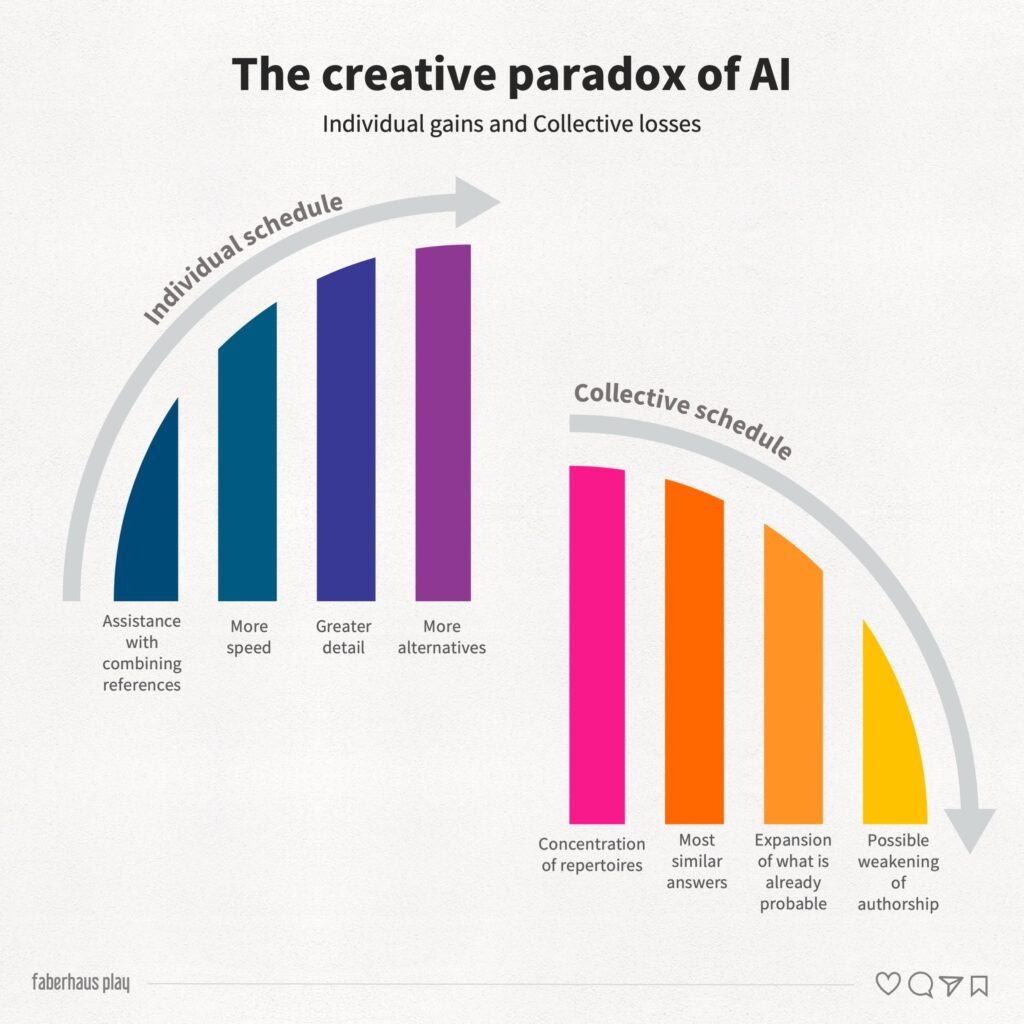
This can expand individual capabilities.
Across five experiments published in 2024, researchers observed that using ChatGPT increased the creativity of assessed ideas compared with using no technology or conventional search, particularly for incremental innovations.
But “more creative for each individual” does not necessarily mean “more diverse for society.”
Another study found evidence that ChatGPT-supported users produced more and more detailed ideas, while proposals from different participants became more similar to one another.
Participants also felt less authorship and responsibility for the result.
That combination should concern every designer: Higher individual productivity, lower diversity, and more fragile authorship.
It is almost the perfect industrial formula.
AI does not need to impose a single answer to homogenize design.
It only needs to make some answers far easier, faster, and more available than others.
• Gradually, the probable defeats the particular.
• The recognizable defeats the strange.
• The polished defeats the lived.
If we ask a machine to design “the best experience,” it will probably synthesize traces of the most frequent, best-documented, and most highly valued experiences in the data available to it.
But the quality without a name is not a statistical average.
It depends on the precise correspondence between a form and a concrete situation.
It depends on what only becomes visible when we remain long enough with particular people, in a particular context, facing a particular conflict.
AI can suggest a thousand interfaces.
But it cannot replace the relationship through which we discover which one should exist or whether an interface should exist at all.
UX Is Not the Decoration of the Interface Between Two Agents
One risk in contemporary practice is reducing UX to the removal of friction.
Fewer steps, less waiting, less effort, and more conversion.
Sometimes that is exactly what people need.
No one wants a deliberately confusing experience when paying a bill or scheduling a medical appointment.
But not every friction is a defect.
• Some frictions protect: the pause before publishing something destructive, the confirmation before an irreversible decision, the time required to understand a diagnosis.
• Some frictions teach: assembling, experimenting, making mistakes, and developing a mental model.
• Some frictions make relationships possible: negotiating, listening, disagreeing, and building a collective decision.
There is also harmful seamlessness.
• Buying without noticing how much was spent.
• Continuing to scroll without deciding to continue.
• Accepting terms without understanding them.
• Delegating a choice before recognizing that a choice existed.
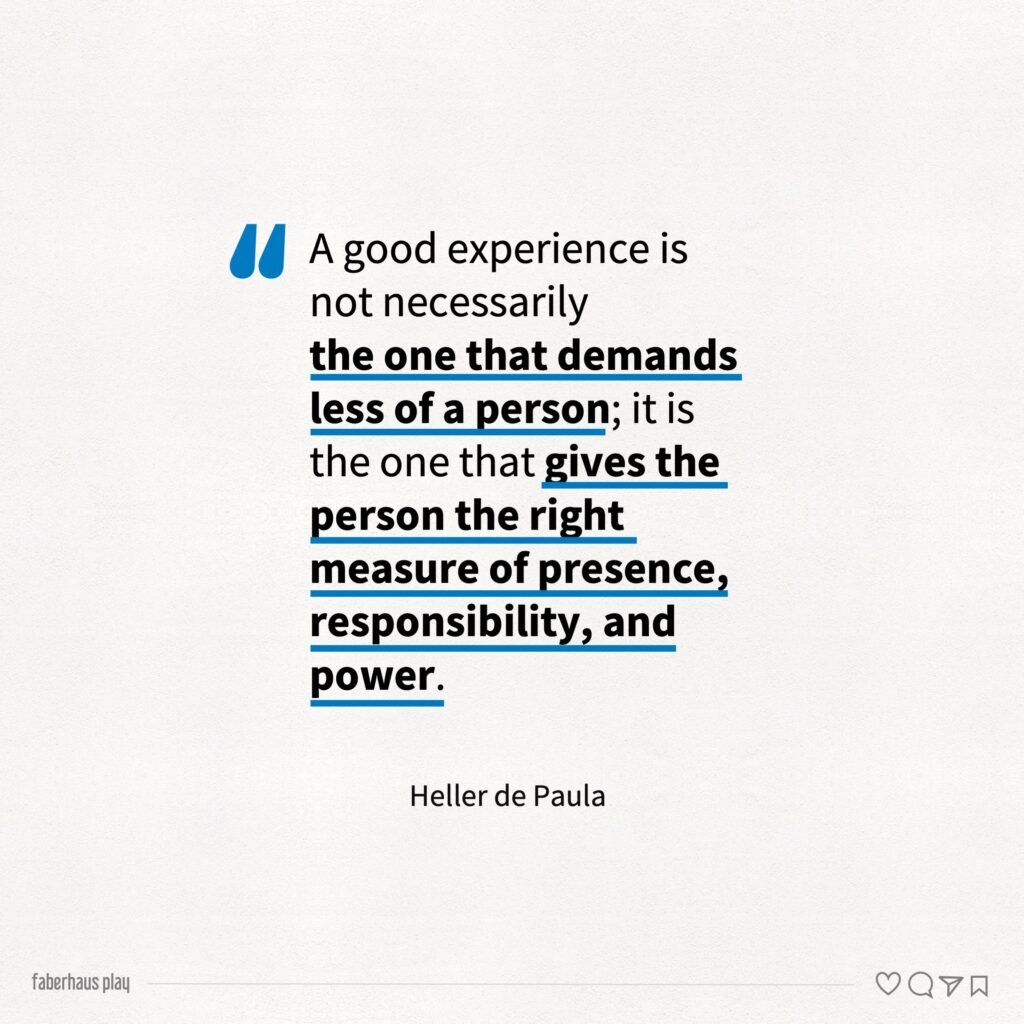
A good experience is not necessarily the one that demands less of a person; it is the one that gives the person the right measure of presence, responsibility, and power.
In this sense, UX should not be the pleasant decoration of the interface between a company’s system and a consumer’s behavior.
It should investigate the conditions for a dignified relationship among people, organizations, communities, and technologies.
Alexander would direct our attention to the whole:
• The interface works, but does the service do good?
• The task was completed, but did the person become more autonomous?
• The metric increased, but what kind of behavior did it make normal?
• Did personalization make choice easier, or did it make alternatives invisible?
• The system learned from the community, but did the community gain anything from it?
The Next Stage: From Living Objects to Living Processes
With The Nature of Order, published in four volumes, Alexander deepened his investigation.
He began to speak of living structure, wholeness, and processes capable of preserving or extending that wholeness.
His thesis was provocative: life, in this structural sense, would not be merely a subjective preference.
Certain configurations would display greater coherence, differentiation, connection across scales, and capacity to sustain the whole.
Design should advance through gradual transformations that preserve and expand those relationships.
For product design, the consequence is important: assessing the final artifact is not enough.
We need to assess the process that produced it.
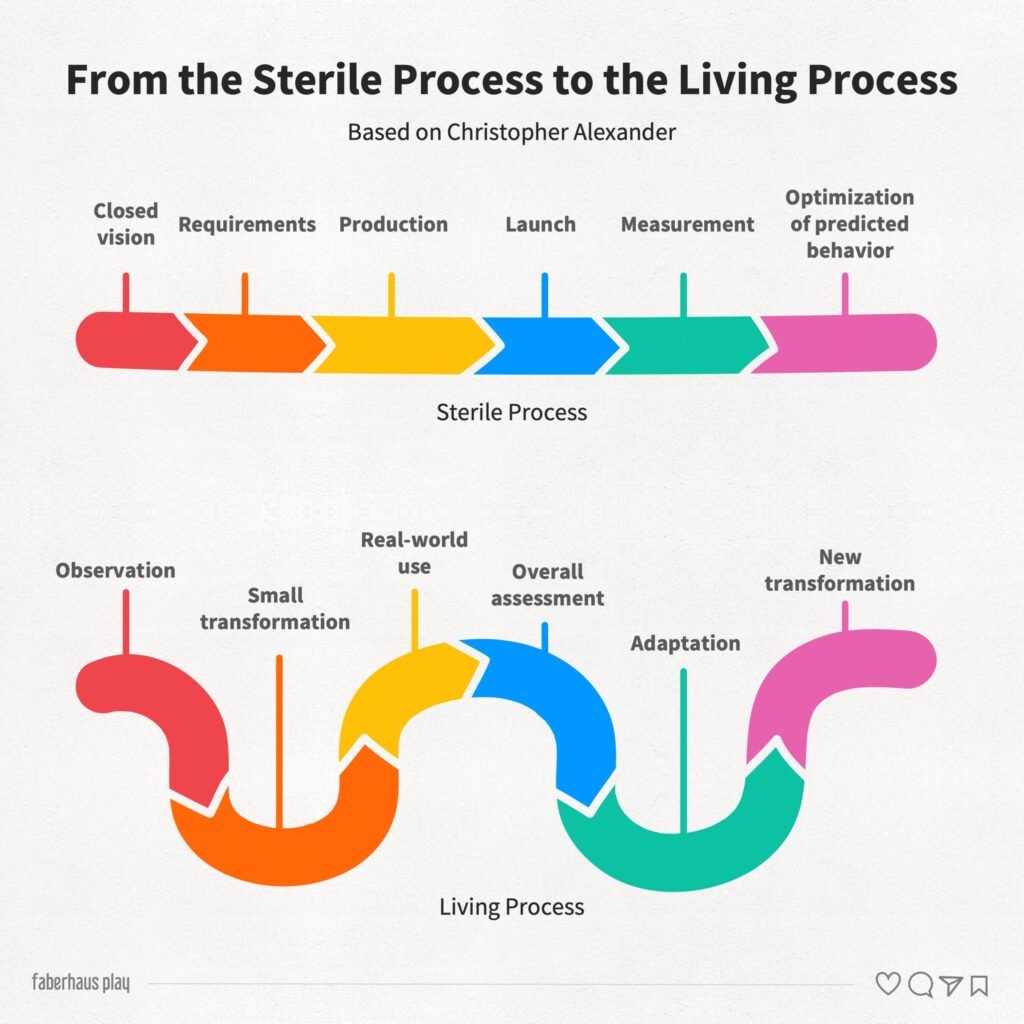
A living process:
• starts from present reality, not only from a future vision;
• produces changes small enough to be understood;
• tests each transformation in relation to the whole;
• allows affected people to participate in decisions;
• preserves important local differences;
• learns from unexpected forms of appropriation;
• distributes the capacity to adapt;
• treats metrics as signals, not substitutes for experience;
• accepts that the outcome cannot be fully known in advance.
This resembles the cultivation of an ecosystem more than a feature-production line.
It does not mean abandoning vision, technique, or intention.
Gardens are designed too.
The difference is that a gardener does not confuse care with absolute control.
Alexander Must Also Be Questioned
Taking Alexander seriously does not require turning him into the patron saint of human-centered design.
His work contains important tensions.
The first tension is his attempt to treat life and beauty as objectively observable qualities.
That ambition challenges the convenient relativism according to which every design decision is merely a matter of taste.
It forces us to recognize that environments have concrete effects on well-being.
At the same time, speaking of universal qualities can erase cultural differences, political conflict, and power relations.
Who decides what feels alive? Which traditions are used as references? Who is allowed to disagree?
The second tension appears in pattern language itself.
Created to broaden participation, it can also become a new authority.
A catalog of good solutions can limit imagination when its patterns are treated as permanent truths.
The third tension lies in the transition from physical to digital space.
A house ages, resists, and keeps traces.
An application can change unilaterally overnight.
Buildings are situated; platforms operate across multiple cultures at once.
Materiality imposes limits, while digital systems can continuously observe, predict, and alter behavior.
That is why we cannot simply copy architectural patterns into UX.
We must carry the questions forward, not freeze the answers.
Perhaps Alexander’s main contribution is not a method that closes the debate.
It is a challenge that keeps it open:
How can we create deliberately without destroying what can only emerge?
We have not yet solved that problem.
Perhaps we have simply become better at hiding it behind beautiful interfaces.
The Challenge for Product Designers
Product designers occupy an ambiguous position.
We are hired to represent people inside organizations, but also to guide those people toward outcomes desired by the organizations.
We speak of empathy, yet work within structures of power, deadlines, revenue, and scale.
We defend users, but they are rarely able to deliberate with us about the product’s fundamental goals.
There is no purity available in this position.
There is responsibility.
Reading Alexander can begin with a change in questions.
Instead of asking, “What user problem are we going to solve?”, ask:
Who decided that this is a problem?
Instead of asking, “How do we reduce friction?”, ask:
What attention, learning, or protection does this friction sustain?
Instead of asking, “How do we scale this solution?”, ask:
What needs to remain local, adaptable, and under community control?
Instead of asking, “Which pattern should we apply?”, ask:
What forces does this pattern reconcile, and which experiences does it make invisible?
Instead of asking, “How do we use AI in this flow?”, ask:
Which human capacity will be expanded, which may atrophy, and who will remain responsible for the result?
Instead of asking, “Can the user complete the task?”, ask:
Does the user recognize themselves in the experience? Do they leave with greater autonomy? Does the system allow something of their own to emerge?
These questions do not fit easily into a handoff.
And that is a good thing.
Design Conditions, Not Behavior
For years, part of digital design has learned to treat behavior as manipulable raw material.
We create triggers, rewards, urgency, repetition patterns, and choice architectures.
We call it engagement, retention, or optimization.
In many cases, the result has been a digital environment highly efficient at capturing attention and poorly equipped to sustain a life worth the attention captured.
Alexander offers a different image of the designer’s work.
Not the specialist who designs behavior from the outside, but the participant who helps a context take form without removing its capacity for transformation.
This requires technical humility.
The interface is not the center of the experience. It is one element within a larger relationship.
It requires epistemological humility.
Research does not grant us complete access to people.
Data do not exhaust meaning.
A predictive model does not know someone simply because it correctly guesses their next click.
And it requires political humility.
Giving people a voice is not the same as sharing power.
Participation without the capacity to alter decisions may be nothing more than a friendly performance.
More living products may be less impressive in a presentation and more valuable over time.
They allow configuration, extension, contestation, and appropriation.
They reveal their rules.
They preserve memory.
They create room for groups to establish their own norms.
They do not immediately convert every emergent behavior into a platform-controlled feature.
They do not treat people as temporary visitors in a world owned by the company.
What Cannot Be Automated
Christopher Alexander left us books, buildings, patterns, and an ambitious theory about the nature of order.
But perhaps his greatest contribution is a way of paying attention.
Attention to what already exists before we design.
To the relationships a solution can strengthen or break.
To the distance between an apparently correct form and a genuinely living experience.
To the difference between organizing a system and forcing life to obey it.
When machines can produce plausible images, texts, code, and interfaces in seconds, that attention becomes even more valuable.
Production has become cheap, discernment has not.
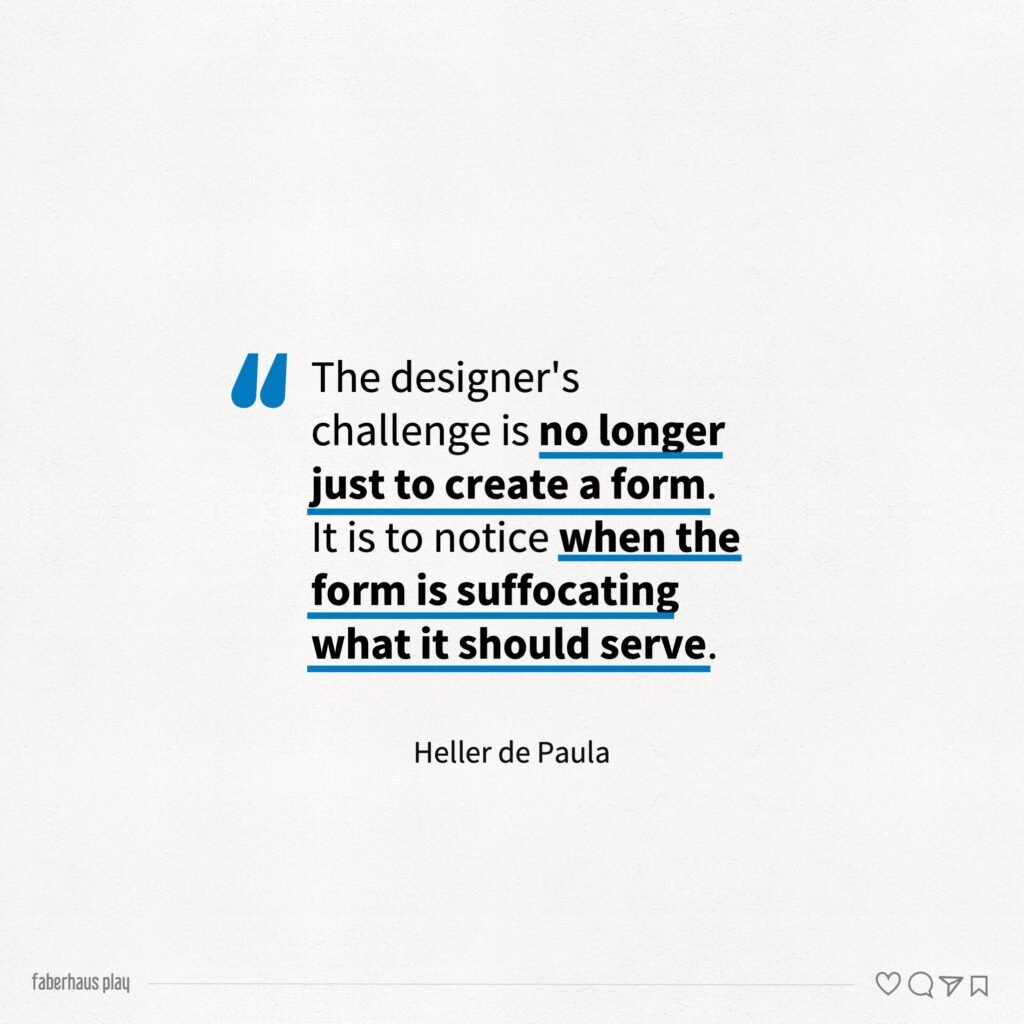
So the designer’s challenge is no longer just to create a form. It is to notice when the form is suffocating what it should serve.
Before opening the design file, choosing a component, or asking AI for another alternative, it is worth asking the question that runs through Alexander’s work:
What, in this situation, is trying to come alive?
Then a second question:
Does our design create the conditions for that to happen, or has it already decided, arbitrarily, what that life should be?
There is no ready-made component that can answer.
And perhaps that is precisely where design needs to act most forcefully today.
References
ALEXANDER, Christopher. A city is not a tree. Architectural Forum, New York, v. 122, n. 1, p. 58–62, Apr. 1965; v. 122, n. 2, p. 58–62, May 1965.
ALEXANDER, Christopher. Notes on the synthesis of form. Cambridge, MA: Harvard University Press, 1964.
ALEXANDER, Christopher. The nature of order: an essay on the art of building and the nature of the universe. Berkeley: Center for Environmental Structure, 2002–2005. 4 v.
ALEXANDER, Christopher. The origins of pattern theory: the future of the theory, and the generation of a living world. San Jose, 6 Oct. 1996. Lecture presented at the Conference on Object-Oriented Programs, Systems, Languages and Applications — OOPSLA. Available at: https://www.patternlanguage.com/archive/ieee.html. Accessed: 1 Aug. 2026.
ALEXANDER, Christopher. The timeless way of building. New York: Oxford University Press, 1979.
ALEXANDER, Christopher et al. A pattern language: towns, buildings, construction. New York: Oxford University Press, 1977.
ALEXANDER, Christopher et al. The Oregon experiment. New York: Oxford University Press, 1975.
ANDERSON, Barrett R.; SHAH, Jash Hemant; KREMINSKI, Max. Homogenization effects of large language models on human creative ideation. In: ACM CONFERENCE ON CREATIVITY & COGNITION, 16., 2024, Chicago. Proceedings […]. New York: Association for Computing Machinery, 2024. Available at: https://arxiv.org/abs/2402.01536. Accessed: 1 Aug. 2026.
CHIRIGATI, Fernando. Collective deliberation driven by AI. Nature Computational Science, [s. l.], v. 4, p. 802, 2024. DOI: https://doi.org/10.1038/s43588-024-00736-y.
GAMMA, Erich; HELM, Richard; JOHNSON, Ralph; VLISSIDES, John. Design patterns: elements of reusable object-oriented software. Boston: Addison-Wesley, 1994.
JIANG, Bin. Christopher Alexander and his life’s work: the nature of order. Urban Science, Basel, v. 3, n. 1, art. 30, 2019. DOI: https://doi.org/10.3390/urbansci3010030.
LEE, Byung Cheol; CHUNG, Jaeyeon. An empirical investigation of the impact of ChatGPT on creativity. Nature Human Behaviour, [s. l.], v. 8, p. 1906–1914, 2024. DOI: https://doi.org/10.1038/s41562-024-01953-1.
UNIVERSITY OF CALIFORNIA, BERKELEY. College of Environmental Design. In memoriam: Christopher Alexander. Berkeley, 4 Apr. 2022. Available at: https://ced.berkeley.edu/news/in-memoriam-christopher-alexander. Accessed: 1 Aug. 2026.
LANDY, Ruth. How do buildings make you feel? Available at: https://medium.com/@ruthlandy/how-do-buildings-make-you-feel-bf0f302a093. Accessed: 1 Aug. 2026.
ALEXANDER, Christopher. The battle for the life and beauty of the earth: a struggle between two world-systems. New York: Oxford University Press, 2012.
ALEXANDER, Christopher; NEIS, Hajo; ANNINOU, Artemis; KING, Ingrid. A new theory of urban design. New York: Oxford University Press, 1987.
BJÖRGVINSSON, Erling; EHN, Pelle; HILLGREN, Per-Anders. Design things and design thinking: contemporary participatory design challenges. Design Issues, Cambridge, MA, v. 28, n. 3, p. 101–116, 2012. DOI: https://doi.org/10.1162/DESI_a_00165.
CRAWFORD, Matthew B. The world beyond your head: on becoming an individual in an age of distraction. New York: Farrar, Straus and Giroux, 2015.
EHN, Pelle. Participation in design things. In: PARTICIPATORY DESIGN CONFERENCE, 10., 2008, Bloomington. Proceedings […]. Indianapolis: Indiana University, 2008. p. 92–101.
ILLICH, Ivan. Tools for conviviality. New York: Harper & Row, 1973.
JIANG, Bin. Living structure down to earth and up to heaven: Christopher Alexander. Urban Science, Basel, v. 3, n. 3, art. 96, 2019. DOI: https://doi.org/10.3390/urbansci3030096.
MANZINI, Ezio. Design, when everybody designs: an introduction to design for social innovation. Cambridge, MA: MIT Press, 2015.
MOROZOV, Evgeny. To save everything, click here: the folly of technological solutionism. New York: PublicAffairs, 2013.
NORMAN, Donald A. Design for a better world: meaningful, sustainable, humanity centered. Cambridge, MA: MIT Press, 2023.
SCHÖN, Donald A. The reflective practitioner: how professionals think in action. New York: Basic Books, 1983.
SPINUZZI, Clay. The methodology of participatory design. Technical Communication, Washington, DC, v. 52, n. 2, p. 163–174, 2005.
SUCHMAN, Lucy A. Human-machine reconfigurations: plans and situated actions. 2nd ed. Cambridge: Cambridge University Press, 2007.
TIDWELL, Jenifer; BREWER, Charles; VALENCIA, Aynne. Designing interfaces: patterns for effective interaction design. 3rd ed. Sebastopol: O’Reilly Media, 2020.
TURKLE, Sherry. Reclaiming conversation: the power of talk in a digital age. New York: Penguin Press, 2015.
WINNER, Langdon. Do artifacts have politics? Daedalus, Cambridge, MA, v. 109, n. 1, p. 121–136, 1980.
ZUBOFF, Shoshana. The age of surveillance capitalism: the fight for a human future at the new frontier of power. New York: PublicAffairs, 2019.