Starting a new job often brings a mix of excitement, anxiety, and the desire to prove yourself. In this situation, it is easy to do too much—trying to change everything immediately—or too little, waiting too long to take ownership.
A 30-60-90 day plan can help you find the right balance. It should not be treated as a rigid formula, but as a way to understand the main focus of each stage: learn first, then contribute, and finally demonstrate your impact.
The first 30 days: Observe before trying to transform
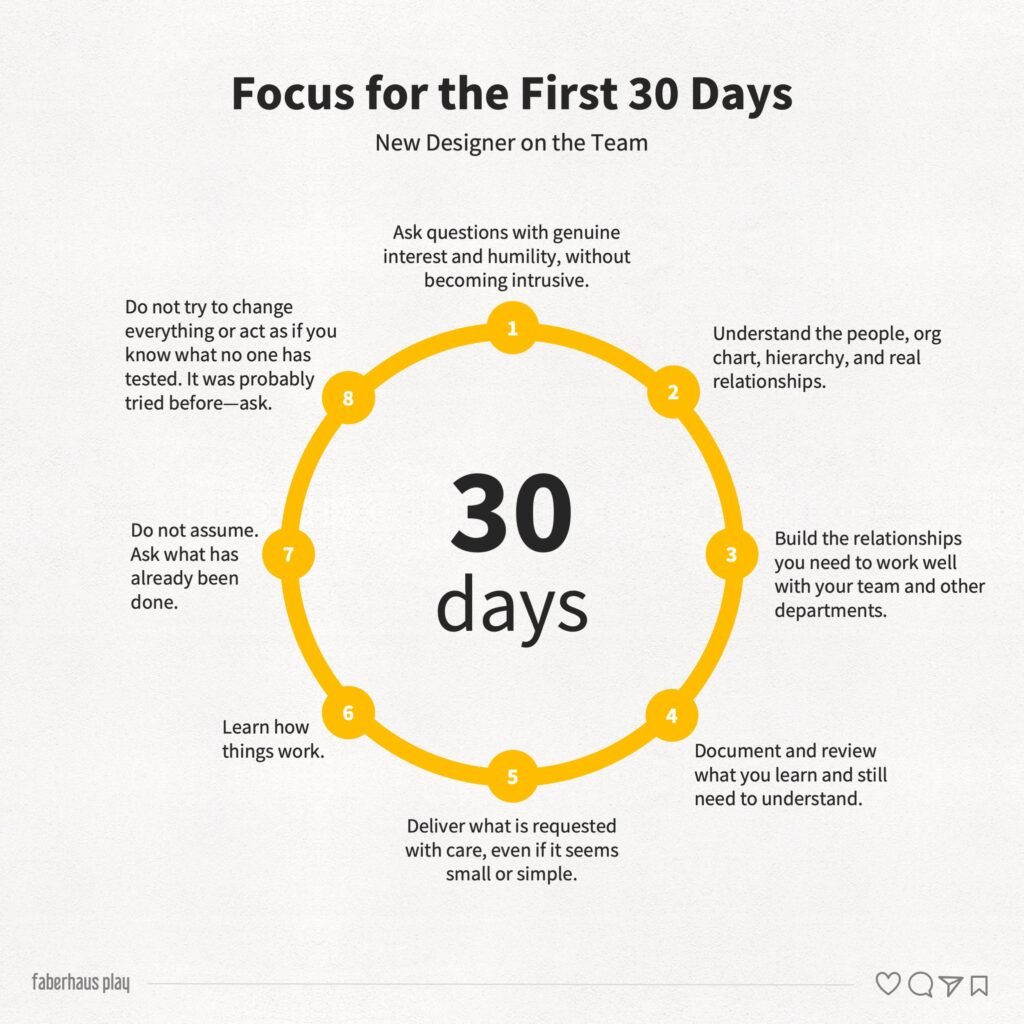
During your first month, your main responsibility is to understand the environment.
Ask questions with genuine interest and humility. Do not assume that something has never been attempted—or that you already know the best answer. Many seemingly obvious ideas may have been tested before, and there are usually reasons behind the current way of working.
Beyond formal processes, pay attention to how the company actually operates. Learn who participates in decisions, how teams collaborate, how the hierarchy works, and which relationships are important for getting things done.
Take notes, document what you learn, and keep track of what you still need to understand. This will help you connect information, avoid asking the same questions repeatedly, and gradually form a more accurate picture of the organization.
Give proper attention even to assignments that seem small or simple. If someone requested a deliverable, it probably matters within that context. A small task handled with care can also become the starting point for larger projects and more meaningful opportunities.
The greatest risk at this stage is arriving with the intention of changing everything. Before proposing a transformation, understand what has already been tried, what worked, what failed, and which constraints influenced those outcomes.
In short: During the first 30 days, listen, ask, document, build relationships, and deliver carefully.
Days 30 to 60: Start creating value
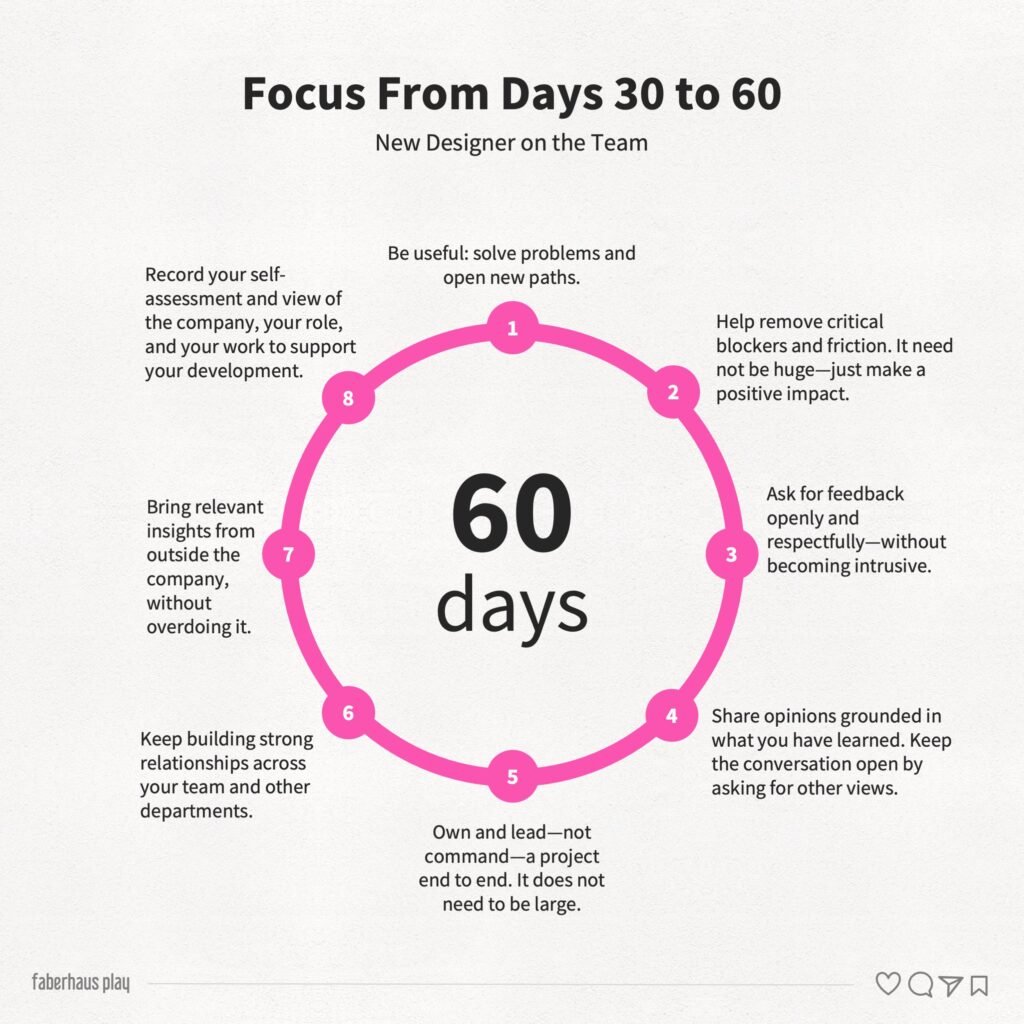
Once you understand the environment better, you can begin using your technical skills to solve problems and open new paths.
This does not mean taking responsibility for transforming the entire company. Look for small friction points or critical issues where your work can make a noticeable difference. Solving something that positively affects your team’s daily routine is already a valuable contribution.
This is also a good time to ask for feedback. Be open and respectful, but give people enough time and space to respond. A strong desire to improve is positive, but it should not create another urgent task for already busy colleagues.
You can now bring your opinions into conversations more confidently. Base them on what you have learned, while remaining open to other perspectives. For example:
“I noticed this issue and thought about this alternative. Has something similar been tested before? How do you see this possibility?”
This approach allows you to contribute without positioning your perspective as the only correct one.
Another valuable step is to take ownership of a project from beginning to end. Leadership, in this context, does not mean managing or giving orders. It means connecting the dots, coordinating the work, following up, and taking responsibility for the result.
The project does not need to be large. It only needs to give you an opportunity to demonstrate that you can understand a problem and guide a complete delivery.
At this stage, begin recording your own assessment as well. What have you learned? How do you now understand the company? How does your role support the team? Which skills would you like to develop next?
In short: From days 30 to 60, be useful, solve manageable problems, ask for feedback, and take ownership of a complete delivery.
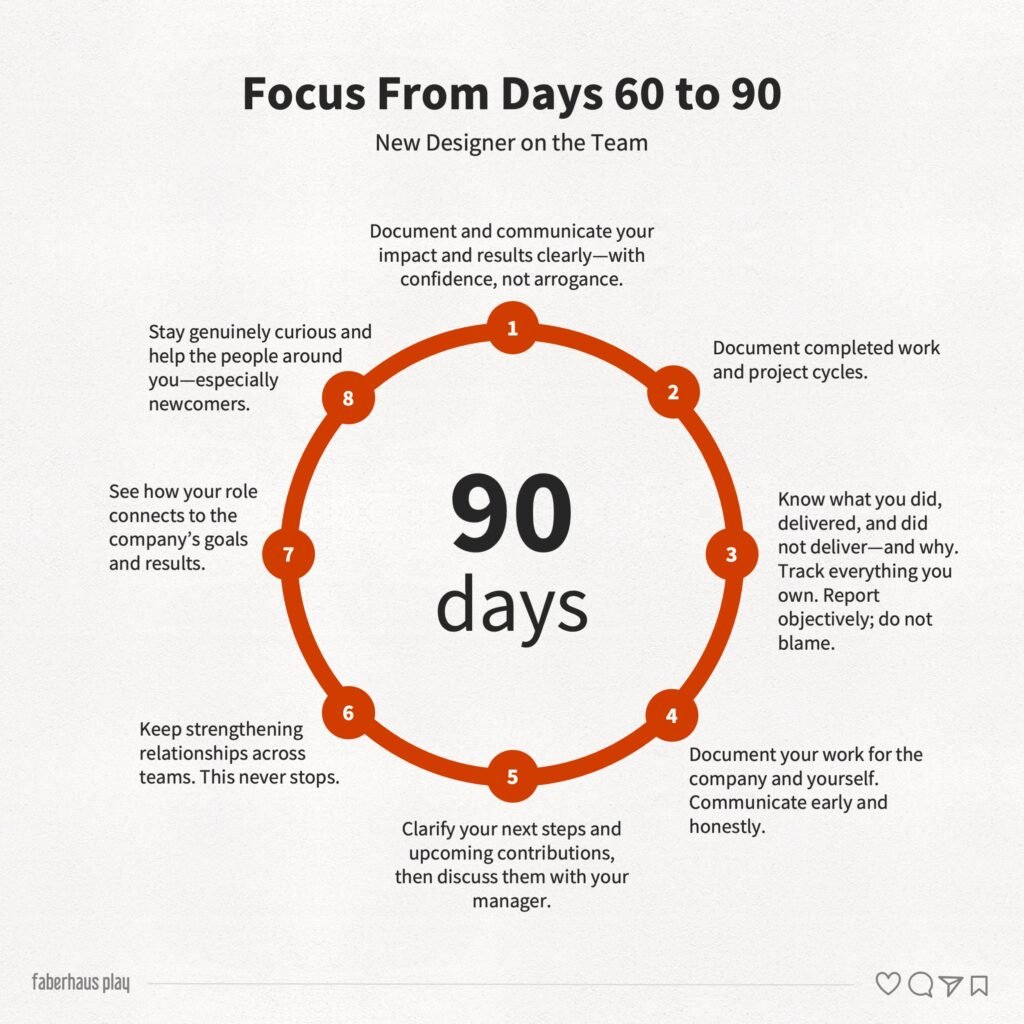
Days 60 to 90: Make your impact visible
During the final stage, focus on consolidating your work and communicating its results clearly.
Making your impact visible is not about arrogance or taking credit for everything. It is about creating evidence that helps you, your manager, and the company understand the value of your contributions.
Document completed projects, decisions, metrics, screenshots, and lessons learned. Even a small interface improvement can become a strong case when the original problem, your role, and the results are clearly explained.
By this point, you should know:
- What you have delivered
- What is still in progress
- What was not completed and why
- What was deprioritized
- What the next steps should be
When problems arise, communicate them early and objectively. Documentation should not be used to assign blame. Its purpose is to help the team adjust its course before a small difficulty becomes a major surprise.
This is also the right time to connect your work to the company’s broader goals. Learn about its performance indicators and, when applicable, its OKRs and KPIs. Try to understand how your role contributes to the results the organization wants to achieve.
This broader perspective is particularly important for designers who want to become more strategic. Strategic influence does not come only from improving technical skills. It also depends on understanding how design decisions support users, teams, and business outcomes.
Finally, prepare to discuss your next steps with your manager. What kind of project would you like to take on? Which skill do you want to develop? Where do you believe you can contribute more?
Arriving at this conversation with a clear perspective demonstrates maturity, self-awareness, and direction.
In short: From days 60 to 90, document your work, communicate clearly, demonstrate results, and connect your role to the company’s strategy.
Build it one brick at a time
A 30-60-90 day plan is not only about making a strong first impression. It helps you build relationships, knowledge, confidence, and evidence of your work.
One quality should remain present throughout every stage: honest curiosity. Continue asking questions, helping others, and building connections—including with people who join the company after you.
If you document each lesson and delivery from the beginning, you will not have to reconstruct your entire journey later. Over time, the results will resemble a house built with consistency: one brick, one conversation, and one delivery at a time.
References
Career Growth: Transitions, Stages, Cycles, and Areas of Focus. Available at: https://faberhausplay.com.br/crescer-na-carreira-profissional/. Accessed on the publication date.
Career Development Using an Individual Development Plan (IDP) and the 9-Box Grid. Available at: https://faberhausplay.com.br/pdi/. Accessed on the publication date.
APPARICIO JÚNIOR. Apparicio Júnior: Portfolio and publications on Design, Product, DesignOps, and Artificial Intelligence. Available at: https://www.apparicio.co.uk/aj/. Accessed June 15, 2026.
DESIGN CIRCUIT. Design Circuit: Community and content platform focused on Design, Product, UX, and Artificial Intelligence. Available at: https://designcircuit.co/. Accessed June 15, 2026.