Recently, while talking to an acquaintance about my job search, he asked me:
“How did you validate whether your portfolio was aligned with the roles you were applying for?”
The question made me realize that the answer involved a process I have been building for more than three years.
I did not simply create a portfolio, publish it, and wait to find out whether it was good.
Nor did I ask an AI to review half a dozen screens and give me a score from zero to ten, because that would probably have produced an answer that sounded polished and confident but was not particularly useful.
What I did was turn my portfolio into a living system: something that observes the market, compares evidence, receives feedback, and continuously evolves.
First things first: what does an “aligned” portfolio mean?
Alignment does not mean copying the portfolio of someone who already works at the company.
It also does not mean including every word used in the job description.
To me, an aligned portfolio is one that helps a recruiter or hiring manager quickly recognize the relationship between:
- The problems the company needs to solve;
- The skills the role requires;
- The experience I already have;
- The way I think and work.
This is not a definitive validation. It is a positioning hypothesis.
And like any hypothesis, it needs to be tested.
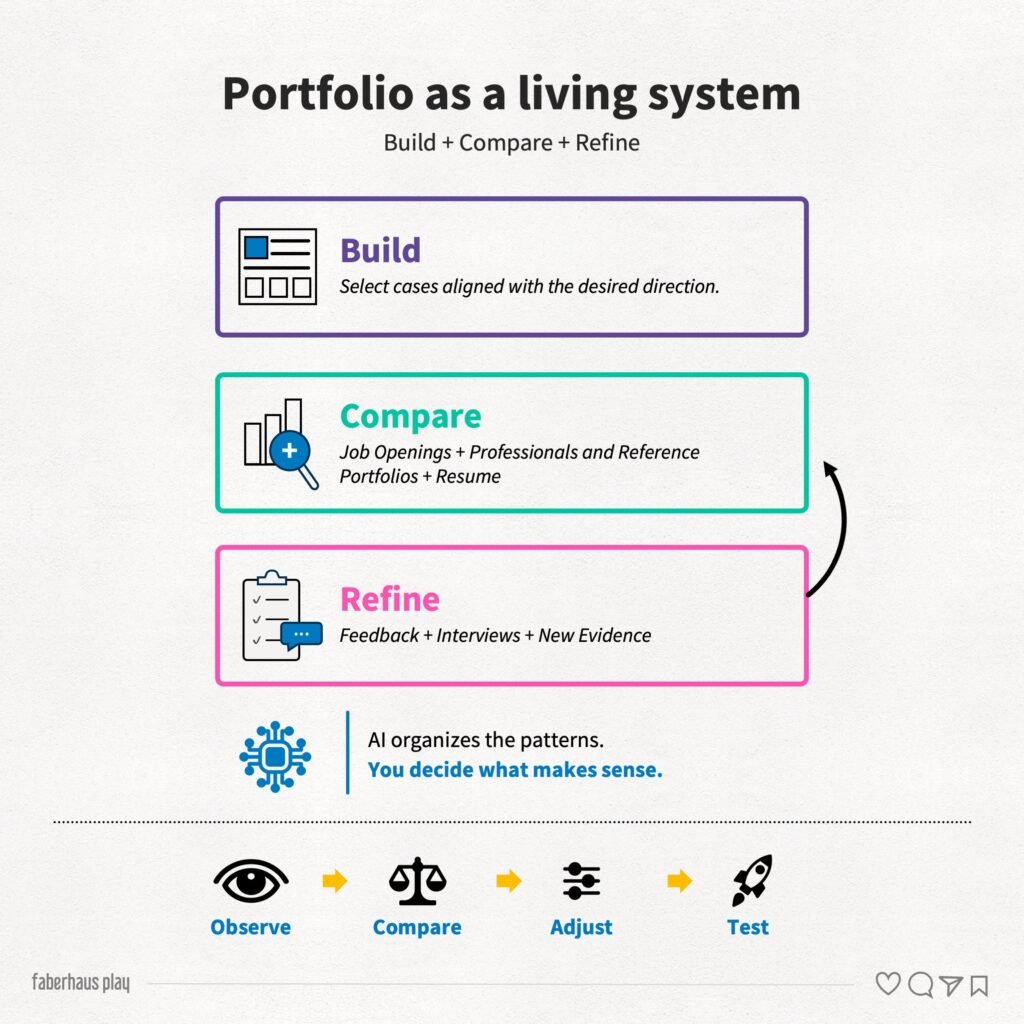
Phase 1: building an initial direction
I started by creating the portfolio introduction and structuring the case studies that made the most sense for me.
This matters because a portfolio should not reflect only what you have already done.
It should also point toward the kind of work you want to do next.
That is why my first selection was not based solely on the projects that looked the most impressive.
I chose case studies that could help demonstrate:
- The problems I know how to tackle;
- How I make decisions;
- How I work with other people;
- The kind of impact I can create;
- The skills I want to continue developing.
This first version did not need to be perfect. It needed to be concrete enough to compare with the market.
Without something tangible, the analysis becomes pure speculation.
Phase 2: comparing against real evidence
Once the initial structure was ready, I began using GPT to analyze different sources:
- Job postings from the companies I was interested in;
- Skills and responsibilities that repeatedly appeared in those postings;
- Profiles of professionals who already worked at those companies;
- Public portfolios from designers I admire;
- My résumé;
- The case studies presented in my own portfolio.
The goal was not to ask whether my portfolio was “good.”
Generic questions tend to produce generic answers.
The goal was to identify more specific differences:
- Which skills appear repeatedly in job postings but are barely visible in my material?
- Which experiences do I have but fail to communicate clearly?
- Do my case studies show only the final solution, or do they also reveal my reasoning?
- Is the level of depth appropriate for the seniority of the roles?
- Is there consistency across my résumé, portfolio, and professional presentation?
- What patterns appear among professionals who already hold roles similar to the ones I am pursuing?
AI mainly helped me organize information, compare content, and identify patterns that would have been difficult to notice by looking at each source in isolation.
But it did not make the decisions for me.
A gap identified by AI does not automatically mean that something needs to be added.
Sometimes that characteristic simply does not represent my background or the direction I want to pursue.
Technology helped broaden my perspective, but the judgment remained mine.
Phase 3: refining, testing, and learning from feedback
Based on those analyses, I restructured parts of my résumé and portfolio.
Some changes were more obvious, such as improving how I described results or making certain skills more visible.
Others required more reflection:
- Reorganizing the narrative of a case study;
- Explaining my role in decisions more clearly;
- Removing details that took up space without strengthening my positioning;
- Providing context for constraints;
- Making what I learned from the project more explicit.
Then came applications, conversations, reviews from colleagues, and interviews.
Every response became part of the process.
When someone did not understand a case study, that became data.
When the same question came up repeatedly in interviews, that became data.
When my profile advanced for one type of role but not another, that also became data—although I treated it carefully, because hiring processes contain many variables we cannot see.
With every new piece of evidence, I updated the context and reviewed my hypotheses.
The process began to work more or less like this:
Observe → compare → adjust → test → observe again.
The knowledge base became more valuable over time
This process did not happen in a single afternoon.
I have spent more than three years collecting public job postings, professional references, portfolios, feedback, interview questions, and observations about my own work.
I also asked colleagues for their assessments and compared different perspectives instead of relying exclusively on AI.
Over time, I organized this material in a GPT project, keeping the history, references, and previous decisions together.
This makes a difference because an isolated analysis knows only the document placed in front of it at that moment.
A contextualized analysis can consider:
- Patterns found across different job postings;
- Differences between companies and roles;
- Changes made previously;
- Feedback I had already received;
- The professional goals guiding those decisions.
The better the context, the more specific the analysis tends to be.
Not because AI somehow came to understand the market or my career magically, but because it began working with a richer body of evidence that I continuously supplied and reviewed.
What I learned from the process
1. A portfolio is not a file; it is a product
It has an audience, an objective, hypotheses, constraints, and signals of success.
That is why it makes sense to treat it as we would a product: research, build, test, and improve.
2. Match is not a magic percentage
A tool can compare words, requirements, and experiences. But no percentage can fully represent culture, the company’s current moment, leadership preferences, or the quality of the competition.
A match score works better as a diagnostic than as a verdict.
3. AI is most useful when it compares evidence
Simply asking, “Review my portfolio,” is not enough.
Comparing one case study against ten relevant job postings, identifying patterns, and showing which claims need evidence is far more useful.
4. Feedback needs to become actionable data
“I liked it” or “I did not like it” is almost never enough.
Feedback becomes useful when we can identify where confusion occurred, what information was missing, and which change can be tested.
5. Alignment should not erase identity
There is a risk of optimizing the material so heavily for job postings that the portfolio stops representing the person behind it.
My goal is not to appear suitable for every role.
It is to communicate more clearly why I may be a good fit for certain roles.
How another designer can get started
You do not need to wait three years before building a huge knowledge base.
You can start with:
- Your current résumé.
- Two or three portfolio case studies.
- Ten job postings related to the type of role you are seeking.
- A few profiles and portfolios from professionals who already hold those roles.
- Feedback received during hiring processes or from colleagues you trust.
Then use AI to compare these sources and answer specific questions.
For example:
“Which skills appear most frequently in these job postings, and which of them are supported by evidence in my case studies?”
“Which parts of my résumé make promises that my portfolio does not yet support?”
“What questions would a design leader probably ask after reading this case study?”
“How does the way I present my work differ from the way professionals at these companies present similar experiences?”
Also ask the AI to quote the passages that support each conclusion.
This helps separate evidence-based analysis from generic opinion.
In the end, the portfolio remains personal
AI accelerated comparisons, organized patterns, and helped me revise narratives.
But it did not live through the projects, take part in the decisions, or know on its own what kind of career I want to build.
That part remains with me.
Perhaps that was the most important discovery in the process: the more I use artificial intelligence, the more important it becomes to keep my own judgment clear.
AI organizes patterns.
I decide what makes sense.
References
What 310 Product Design Job Postings Taught Me About Today’s Market. Available at: <https://faberhausplay.com.br/310-vagas-de-product-design/>. Accessed on the publication date.