
With AI generating interfaces in seconds and design systems accelerating product development, it is tempting to believe that usability has become easier.
In many ways, it has.
Teams can prototype faster than ever.

Developers can generate front-end code in minutes.
Designers can create multiple interface variations with a single prompt.
But there is one thing AI still struggles to do consistently:
Judge whether an experience actually works for people.
That is where heuristic evaluation remains valuable.
More than thirty years after Jakob Nielsen introduced his famous usability heuristics, and years after Abby Covert expanded the conversation through information architecture principles, heuristic evaluation continues to be one of the fastest and most effective ways to identify problems before they reach users.
What is heuristic evaluation?
Heuristic evaluation is a structured review of a product, service, or interface using a predefined set of usability principles.
Instead of waiting for user testing to reveal issues, teams proactively inspect an experience and ask:
- Can people find what they need?
- Can they understand what is happening?
- Can they recover from mistakes?
- Can they complete their goals efficiently?
- Can they trust the experience?
Think of it as a health check for a product.
It does not replace user research.
It does not replace usability testing.
But it often reveals obvious problems before investing time and resources in more expensive forms of validation.
Why heuristic evaluation is becoming important again
Many teams today are producing more interfaces than ever before.
AI has dramatically reduced the cost of creating screens, flows, and prototypes.
As a result, the bottleneck has shifted.
The challenge is no longer generating solutions.
The challenge is evaluating their quality.
A designer can generate ten interface concepts in an afternoon.
A product team still needs a way to assess whether those concepts are understandable, useful, accessible, and valuable.
Heuristic evaluation provides that framework.
It helps teams move beyond personal opinions and evaluate experiences through a more consistent lens.
Abby Covert’s perspective: does the design have legs?
One of the most interesting contributions from information architect Abby Covert is her idea that design critiques should help us understand whether a solution has “legs.”
In other words:
- Can it support real usage?
- Can it remain effective over time?
- Can it sustain itself as the product evolves?
This perspective moves heuristic evaluation beyond usability alone.
It becomes a way to evaluate whether an experience is resilient enough to survive real-world complexity.
Her 10 heuristics are:
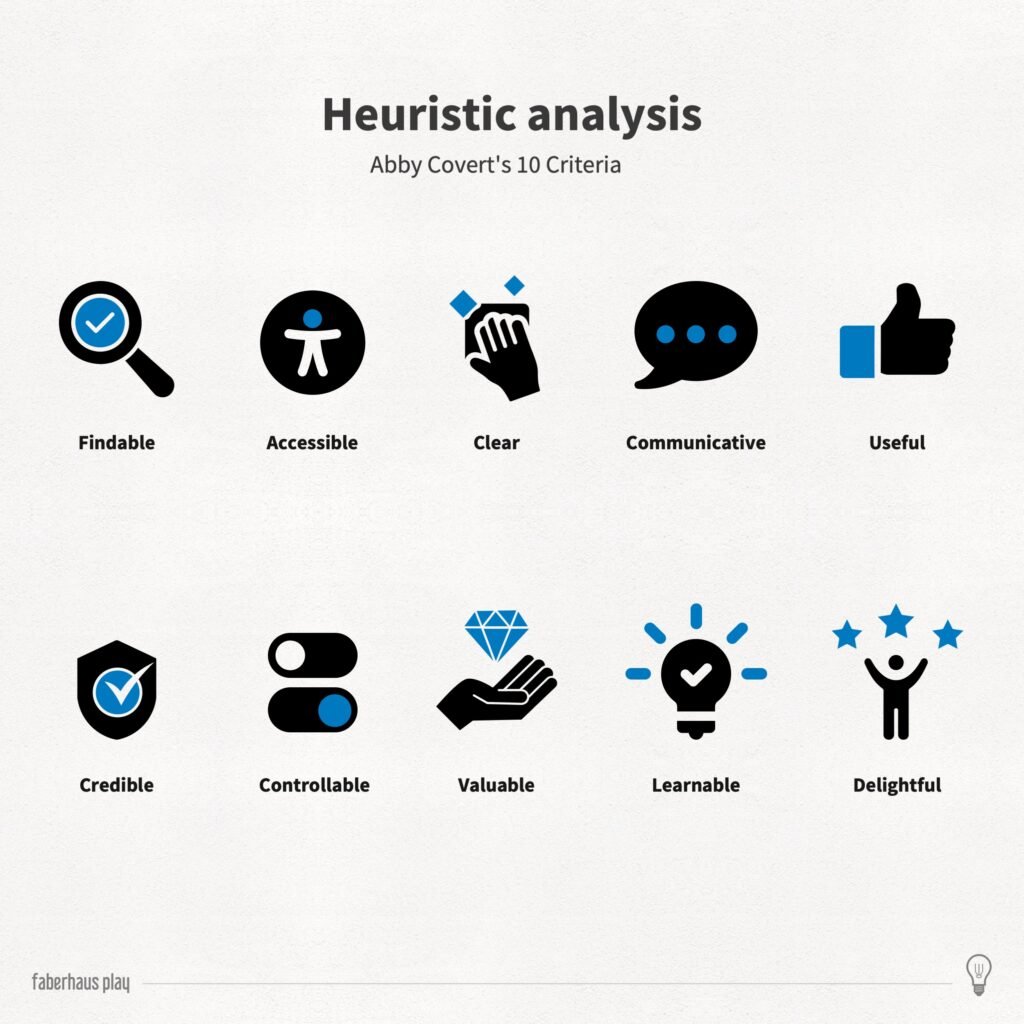
1. Findable
Can people easily find what they are looking for?
Questions to consider:
- Are there multiple paths to information?
- Does navigation support different user behaviors?
- Do search systems return useful results?
- Is information organized according to user expectations?
2. Accessible
Can people use the service regardless of device, context, or limitations?
Questions to consider:
- Does the experience work across devices?
- Is it resilient across different environments?
- Does it support users with disabilities?
3. Clear
Can people understand what is available and what to do next?
Questions to consider:
- Is the path forward obvious?
- Is language easy to understand?
- Does the interface match the user’s knowledge level?
Three common enemies of clarity:
- Designing around organizational structures instead of user needs.
- Using technical jargon.
- Using vague language to hide complexity.
4. Communicative
Does the interface provide information at the right moment?
Questions to consider:
- Do users know where they are?
- Do they understand system status?
- Are messages helpful and contextual?
5. Useful
Can users accomplish what they came to do?
Questions to consider:
- Can tasks be completed successfully?
- Are flows efficient?
- Do different types of users find value in the experience?
6. Credible
Can people trust the experience?
Questions to consider:
- Does the design fit the context?
- Is information current?
- Is it easy to verify who is behind the service?
- Is support available when needed?
7. Controllable
Can users manage their experience and recover from mistakes?
Questions to consider:
- Are exits clearly available?
- Can users undo actions?
- Are errors prevented or recoverable?
8. Valuable
Does the experience create meaningful value?
Questions to consider:
- Is it desirable?
- Can users explain its value?
- Does it improve customer satisfaction?
- How is success measured?
9. Learnable
Can people learn the system quickly?
Questions to consider:
- Are complex processes easy to understand?
- Is behavior consistent?
- Can users predict what will happen next?
10. Delightful
Does the experience go beyond functionality?
Questions to consider:
- What makes it memorable?
- What differentiates it from competitors?
- How does it exceed expectations?
Nielsen’s classic heuristics
While Abby Covert expands the discussion toward information architecture and service design, Jakob Nielsen’s ten usability heuristics remain one of the most influential frameworks in digital product design.
They include:
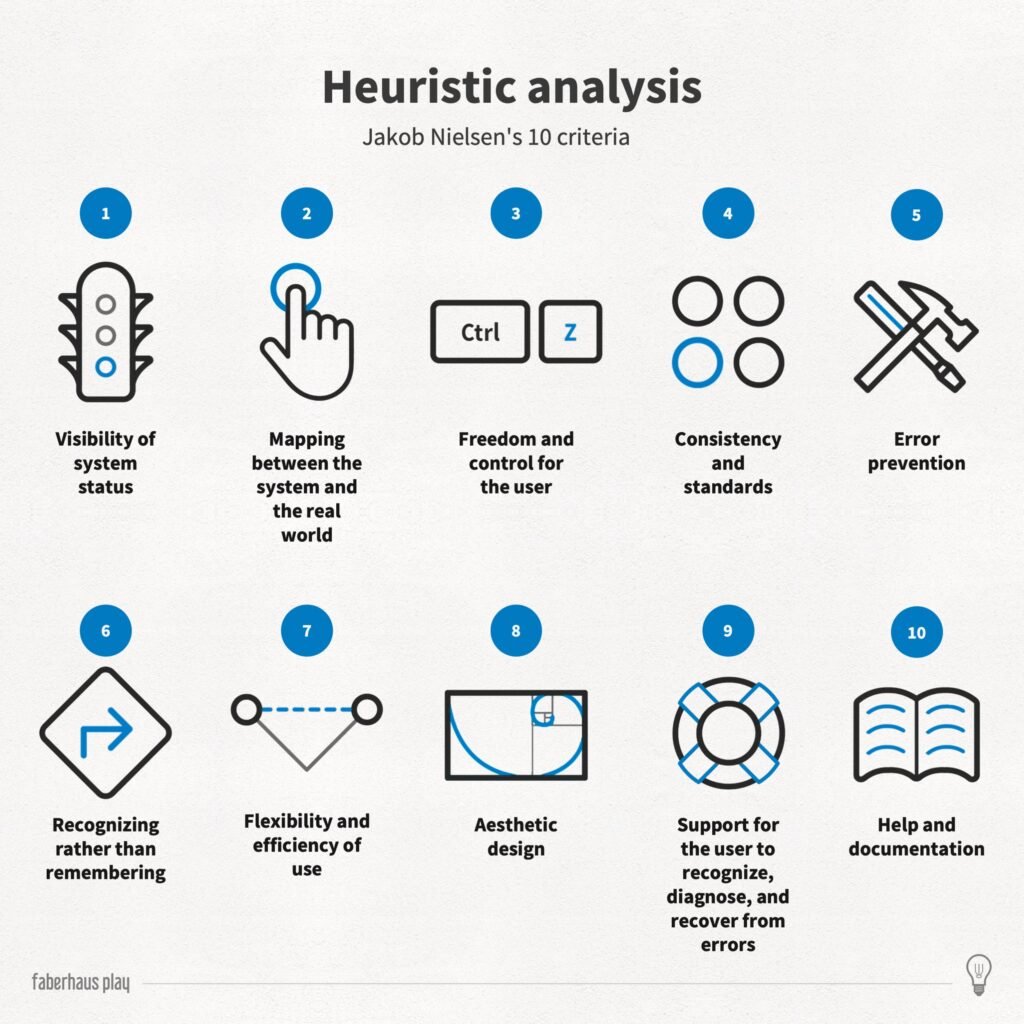
- Visibility of system status
- Mapping between the system and the real world
- Freedom and control for the user
- Consistency and standards
- Error prevention
- Recognizing rather than remembering
- Flexibility and efficiency of use
- Aesthetic design
- Support for the user to recognize, diagnose, and recover from errors
- Help and documentation
Many UX reviews today still use Nielsen’s framework as their foundation.
Heuristic evaluation as an AI skill
One of the most practical uses of AI today is applying heuristic evaluation at scale.
Instead of reviewing screens manually, designers can use AI to perform a first-pass assessment of:
- User flows
- Wireframes
- Prototypes
- Landing pages
- Design system components
For example, a designer can ask an AI assistant:
“Evaluate this checkout flow using Nielsen’s heuristics.“
Or:
“Review this onboarding experience using Abby Covert’s principles and identify usability risks.“
The output should never replace human judgment.
However, it can accelerate critique, surface blind spots, and help teams identify areas worth investigating further.
In this sense, heuristic evaluation is becoming a valuable AI skill.
The designer is no longer just applying heuristics personally.
They are using systems to search for those heuristics consistently so they could use their time to refine the topics found and decide how to resolve it.
The real value of heuristic evaluation
The greatest value of heuristic evaluation is not finding flaws.
It is creating a shared language for discussing quality.
Without heuristics, design reviews often become subjective debates.
People argue about preferences.
People defend personal opinions.
People discuss aesthetics without discussing outcomes.
Heuristics shift the conversation toward principles.
They help teams ask better questions.
And in a world where creating interfaces becomes increasingly easy, the ability to evaluate them critically may become one of the most valuable design skills of all.
References
Covert, A. Information Architecture Heuristics. Available at: https://www.slideshare.net/AbbyCovert/information-architecture-heuristics
Cybis, W., Betiol, A. H., & Faust, R. (2010). Ergonomics and Usability: Knowledge, Methods and Applications. São Paulo: Novatec.
Nielsen, J. 10 Usability Heuristics for User Interface Design. Nielsen Norman Group. Available at: https://www.nngroup.com/articles/ten-usability-heuristics/