
Over the past few months, I’ve been following a lot of conversations about Artificial Intelligence in digital products.
And there’s one question that keeps coming up:
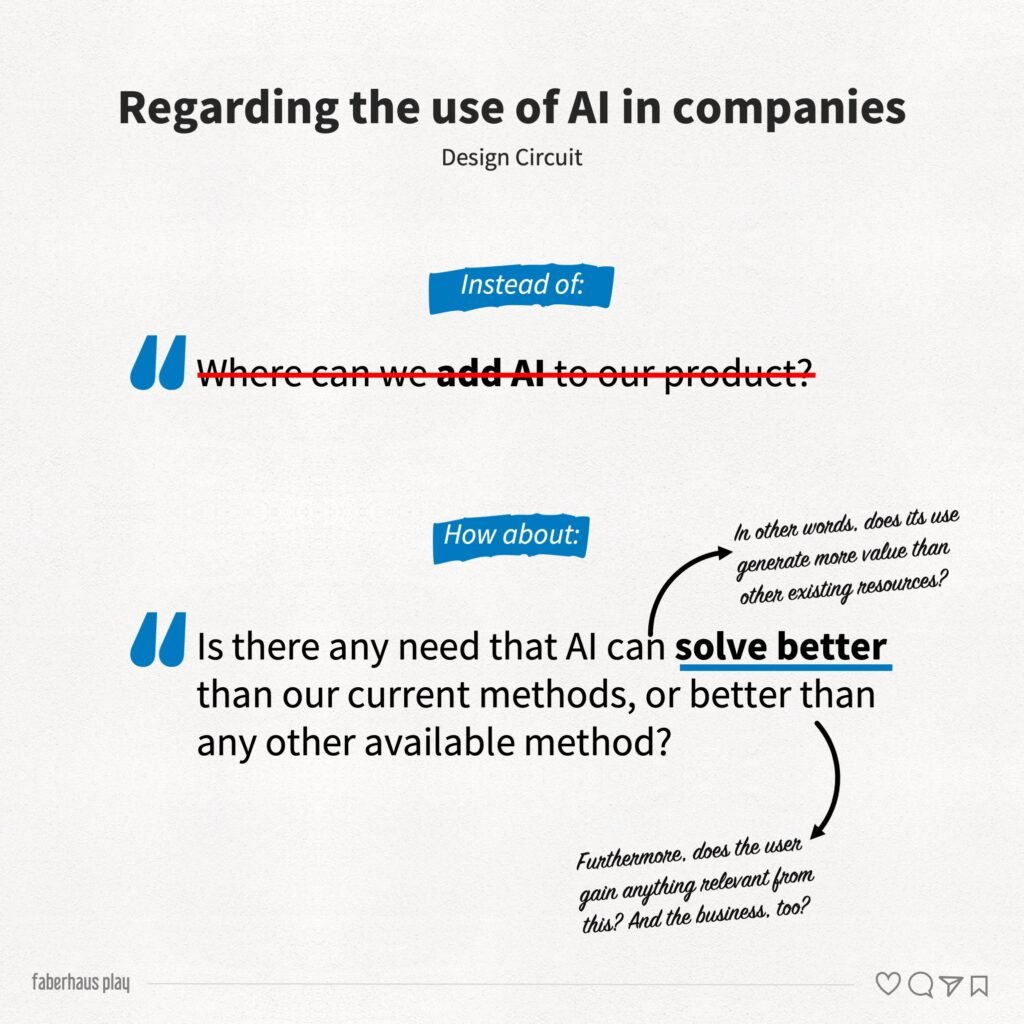
“Where can we add AI to our product?”

At first, it sounds reasonable.
But there’s a problem with it.
When we start with that question, the technology becomes the center of the discussion.
Not the problem we’re trying to solve.
A better question might be:
“Is there any need that AI can solve better than our current methods, or better than any other available method?”
Notice the difference.
In the first question, we are looking for a place to fit a technology.
In the second, we are looking for a better way to solve a problem.
And that changes the entire conversation.
Not Everything Needs AI
Many companies are rushing to add AI to products, services, and internal operations.
But there’s a simple question that should come first:
Does its use generate more value than other existing resources?
And value is not only about user experience.
It is also about cost.
If an AI-based solution is more expensive, more complex, and delivers the same outcome as an existing process, it is not necessarily innovation.
It may simply be a technology swap.
In some cases, AI creates tremendous value.
In others, it becomes an expensive vanity metric that is difficult to justify.
The question remains the same:
Does the user gain anything relevant from this? And the business, too?
If the answer is no, AI may not be necessary.
It is also worth remembering that important decisions should be supported by evidence, not just opinions or personal impressions.
AI as a Practice and AI as an Offering
There is an important distinction that often gets overlooked.
Organizations can use AI in two very different ways.
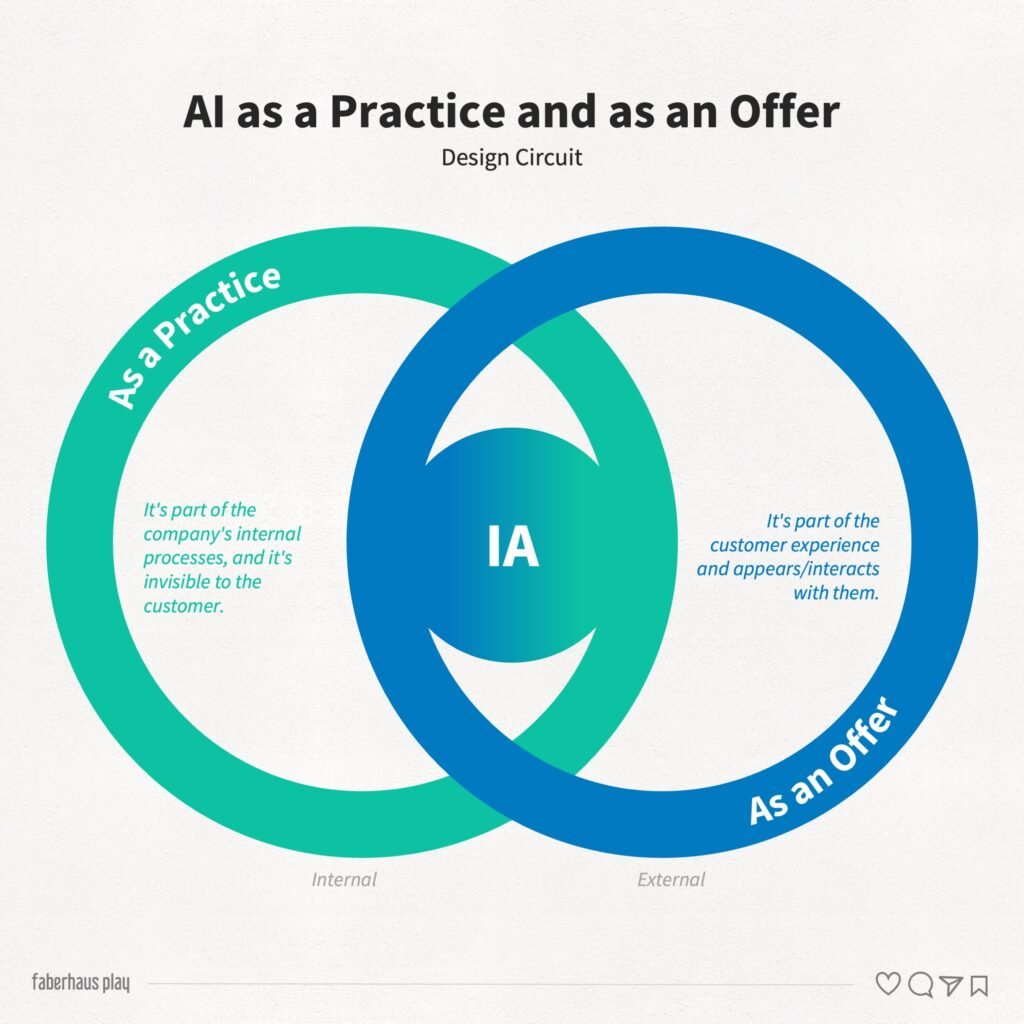
The first is as a practice.
In this scenario, AI becomes part of the company’s internal workflows.
It helps organize information, synthesize research, analyze data, generate documentation, and support operational activities.
Customers may never even notice it exists.
Yet the organization becomes more efficient.
The second is as an offering.
Here, AI becomes part of the customer experience itself.
- A chatbot.
- A virtual assistant.
- A recommendation engine.
- A content generation feature.
In this context, the bar should be much higher.
It is not enough for the feature to be interesting.
It must make sense for the people who will actually use it.
Otherwise, we are simply adding complexity to an experience that was already working — often driven by internal excitement rather than real customer value.
A company can use AI extensively behind the scenes and create enormous value.
That does not automatically mean AI should become a visible feature in the product.
During the Design Process, AI Should Respect the Stage of the Work Too
Another common mistake happens during product exploration.
AI tools are incredibly good at creating artifacts quickly.
But that does not mean we should always aim for maximum fidelity.
Imagine an early discovery phase.
The team is still exploring possibilities.
Testing assumptions.
Questioning directions.
If the AI generates something that looks polished and production-ready, it can create a false sense of certainty.
The conversation shifts toward execution details before the team has validated whether the direction is even correct.
That is why AI outputs should match the stage of the work.
Exploration requires exploration.
Validation requires validation.
Refinement requires refinement.
Not every output needs to look ready for launch.
Scaling AI Requires Governance
As adoption grows, a new challenge emerges:
Consistency.
Simply giving everyone access to AI tools is not enough.
Organizations need a minimum level of structure.
That includes:
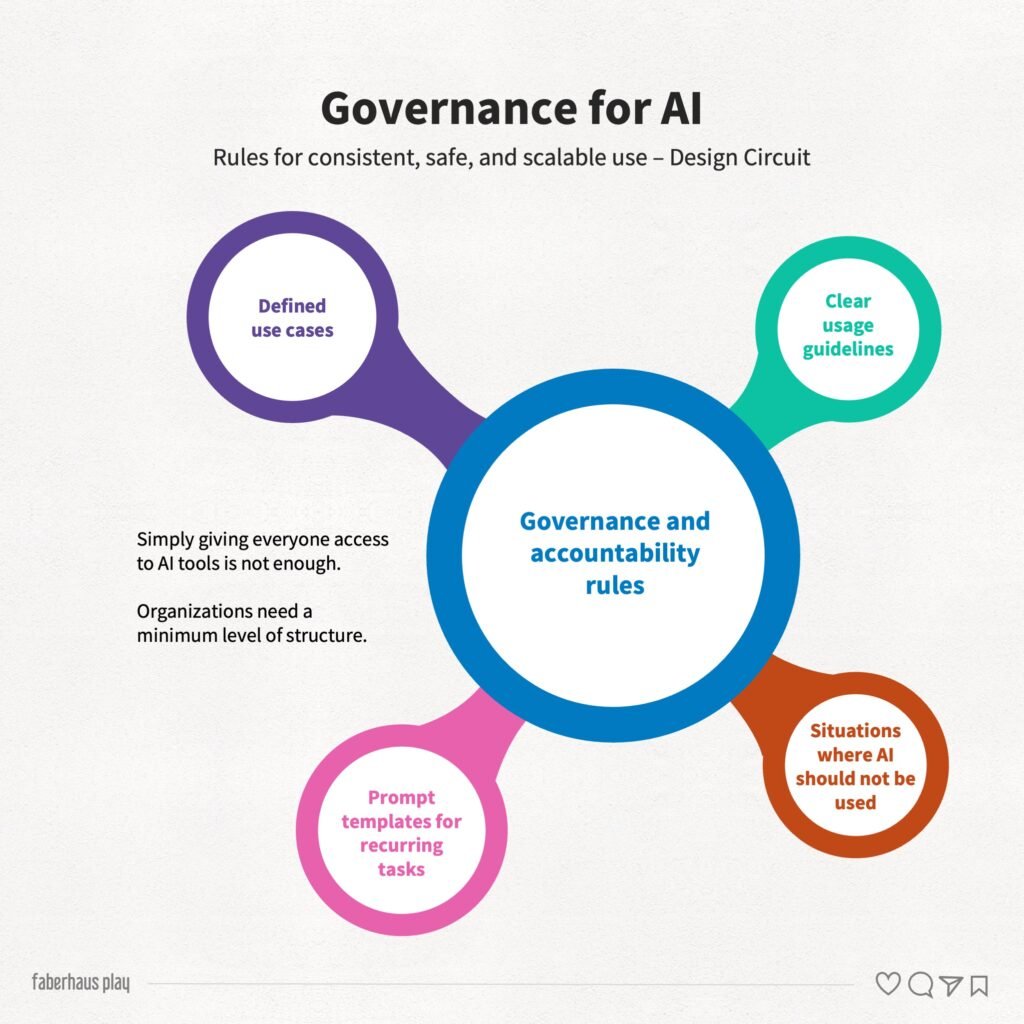
- Prompt templates for recurring tasks
- Clear usage guidelines
- Defined use cases
- Situations where AI should not be used
- Governance and accountability rules
Without these foundations, each person develops their own approach.
The result is often more noise than productivity.
Where AI Truly Shines
If there is one area where AI already demonstrates enormous potential, it is in processing large volumes of information.
Organizations accumulate research reports, interviews, metrics, documents, and operational records for years.
Much of that knowledge becomes scattered.
Difficult to access.
Difficult to connect.
Difficult to turn into action.
In this environment, AI becomes a powerful tool for identifying patterns, organizing knowledge, and accelerating analysis.
That is why periodically revisiting processes remains such a valuable practice.
Mapping journeys.
Auditing experiences.
Identifying bottlenecks.
Finding opportunities for improvement.
The difference is that we now have a much more capable tool to help us navigate complexity.
The Core Question Has Not Changed
Artificial Intelligence changes tools.
It changes speed.
It changes some ways of working.
But it does not change the most important question in product development and design:
Are we solving a real problem for people in a sustainable, scalable way and with an adequate financial return?
If AI helps us do that better, great.
If it does not, it may simply be a sophisticated solution looking for a problem.
References
APPARICIO JÚNIOR. Apparicio Júnior. Available at: https://www.apparicio.co.uk/aj/. Accessed on: June 15, 2026.
DESIGN CIRCUIT. Design Circuit. Available at: https://designcircuit.co/. Accessed on: June 15, 2026.