
Why do people choose one product instead of another?
It is rarely because of a single feature.
And it is almost never because a company says its product is “the best.”

Customers choose products that create value in ways that matter to them.
Sometimes that value is functional.
Sometimes it is emotional.
Sometimes it changes how they see themselves.
Understanding that difference is one of the reasons Bain & Company’s Elements of Value has become one of the most influential frameworks for product strategy and customer experience.
Inspired by Abraham Maslow’s hierarchy of needs, the model organizes the different ways products and services create value for customers.
More importantly, it reminds us that successful products are not simply usable.
They are meaningful.
What are the Elements of Value?
The Elements of Value framework identifies 30 different types of value customers may perceive when interacting with a product, service, or brand.
These elements are organized into four levels:
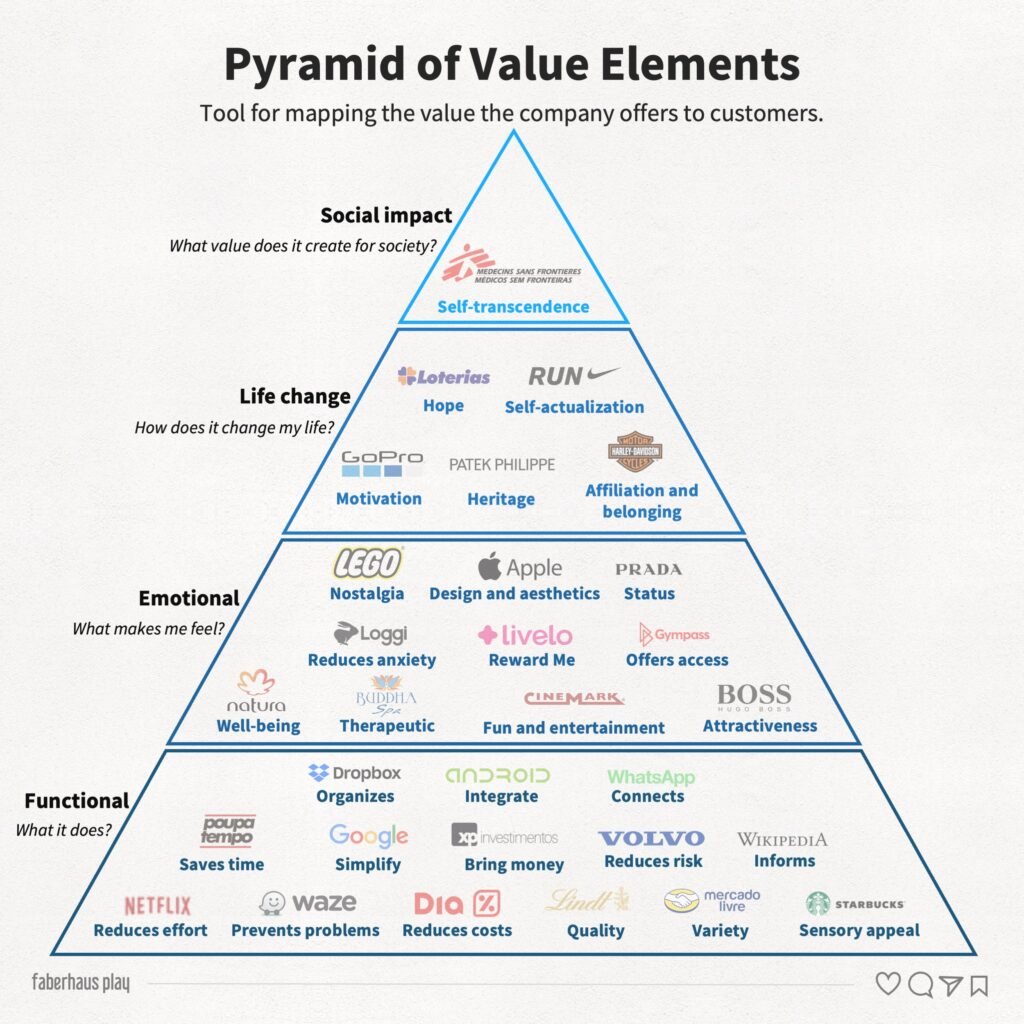
- Functional value
- Emotional value
- Life-changing value
- Social impact
The higher a product climbs within this hierarchy, the more likely it is to create long-term loyalty and differentiation.
This does not mean every product should deliver all 30 elements.
Instead, successful companies understand which elements matter most for their customers and consistently deliver them.
Functional value
The foundation of every product.
These elements help customers accomplish tasks more effectively.
Examples include:
- Saves time
- Reduces effort
- Reduces cost
- Simplifies
- Organizes
- Connects
- Reduces risk
- Improves quality
- Provides variety
- Generates income
- Informs
- Integrates
- Appeals to the senses
- Avoids problems
These are often the easiest elements to identify because they describe what a product does.
Emotional value
Products also influence how people feel.
Examples include:
- Reduces anxiety
- Rewards me
- Wellness
- Nostalgia
- Design and aesthetics
- Entertainment
- Attractiveness
- Status
- Provides access
- Therapeutic value
These elements explain why two products with similar functionality can generate completely different customer experiences.
Life-changing value
Some products go beyond solving immediate problems.
They influence identity and personal growth.
Examples include:
- Motivation
- Self-actualization
- Belonging
- Hope
- Legacy
This is where brands often become communities rather than products.
Social impact
At the top of the hierarchy sits a single element:
Self-transcendence.
These are products and organizations that help customers contribute to something larger than themselves.
Purpose-driven organizations frequently operate at this level.
Why this framework matters for Product Design
Many product teams spend enormous amounts of time discussing features.
Customers rarely do.
Customers experience value.
This changes the conversation.
Instead of asking:
“What feature should we build next?”
Product teams can ask:
- What value are we trying to create?
- Which customer need does this solve?
- Is this creating functional value or emotional value?
- Are we strengthening our positioning or simply adding complexity?
This perspective shifts roadmap discussions from outputs to outcomes.
Different industries create value differently
One of the most interesting findings from Bain’s research is that value is contextual.
The elements that matter for a banking app are different from those that matter for a streaming platform.
For example:
A smartphone might compete through:
- Quality
- Reducing effort
- Organization
- Connectivity
- Variety
A supermarket may focus on:
- Quality
- Variety
- Cost reduction
- Sensory appeal
- Rewards
Meanwhile, financial services often emphasize:
- Trust
- Security
- Access
- Reducing anxiety
There is no universal combination.
The goal is not maximizing the number of value elements.
The goal is maximizing the right ones.
The Elements of Value in the age of AI
Artificial intelligence is making products increasingly similar.
Generating interfaces is easier.
Building features is faster.
Automation is becoming expected.
As technology becomes commoditized, perceived value becomes a stronger competitive advantage.
AI may help companies build products more efficiently.
It does not automatically make those products more valuable.
Customers still evaluate experiences through the same questions:
- Does it save me time?
- Can I trust it?
- Does it reduce effort?
- Does it make my life easier?
- Does it help me achieve something meaningful?
Technology changes.
Human value evolves much more slowly.
How product teams can use this framework
One practical approach is to evaluate your product from two perspectives.
Current perception
Ask customers:
“What value does our product create today?”
Compare those answers with internal perceptions.
The differences are often revealing.
Desired perception
Then ask:
“What value do we want customers to associate with our product in the future?”
The gap between those two answers becomes an opportunity for strategy.
Design initiatives, product discovery, service improvements, and experiments can all be prioritized around closing that gap.
Designing for value
One of the biggest mistakes product teams make is assuming that value is created by adding more features.
Often, the opposite is true.
The best products create value because they remove friction.
They reduce uncertainty.
They simplify decisions.
They make people feel more confident.
Features can be copied.
Value is much harder to replicate.
That is why the Elements of Value remain one of the most useful frameworks for anyone working with Product Design, Service Design, Customer Experience, or Product Strategy.
Ultimately, customers don’t remember everything a product can do.
They remember how much value it created in their lives.
References
Almquist, E., Senior, J., & Bloch, N. (2016). The Elements of Value. Harvard Business Review.
Bain & Company. The Elements of Value. Available at: https://www.bain.com/insights/elements-of-value-interactive/