For 11 months, I tracked applications, job titles, seniority levels, work arrangements, requirements, and company responses.
The data does not offer a formula for landing a job. It does, however, reveal a market that is more fragmented, demanding, and opaque than it appears on LinkedIn.
There is a comforting explanation for people looking at unemployment from the outside: many jobs are being advertised, so anyone who has not found an opportunity must be too selective, refusing on-site work, or waiting for the perfect role.

For those searching for work every day, the experience is usually far less simple.
I have been looking for a new opportunity for about three and a half years.
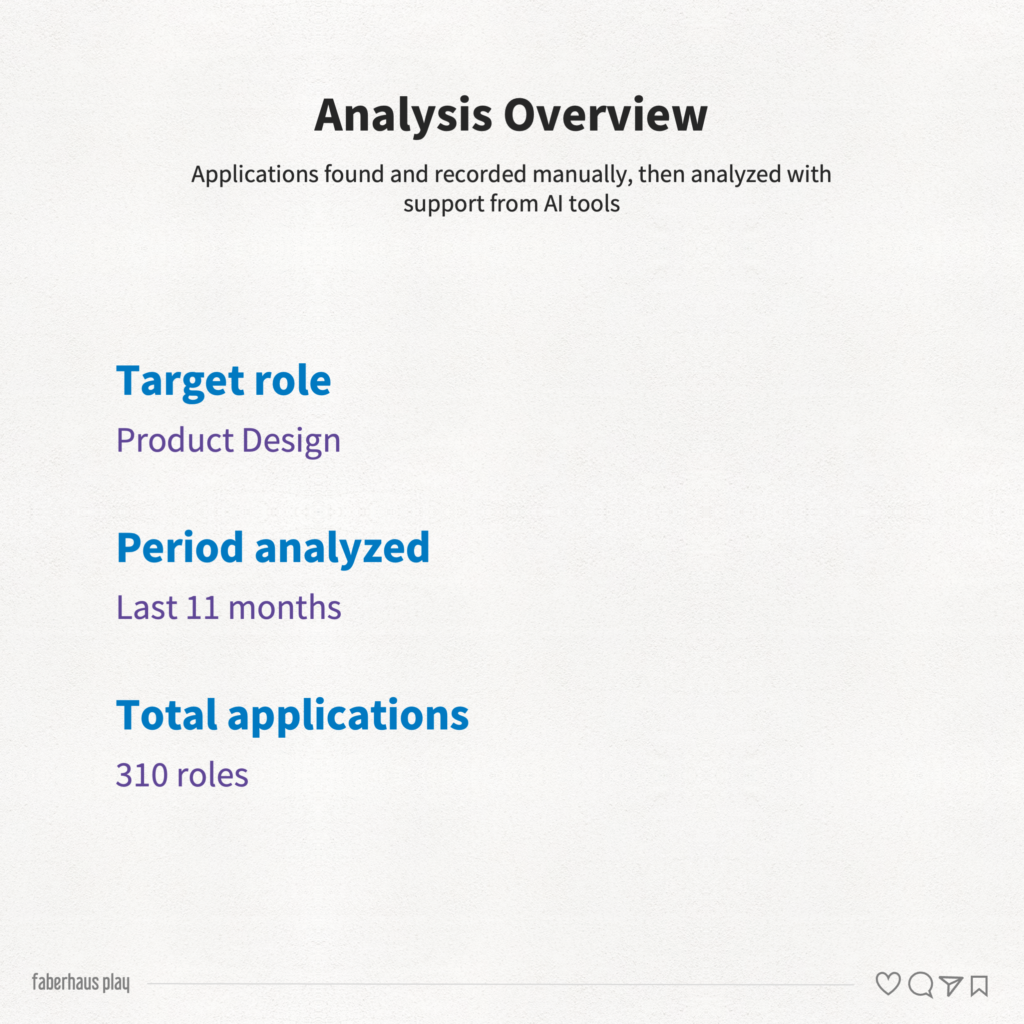
Over the past 11 months, I decided to turn part of that experience into data.
I began tracking the roles I applied for more carefully: company, title, seniority, work arrangement, job description, date, estimated match, and application status.
When I reached 310 applications, I gathered the material and did what many designers would probably do when faced with a confusing problem: I looked for patterns.
This article is the result of that analysis.
It is not intended to represent the entire industry or provide a definitive answer about the market.
It is a portrait of one person’s journey, but one documented extensively enough to raise useful questions for other Product Designers.
The goal is not to prove that the market is impossible. It is to replace isolated impressions with evidence that can help us search more effectively, prepare stronger portfolios, and interpret companies’ silence with a little more context.
How I conducted the analysis
I found, evaluated, and submitted all 310 applications manually. I did not use automation to distribute my résumé indiscriminately.
I read each title and job description, assessed how it related to my background, and only then decided whether to apply.
I later used artificial intelligence to support the analysis of the full dataset: comparing my résumé, portfolio, and experience with stated requirements, grouping similar titles, identifying recurring themes, and calculating percentage distributions.
That distinction matters.
AI helped me analyze the dataset, but it neither selected the roles nor submitted the applications.
It is also important to clarify what the match percentage means.
It is an estimate of the alignment between the public information in a job posting and my professional profile.
It does not reproduce the company’s actual ATS configuration, nor does it know internal criteria, salary range, competing candidates, referrals, or decisions made during recruitment.
Match is therefore useful for measuring apparent alignment, but it cannot explain acceptance or rejection on its own.
Another limitation is that the postings did not communicate every type of information with the same level of detail.
In some cases, the work arrangement, seniority level, or decision criteria were simply not stated.
Recurring themes were extracted from the descriptions available. They indicate textual presence, not necessarily the true weight of each requirement in a company’s decision.
The following sections present the main findings from this first analysis.
1. Most roles appeared highly aligned with my profile
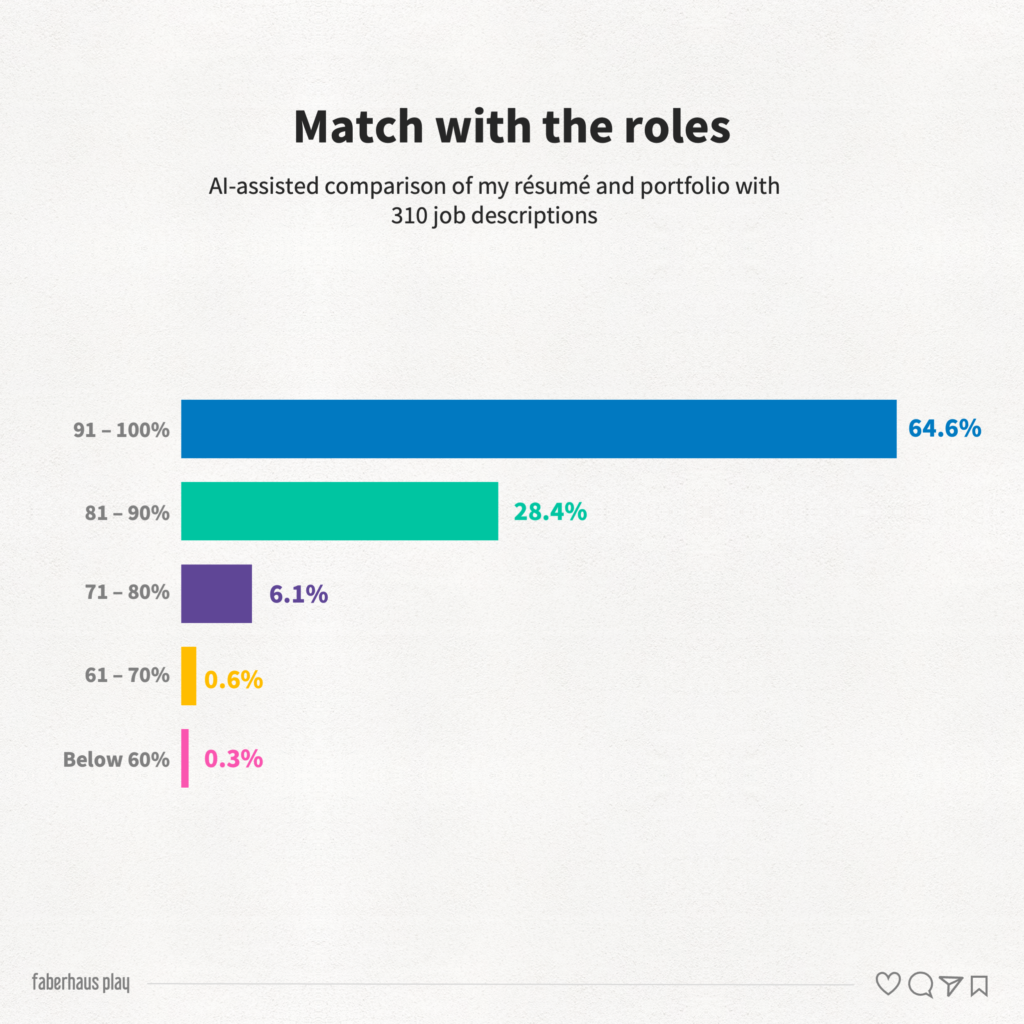
The first result confirms that I curated opportunities before applying: 64.6% of the roles fell within the 91–100% match range.
Another 28.4% were between 81% and 90%.
Combined, approximately 93% of my applications had an estimated match above 80%.
This does not mean I was the best candidate for 93% of the positions.
It means that my experience, résumé, and portfolio covered much of what was publicly stated.
That distinction matters because a job posting is only one part of the hiring system.
The decision may involve criteria that never appear in the text: budget, location, additional spoken languages, recent experience in a specific industry, team composition, salary expectations, career stage, or a preference for referred candidates.
For candidates, the implication is uncomfortable: reading a role carefully improves the quality of an application, but it does not remove the opacity of the process.
2. Product Design is one function with many names
The search for a role begins before the application, and it is fragmented from the start.
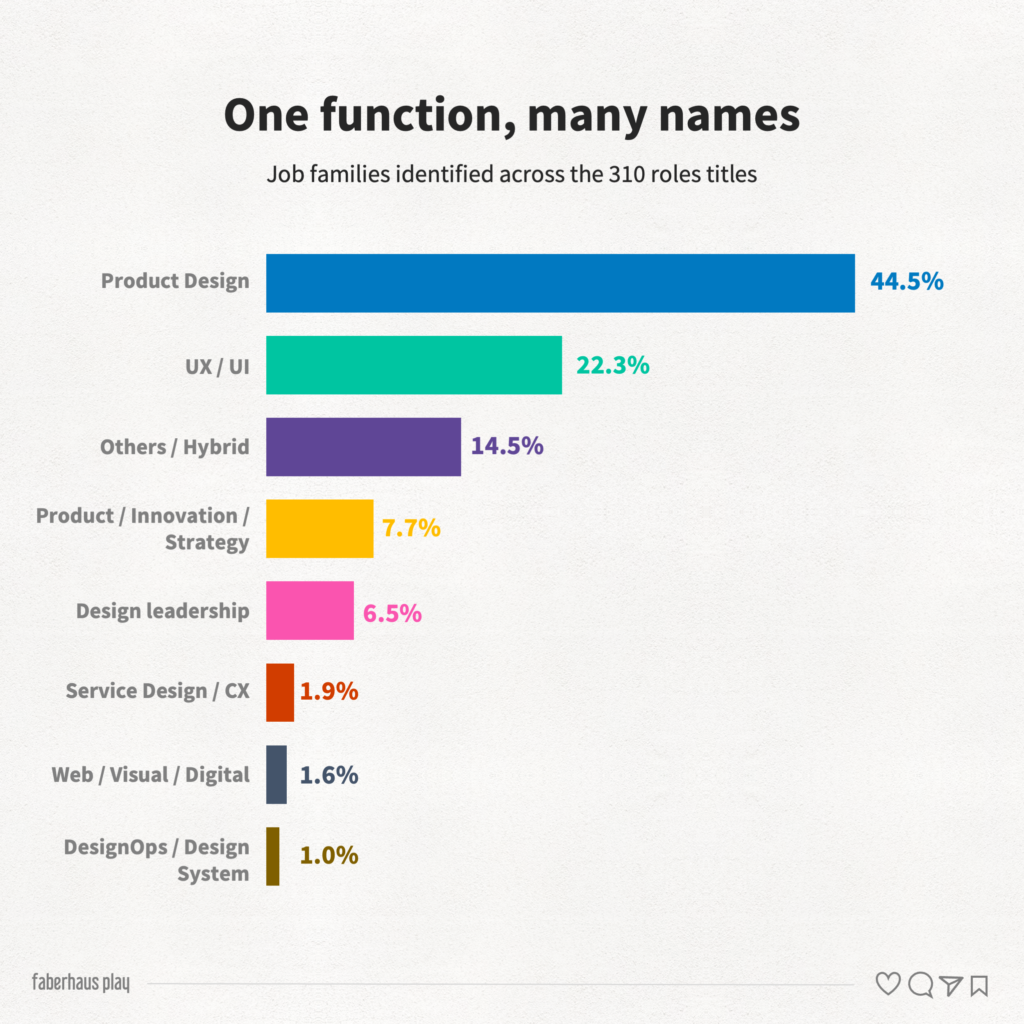
Only 44.5% of the titles used Product Design as their primary job family.
Another 22.3% used UX or UI, while 14.5% combined hybrid labels or company-specific terminology.
The dataset also included roles categorized as product, innovation, strategy, design leadership, Service Design, CX, DesignOps, Design Systems, Web Design, and Visual Design.
In practice, professionals with similar experience may be recruited as Product Designers, UX Designers, UX/UI Designers, Experience Designers, Design Leads, UX Leads, Product Design Specialists, Staff Product Designers, or even under titles closer to strategy and innovation.
This creates two problems.
The first is discoverability.
Someone searching only for “Product Designer” may miss compatible opportunities that use different terminology.
The second is comparability.
Two identical titles may conceal very different responsibilities, while two different titles may describe almost the same work.
For job seekers, the title should be an entry point, not a conclusion.
The decision needs to consider scope: the problem to be solved, level of autonomy, relationship with product and engineering, leadership expectations, and type of deliverables.
3. Seniority does not follow a clear standard either
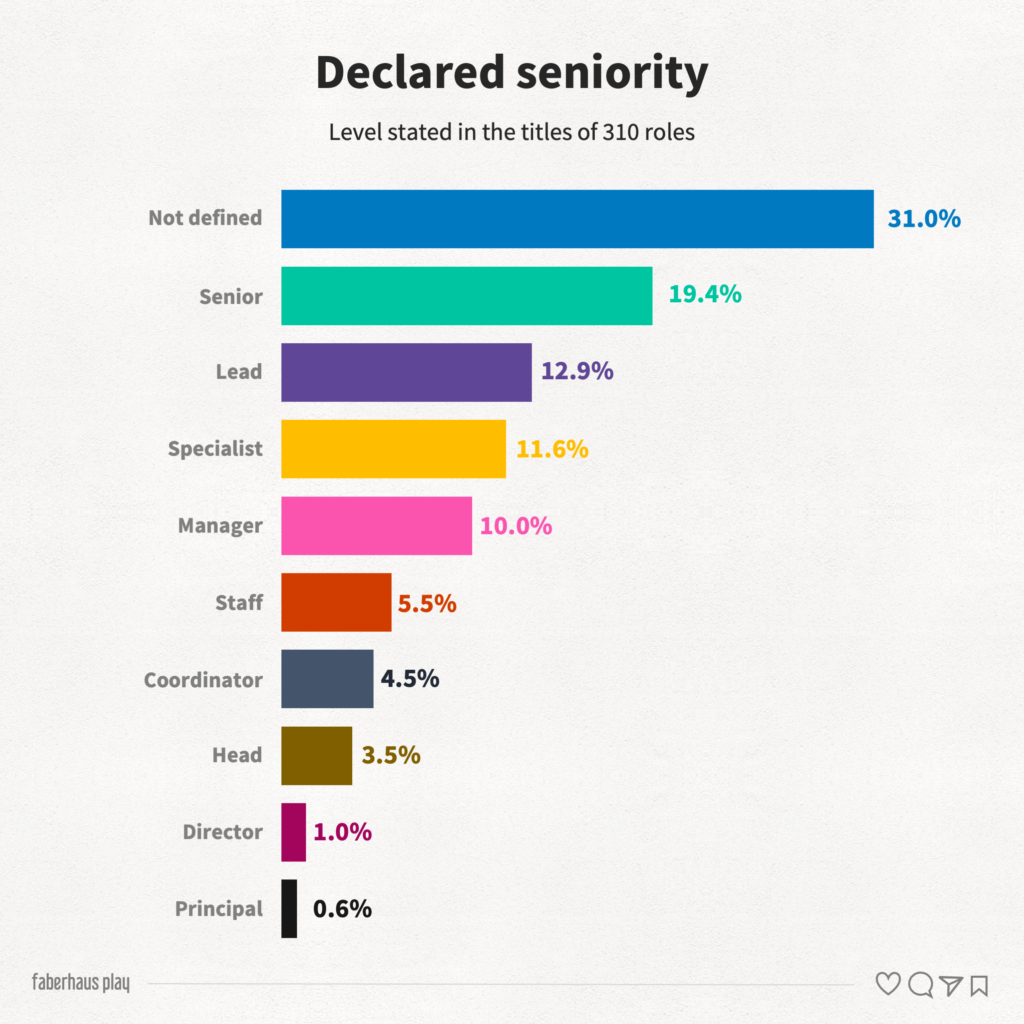
In 31% of the roles, the title did not make seniority explicit.
“Product Designer” or “UX Designer” appeared without junior, mid-level, senior, lead, or any other marker.
Among the roles that stated a level, Senior was the most common term, at 19.4%.
It was followed by Lead (12.9%), Specialist (11.6%), Manager (10%), Staff (5.5%), Coordinator (4.5%), and Head (3.5%).
Once again, the title does not tell the whole story.
Some Senior roles required organizational influence, mentoring, business perspective, and cross-functional work that other companies would associate with Lead or Staff.
“Head” can also mean anything from the primary design reference in a small team to an executive leader responsible for budgets and multiple disciplines.
This inconsistency hurts both sides.
Candidates struggle to assess scope and compensation.
Companies receive misaligned profiles because the title does not communicate expectations clearly.
A good application, then, should not answer only, “Do I have this seniority?”
A more useful question is: Have I handled problems, autonomy, and influence similar to what is described here?
4. In 62% of the roles, the work arrangement was unclear
Another finding that challenges the idea that candidates “only want remote work” is the lack of transparency about the working model.
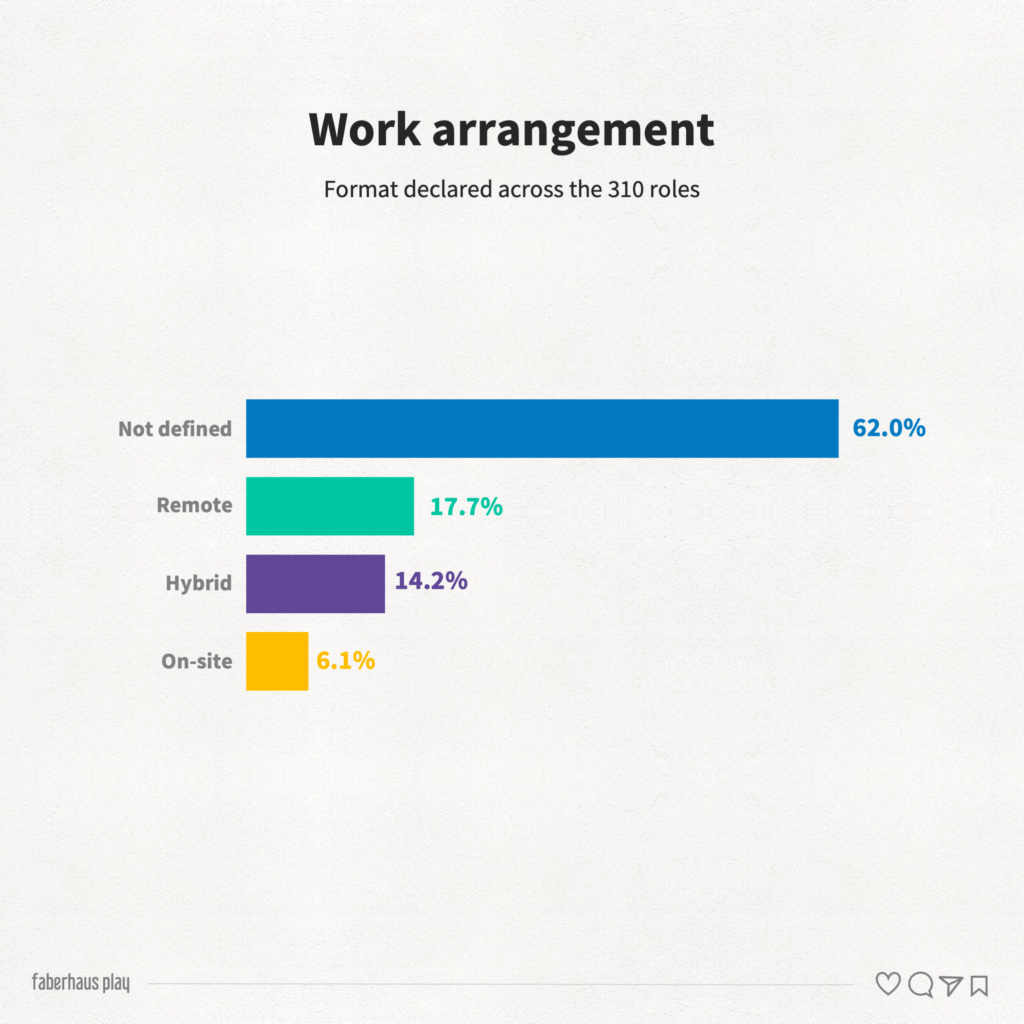
In 62% of the postings, the information provided did not make it possible to determine clearly whether the role was remote, hybrid, or on-site.
Remote work was explicitly stated in 17.7%, hybrid in 14.2%, and on-site in 6.1%.
I applied across different models whenever they were viable for my circumstances.
The most relevant point is not individual preference. It is that, in six out of ten postings in this sample, a basic fact about the working routine would only become clear after passing the initial screening.
Yet work arrangement affects commuting, relocation, family organization, accessibility, costs, and availability.
In other words, it is not a secondary benefit. It is part of the job as a product.
When a company omits this information, it transfers to the candidate the cost of starting a process without knowing whether the opportunity is practical.
5. No response was the most common outcome
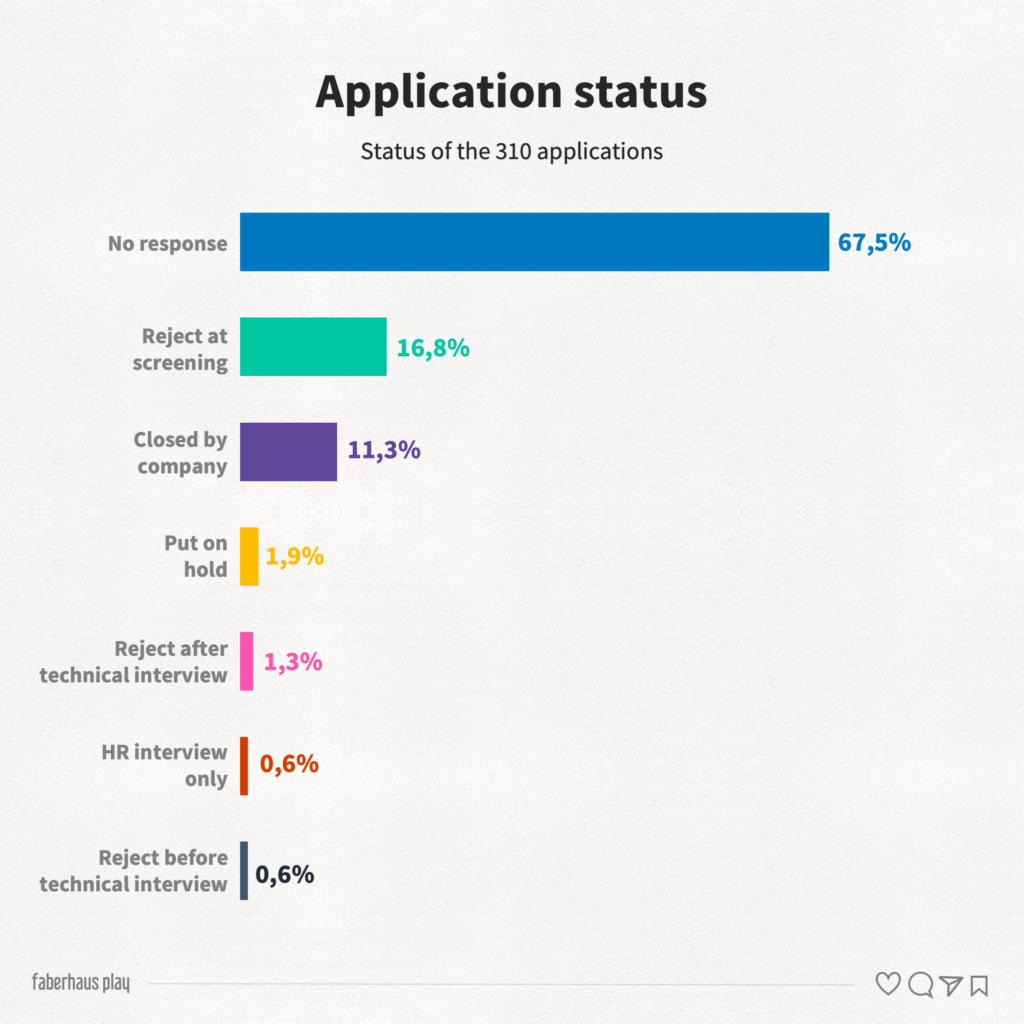
The most emotionally difficult result was also the most frequent: approximately 67.5% of applications received no response beyond the automated confirmation.
Rejections at the screening stage represented 16.8%.
Roles closed by the company represented 11.3%.
Roles put on hold accounted for 1.9%.
Interviews and rejections at later stages made up only a small share of the total.
“No response” includes both recent and older applications.
Some had been in that state for weeks; others, for many months.
The percentage should therefore not be interpreted as the definitive outcome of every role.
Even so, it reveals the communication pattern I experienced during the period.
Among screening rejections, I noticed two recurring timelines.
Some responses arrived within one to three days; others appeared three or four months after the application.
Between those extremes, many companies sent no update at all.
And a response is not the same as feedback.
Of all the rejections, only one offered a genuinely clear and actionable explanation.
It was specific, respectful, and useful—something I could actually work on.
The other responses, when they came, generally relied on generic wording: moving forward with other profiles, another candidate being a closer fit, or simply closing the process.
This creates a paradox: designers are expected to conduct research, learn continuously, and make evidence-based decisions, yet receive almost no evidence about their own experience as candidates.
6. A high match did not guarantee progress beyond screening
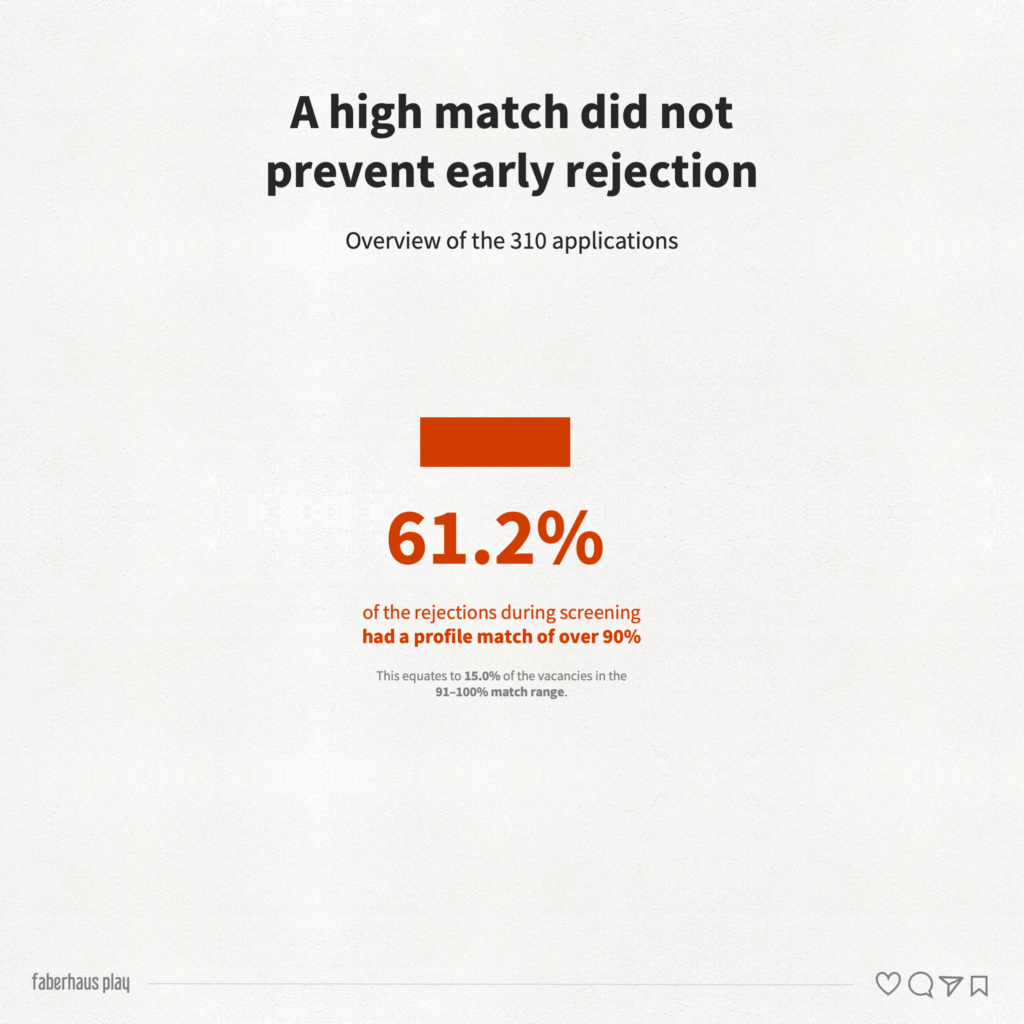
After the latest updates to the dataset, 33 of the 52 screening rejections occurred in roles with an estimated match above 90%.
That represents 63.5% of all rejections at this stage.
This may be the most important finding, and the easiest to misinterpret.
It does not prove that automated systems failed, nor that every decision was made by an ATS.
“Rejected at screening” describes a stage in the process; it does not reveal who made the decision or which criteria were used.
The data shows something else: alignment with the posting alone was not enough to produce progress.
There may be many reasons: intense competition, unpublished internal requirements, salary expectations, location, fluency in other languages, more recent experience in a particular sector, or simply candidates with an even closer fit.
The lesson for professionals is not to abandon résumé customization, but to recognize its limits.
Keyword optimization may help someone be found, but it cannot solve a system with many invisible variables on its own.
7. A small group of companies accounted for many negative responses
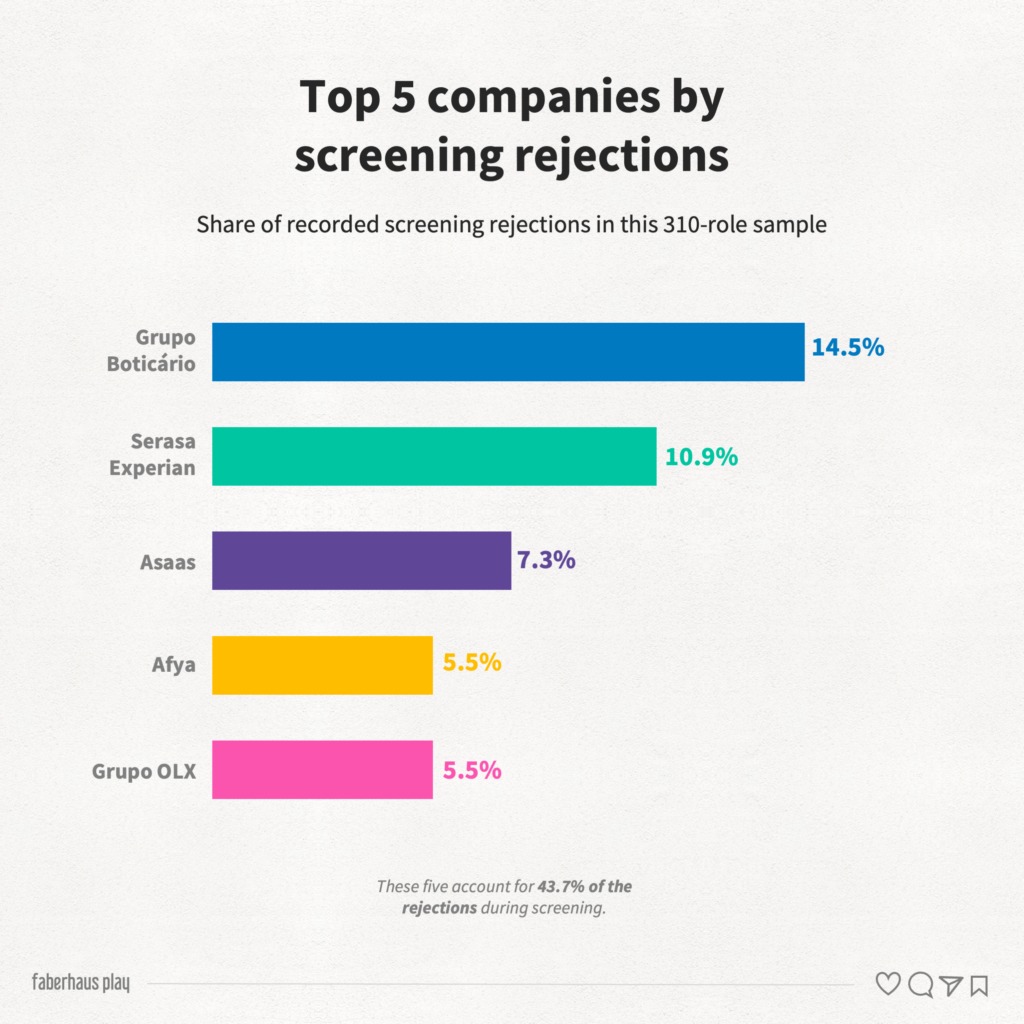
Five companies accounted for 43.7% of the screening rejections in this sample: Grupo Boticário, Serasa Experian, Asaas, Afya, and Grupo OLX.
This ranking needs to be interpreted carefully.
It does not measure the quality of these companies or their rejection rate across all candidates, and it is influenced by the number of roles I applied for at each organization.
There is even a positive interpretation: these companies opened multiple opportunities and, in many cases, communicated the end of my participation.
In a dataset marked by silence, receiving a response is already evidence of a more structured communication process.
The useful point is not to create a list of “good” and “bad” companies.
It is to recognize that the application experience varies considerably across organizations, and that candidates can benefit from tracking their own history by company, platform, and type of role.
8. The market expects far more than interface execution
Grouping the themes in the job descriptions revealed a relatively consistent picture of the Product Designer companies expect.
The most common requirement was cross-functional collaboration, present in 81.4% of the postings analyzed.
Figma, prototyping, and UI appeared in 69.6%.
Strategy and business appeared in 68%.
Communication and influence appeared in 67.6%.
Data, metrics, and experimentation appeared in 63.2%.
Research and discovery appeared in 58.1%, Design Systems in 52.2%, leadership and mentoring in 41.9%, English in 33.2%, and agile methods in 26.1%.
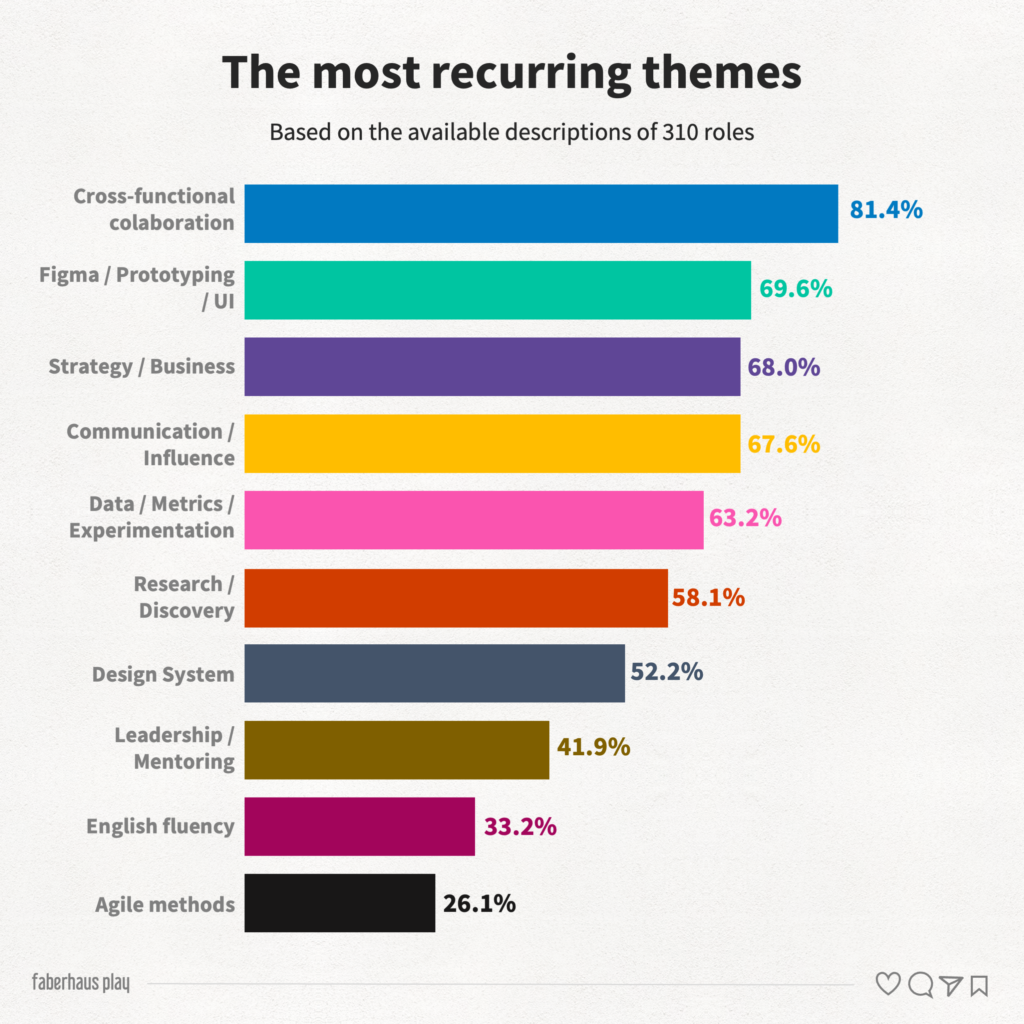
The pattern suggests a bridge-shaped profile.
Companies still expect strong craft, Figma, prototyping, and systems skills.
At the same time, they want someone who can work with engineering, influence stakeholders, understand strategy, use data, and connect experience decisions to business outcomes.
The market appears less interested in a rigid separation between “strategic UX” and “operational UI.”
The most common expectation is for professionals who can move between these layers, even when the title does not communicate that clearly.
The presence of leadership and mentoring in almost 42% of postings also shows that these skills are not limited to management roles.
Technical leadership, facilitation, influence, and raising the team’s quality bar are expected even in individual-contributor careers.
English also deserves particular attention. It appeared as a relevant requirement in roughly one-third of the roles.
At distributed companies or global organizations, English is no longer merely a résumé differentiator; it may be part of everyday collaboration.
What Product Designers can do with this data
This analysis does not produce a hiring formula, but it does suggest actions more useful than simply increasing application volume.
1. Expand your search vocabulary
Create alerts for Product Designer, UX Designer, UX/UI, Experience Designer, Service Designer, Design Lead, Staff, Specialist, and variations related to your background. Then evaluate the scope, not just the title.
2. Read seniority through the problem, not the label
Look at autonomy, influence, complexity, management, mentoring, and organizational reach. A “Senior” title may conceal a Lead role, while a “Specialist” may be primarily operational.
3. Make your portfolio show connections, not just process
The postings combine craft, research, data, business, and communication. A strong case study should show how these elements connect: the problem, the evidence that guided the decision, the constraints, how you collaborated, and the effect the solution produced.
4. Make explicit what recruiters should not have to infer
If a role asks for Design Systems, experimentation, facilitation, or B2B products, make those experiences easy to find in your résumé and portfolio. Clarity helps both people and search systems.
5. Develop communication and influence as design skills
Almost 68% of the roles mentioned this theme. Defending decisions, adapting language for different audiences, facilitating alignment, and telling a coherent story about the work are not peripheral abilities.
6. Treat English as career infrastructure
Not every role requires fluency, but the language expands the opportunity set and may determine participation in global teams.
7. Track your own funnel
Record the date, company, title, source, work arrangement, salary range when available, stage reached, and response time. After a few dozen applications, personal patterns begin to emerge: which titles lead to interviews, which platforms generate responses, and where your profile progresses further.
8. Do not turn silence into a personal diagnosis
An unanswered application contains very little information about your competence. It may reflect volume, an interrupted process, a role being put on hold, a change in priorities, or a simple communication failure. It is frustrating, but it is not feedback, and should not be treated as such.
What companies can learn as well
A few simple improvements would make the candidate experience more respectful and efficient:
- State the work arrangement and location objectively;
- Make the seniority level and expected autonomy clear;
- Distinguish required qualifications from preferred ones;
- Provide a salary range whenever possible;
- Update candidates when a role is put on hold or closed—and explain whether it was repositioned or filled;
- Provide specific feedback after interviews;
- Avoid leaving recurring postings open, or repeatedly opening and closing roles, without responding to people who have already applied;
- Use recognizable titles and reserve internal terminology for the job description.
A job posting is also an interface.
It creates expectations, guides decisions, and communicates an organization’s maturity.
Ambiguity and silence are part of the candidate experience, and, consequently, of the employer brand.
This is a snapshot, not a verdict
This dataset represents 310 roles, 11 months of detailed records, and one person’s journey.
Someone with a different level of experience, location, specialization, network, or salary expectation would probably encounter different results.
Even so, several signals deserve attention:
- Job titles are fragmented;
- Seniority is poorly standardized;
- Work arrangements are often not disclosed;
- The market expects a broad skill set;
- Company responses remain the exception.
There is also a positive signal.
Product Design does not appear as a diminished function.
The postings continue to value research, collaboration, strategy, data, systems, influence, and the ability to solve complex problems.
The discipline is changing, but it remains relevant precisely because it connects these dimensions.
For anyone currently searching, perhaps the most important conclusion is less technical: a long job search does not mean a lack of effort, laziness, or unreasonable demands.
Individual factors exist, but so does a market still maturing, with criteria that are difficult to see and experiences that vary widely.
Sharing data does not eliminate uncertainty, but it can turn isolation into conversation, and conversation into collective learning.
If you are also looking for an opportunity in Product Design, document your experience and share the patterns you find.
A single-person sample has limits.
Many documented experiences can help us better understand the market we are building, and the one in which we still want to work.
Methodological note
This analysis covers 310 applications submitted manually over 11 months.
Match percentages were estimated with the support of artificial intelligence by comparing public job information with the author’s professional profile.
They do not reproduce companies’ internal criteria and cannot establish causality for rejections.
The groupings of titles and requirements are analytical classifications; categories may overlap.
Percentages shown in the visuals may differ slightly because of rounding or reflect updates made while the dataset was consolidated.