
For years, Product Design has been taught as a sequence of methods, frameworks, and deliverables.
Research, user journeys, wireframes, prototypes, usability tests, and interfaces have become part of every Product Designer’s toolkit.
Then Artificial Intelligence arrived and changed the landscape.
Today, many of these activities can be accelerated by tools capable of generating text, interfaces, code, research summaries, and even functional prototypes in just a few minutes.
That naturally raises an important question:
If AI can accelerate so much of the work, what is the real role of a Product Designer?
In my view, the answer has less to do with producing deliverables and much more to do with building knowledge.
Because the job has never been about creating artifacts.
The job has always been about solving complex problems with multiple variables.
Before building solutions, build understanding
Even today, many projects begin with conversations like these:
“Let’s redesign the interface.”
“Let’s add AI.”
“Let’s copy what our competitor is doing.”
But there is a question that should come before any of those discussions:
Do we have enough knowledge to make this decision?
In practice, many products fail not because the solution was poorly executed, but because the team solved the wrong problem.
The issue wasn’t execution.
The issue was understanding.
Product Design is, above all, a knowledge-building process
That idea led to the Product Design Knowledge Model.
The Product Design Knowledge Model is a conceptual model that represents how Product Designers build knowledge throughout the product development process.
Its purpose is to organize a systematic approach for reducing uncertainty and risk, especially in a world where Artificial Intelligence accelerates execution but cannot replace critical thinking.
Rather than being another execution framework, the model proposes a different perspective on Product Design.
Instead of starting with solutions, it starts with understanding.
Throughout the process, different sources of information are transformed into knowledge, allowing teams to make more informed and confident decisions.
The seven stages of the model
The Product Design Knowledge Model by Heller de Paula for Faberhaus Play is organized into seven stages that can be grouped into four major moments of the design process.
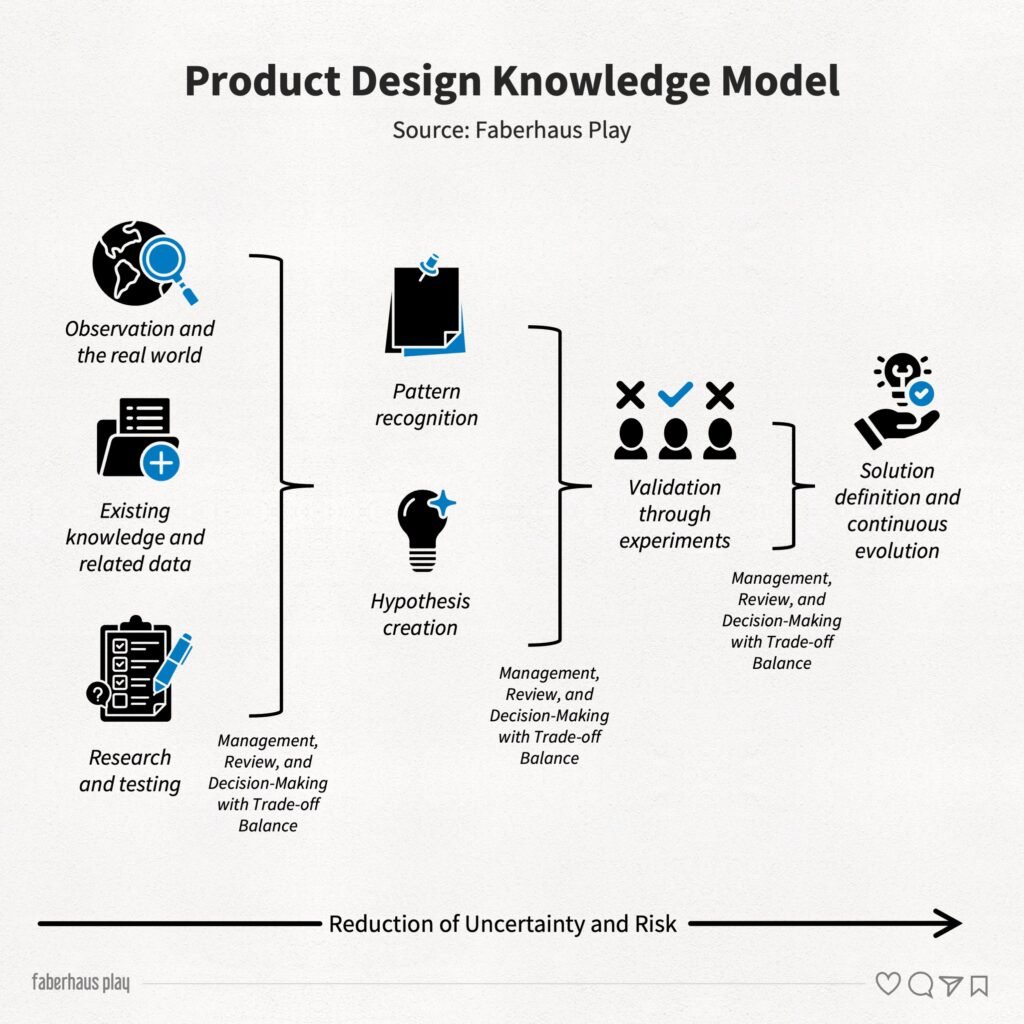
1. Observation and the real world
Before interpreting any problem, we need to understand the context in which it exists.
2. Existing knowledge and related data
Not every insight needs to be discovered from scratch. Previous research, benchmarks, books, market data, and existing evidence all help reduce uncertainty before new research even begins.
3. Research and testing
This is where assumptions are confronted with evidence through interviews, usability testing, and other research methods.
4. Pattern recognition
Individual observations rarely lead to good decisions. The real value comes from identifying relationships, recurring behaviors, and meaningful patterns.
5. Hypothesis creation
Patterns become hypotheses that can be tested and challenged.
6. Validation through experiments
Before investing significant time and resources, experiments help reduce uncertainty and validate assumptions.
7. Solution definition and continuous evolution
Only after building enough knowledge does the team move toward implementation, measurement, and continuous improvement.
Where does Artificial Intelligence fit?
This is probably the most frequently question.
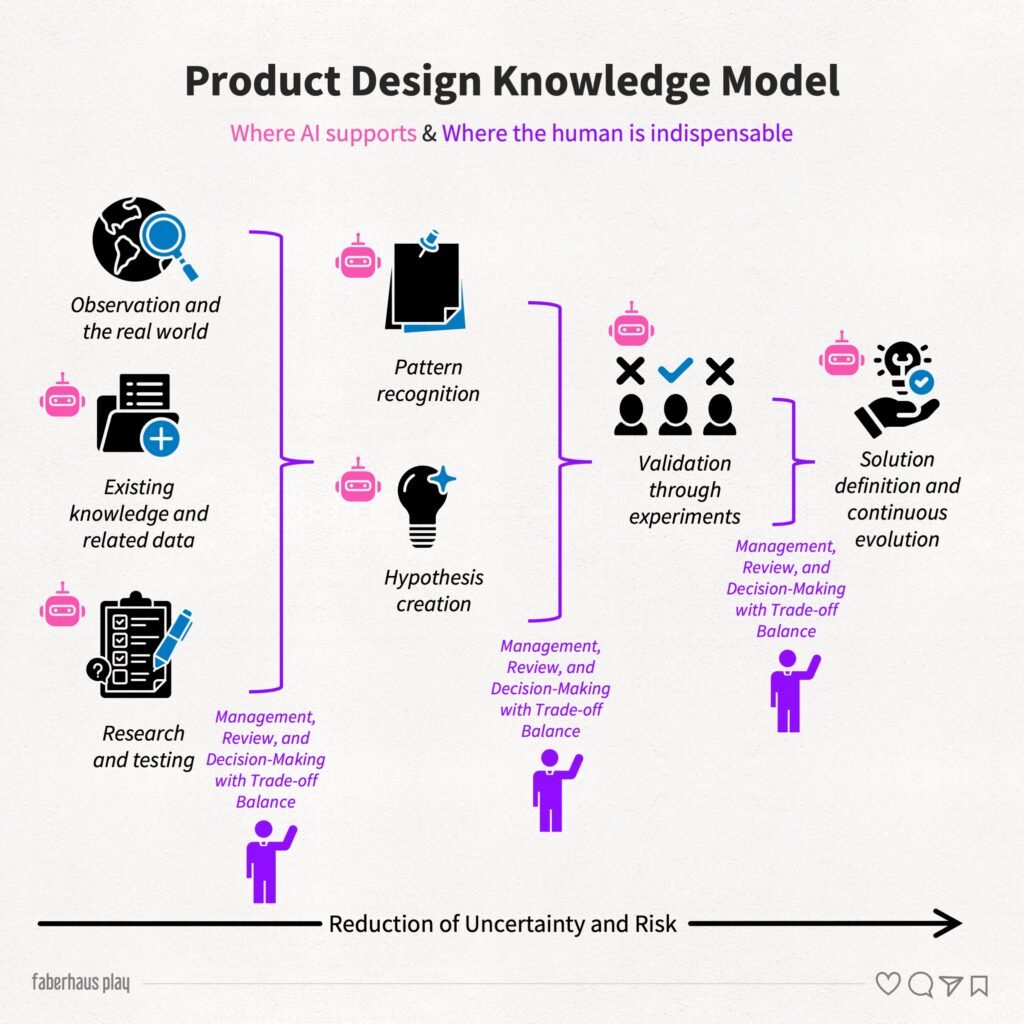
AI can support almost every stage of the process.
It can summarize documents, organize research, identify patterns, generate hypotheses, accelerate prototyping, and analyze metrics.
But there is an important distinction.
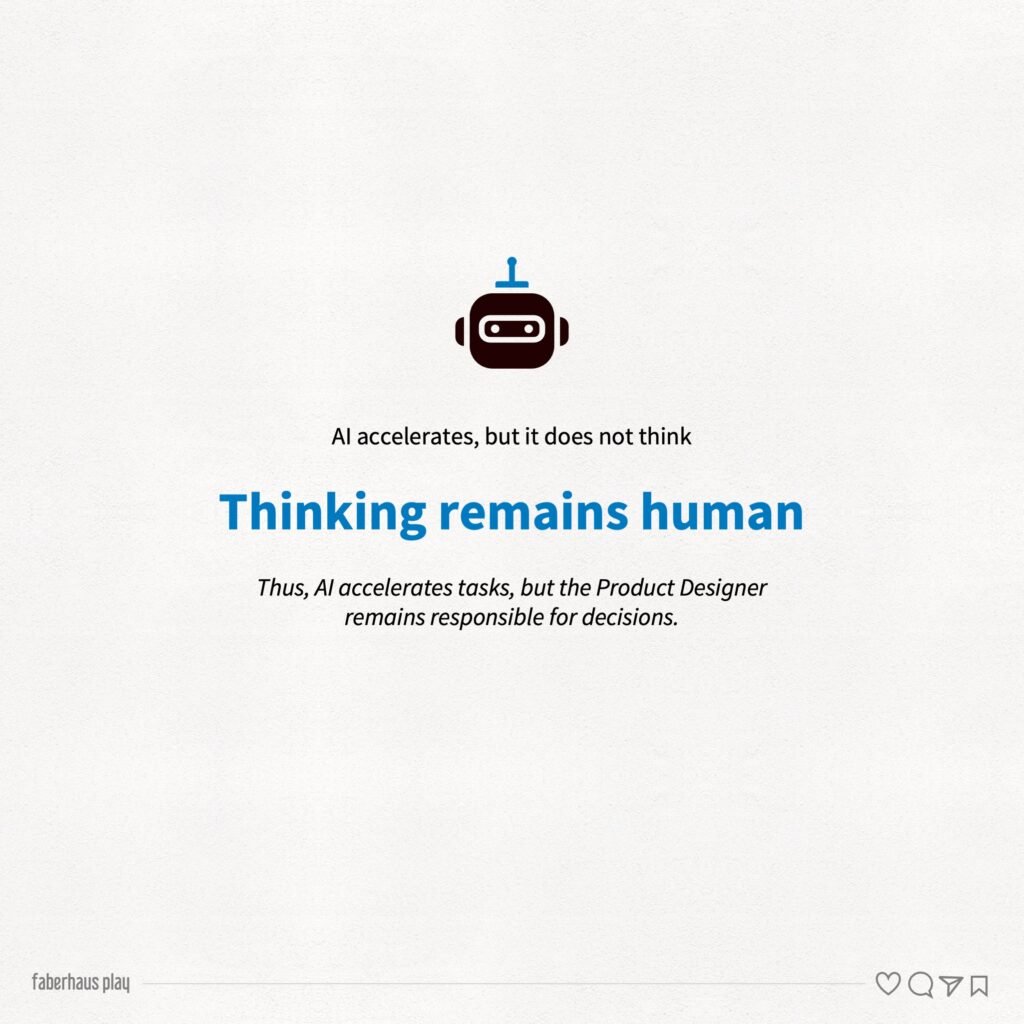
AI accelerates tasks. It does not replace decisions.
Interpreting evidence, balancing the needs of people, business, and technology, and making trade-off decisions remain fundamentally human responsibilities.
For that reason, every transition between stages in the Product Design Knowledge Model is guided by human judgment—not by automation.
The skills that become even more valuable
As execution becomes increasingly automated, other capabilities become even more important.
- Asking better questions.
- Building knowledge.
- Reducing uncertainty.
- Interpreting evidence.
- Making informed decisions.
Perhaps these have always been the true responsibilities of a Product Designer.
Artificial Intelligence has simply made them impossible to ignore.
Want to explore the model in depth?
This article introduces the core ideas behind the Product Design Knowledge Model, but it only scratches the surface.
In the masterclass “The Product Designer in the Age of AI: From Problem to Solution Without Outsourcing Your Thinking“ I walk through each of the seven stages using a complete case study, showing how Artificial Intelligence can support the process without replacing the Product Designer’s critical thinking.
If you’re looking for a more structured way to make decisions, reduce uncertainty, and integrate AI into your Product Design process, this masterclass was created for exactly that purpose.
References
The Product Designer in the Age of AI: From Problem to Solution Without Outsourcing Your Thinking. Available at: https://faberhausplay.com.br/product-design-knowledge-model. Accessed on the publication date.