
Many teams move too quickly into execution.
They start designing screens, building features, or discussing solutions before they truly understand:
- The problem
- The user
- The context
- The risks involved
That’s one of the main reasons so many products become expensive guesses.

This is where design sprint becomes valuable.
Not because it magically creates innovation, but because it creates structured collaboration around solving the right problem before investing too much time, money, and energy into execution.
What is a design sprint?
A design sprint is a type of sprint — usually inspired by agile methodologies — focused on creating and validating a design solution for a specific challenge.
It happens within a predefined period, often around one week, where teams use different methods to:
- Understand users
- Analyze the business context
- Explore ideas
- Prototype solutions
- Test assumptions quickly
The goal is not perfection, is learning fast enough to reduce uncertainty before moving forward and reducing uncertainty around the project.
Design sprint vs design thinking
This is where many people get confused.
Design sprint and design thinking are not the same thing.
A design sprint is a structured process with:
- A defined timeline
- Predefined stages
- Selected methodologies
- A multidisciplinary team
- A clearly framed challenge
One well-known example is the 5-step sprint model popularized by organizations such as Google Ventures and adapted by consulting firms like McKinsey.
The process usually includes stages like:
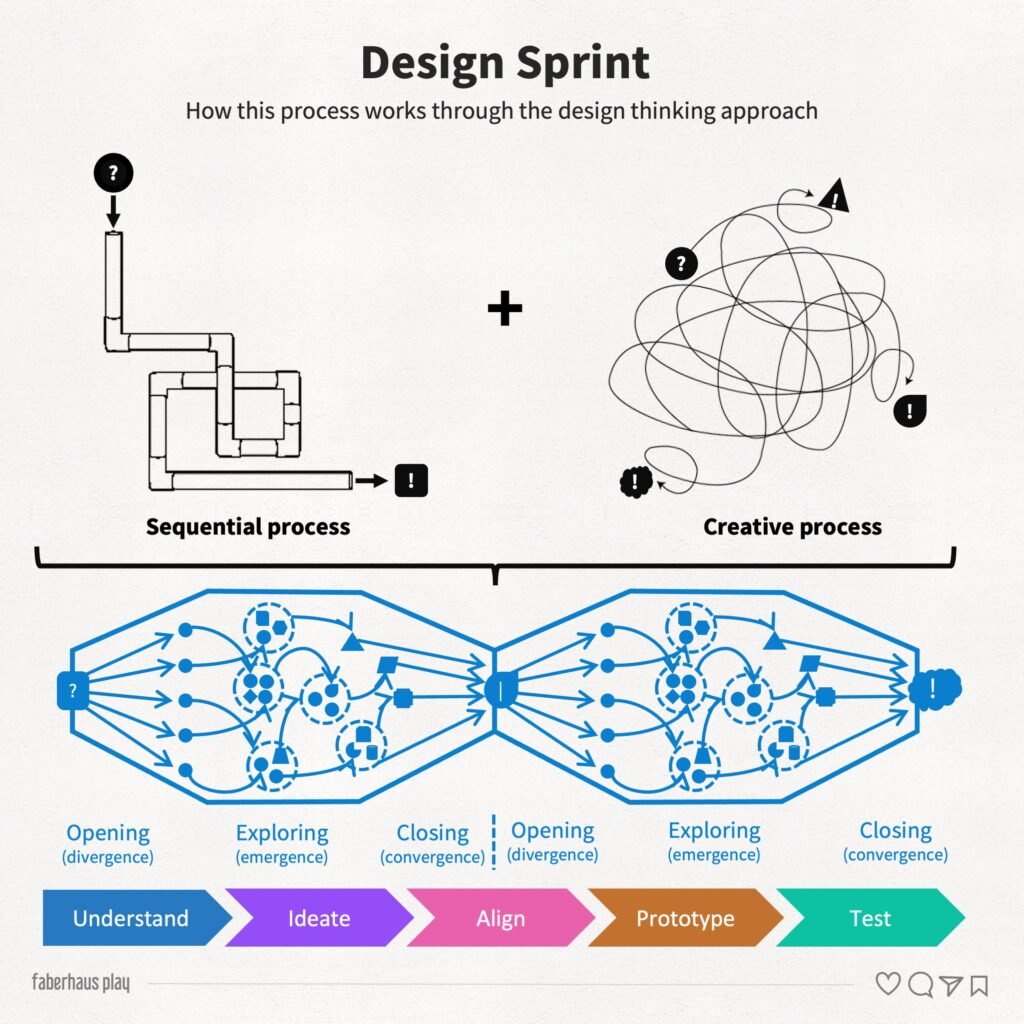
- Understand
Explore the context, the users, and the challenge. - Ideate
Generate as many ideas and alternatives as possible. - Align
Discuss ideas and select the ones with the greatest potential. - Prototype
Create prototypes to make ideas tangible. - Test
Test solutions with real users and collect feedback.
Design thinking, on the other hand, is broader.
It refers to the mindset and approach designers use to solve problems.
One of the most famous representations of the design thinking is the Double Diamond model created by the Design Council in 2005.
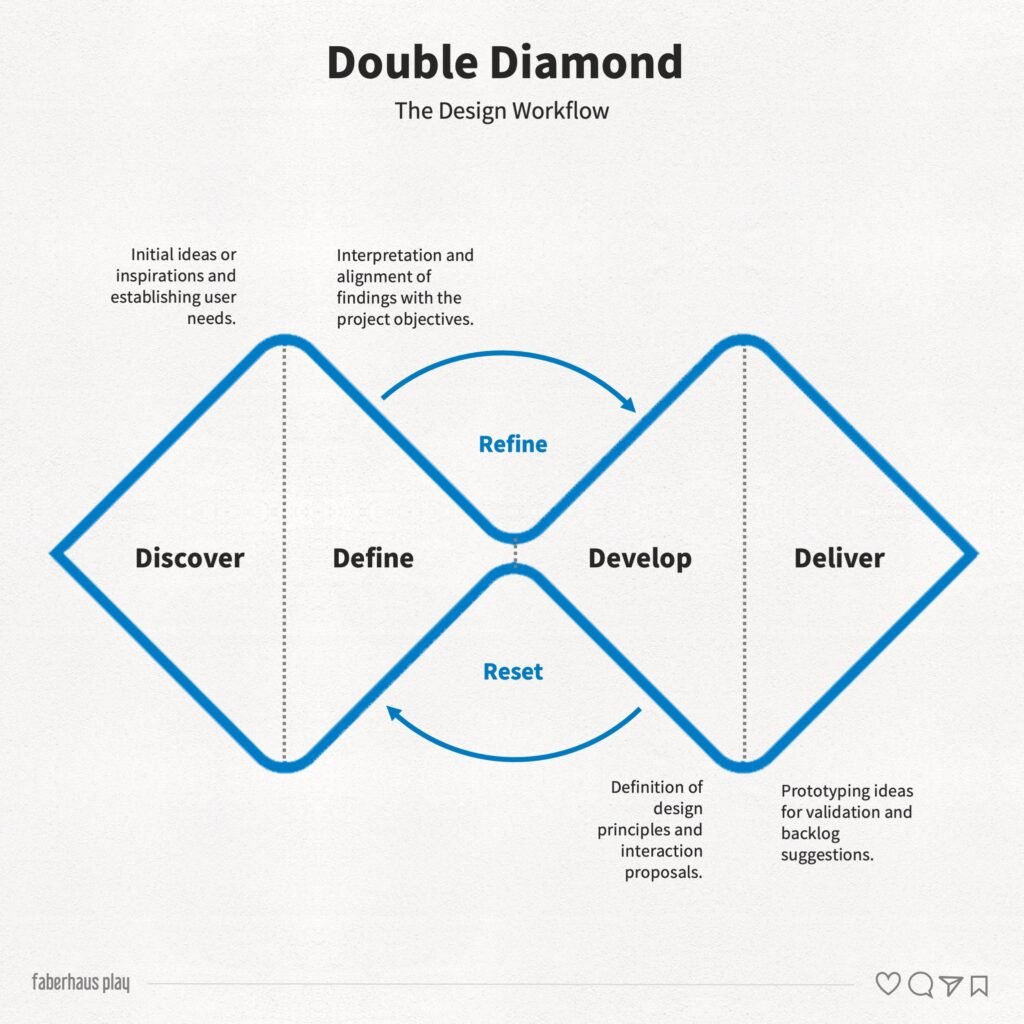
In simple terms:
- Design thinking is the way of approaching problems.
- Design sprint is one structured way to apply that approach within a limited timeframe.
Why design sprint became so popular
Modern organizations operate under constant pressure:
- Faster delivery
- Shorter deadlines
- Lower risk
- Faster validation
- Continuous innovation
At the same time, product complexity keeps increasing.
This creates a dangerous situation: Teams feel pressure to move fast while still dealing with uncertainty.
Design sprint emerged to compress learning into a shorter collaborative cycle.
Instead of debating ideas endlessly, teams create prototypes and test them quickly.
That changes the conversation from:
“What do we think?”
to:
“What did we learn?”
That shift alone can save companies enormous amounts of time and money.
The real value of design sprint
Many people think the biggest value of a design sprint is the prototype, but not necessarily.
The biggest value is alignment.
A good design sprint helps teams:
- Align expectations
- Reveal assumptions
- Reduce ambiguity
- Create shared understanding
- Make decisions together
And in multidisciplinary environments, this matters a lot.
Because most product problems are not caused by lack of intelligence.
They are caused by:
- Misalignment
- Communication gaps
- Conflicting priorities
- Unclear understanding of the problem
Design sprint helps expose those tensions early.
Core rules of a design sprint
Every sprint can have its own rules depending on the team and context.
What matters is that the rules are:
- Clear
- Shared
- Agreed upon
- Respected by everyone involved
Still, most design sprints depend on four fundamental principles:
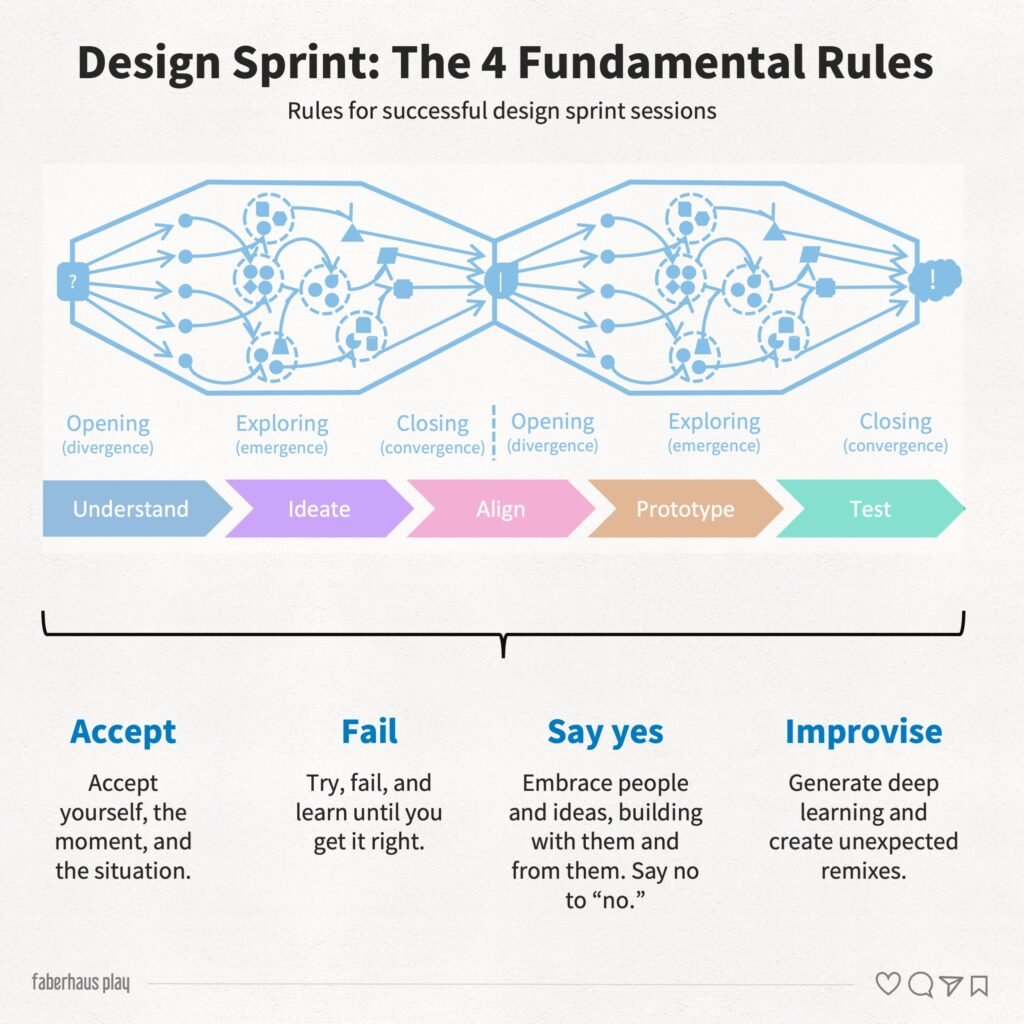
1. Accept
Accept yourself, the situation, and the current moment.
Collaboration becomes much harder when people spend more energy resisting reality than understanding it.
2. Fail
Try, fail, learn, improve.
Design sprint works because it creates space for experimentation before expensive implementation happens.
3. Say yes
Build on ideas instead of shutting them down immediately.
This does not mean accepting every idea blindly.
It means allowing exploration before judgment.
Innovation dies quickly in environments where every idea is immediately attacked.
4. Improvise
Create unexpected combinations, explore alternatives, and generate deeper learning through experimentation.
Sometimes the best solutions emerge from unlikely connections.
There is more than one design sprint format
There is no single universal format.
Different organizations adapt the process according to:
- Team maturity
- Business context
- Time constraints
- Project goals
Some sprints focus more on:
- Concept creation
- Service design
- Business strategy
- Visual design
- Product validation
One of the most famous versions is the Google Design Sprint.
Another example is the Concept Sprint developed by McKinsey & Company.
But even the structure change, the core idea remains the same: collaborative learning under time constraints.
Common design sprint deliverables
Sprint deliverables can vary significantly depending on the challenge and objectives.
Some common outputs include:
- Business model canvases
- Concept backlogs
- User flows
- Layouts
- Prototypes
- Service concepts
- Business models
- Validated ideas
- Tested user experiences.
But again: the most valuable deliverable is often not the artifact itself; it’s the clarity the team gains during the process.
When to use a design sprint
Design sprint works best when:
- The challenge is collaborative
- Uncertainty exists
- Alignment is needed
- Rapid learning is valuable
In general, it is especially useful for:
- Accelerating promising ideas
- Refining concepts
- Validating hypotheses
- Exploring opportunities
- Reducing uncertainty
- Aligning multidisciplinary teams
It is particularly powerful in:
- UX
- Service design
- Product discovery
- Innovation
- Early-stage product thinking
When not to use a design sprint
Design sprint is not a magic solution for every situation.
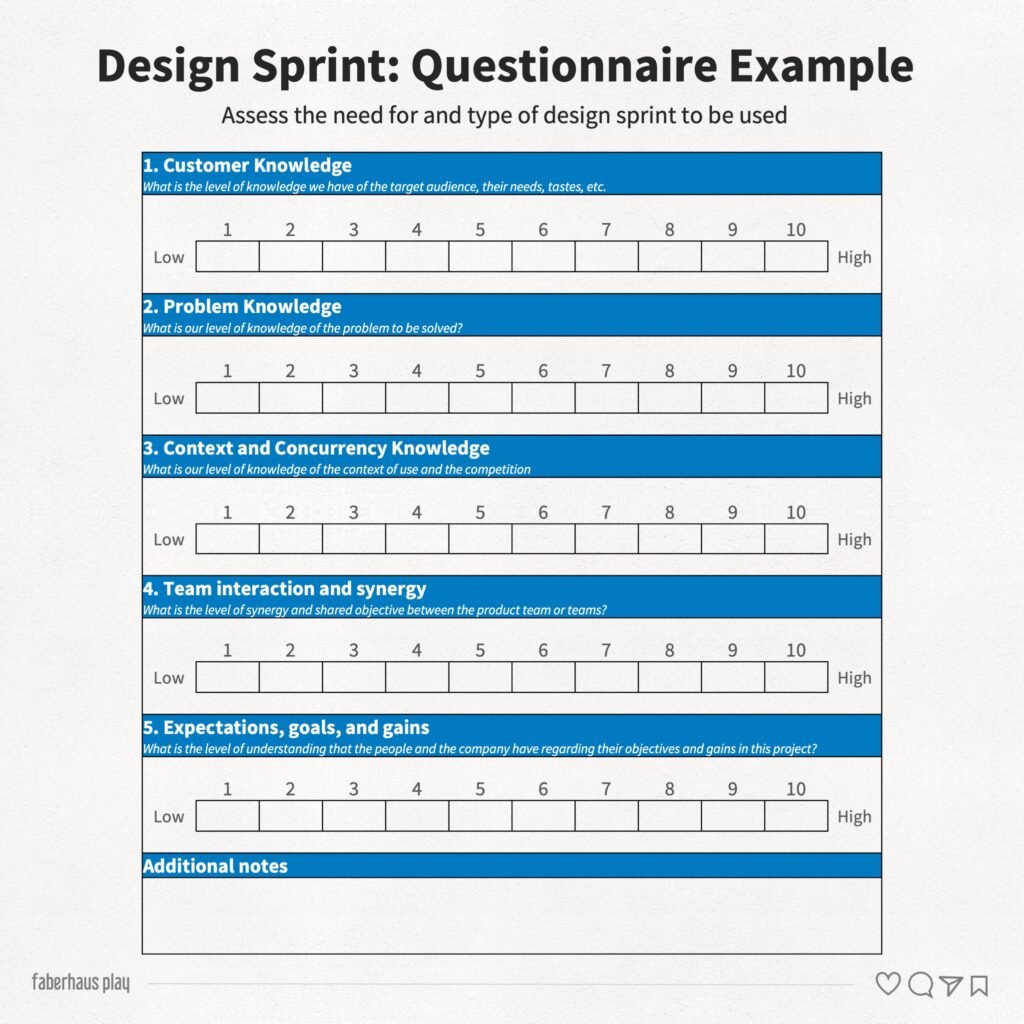
A sprint usually aims to answer two major questions:
- What should we build to solve the user’s problem?
- How should we deliver that solution effectively?
If both answers are already clear, running a sprint may be unnecessary.
Design sprint is also not ideal when:
- The scope is extremely narrow
- The scope is too broad
- The team lacks even basic knowledge about the domain
When the subject is completely unfamiliar, deeper research may be more valuable than accelerated collaboration.
Sometimes the best decision is not speeding up.
It’s slowing down enough to understand the problem properly first.
References
McKinsey & Company. Retrieved from
McKinsey concept sprint article
Design Council. Retrieved from
Design Council website
Márcio Ballas. Retrieved from
Márcio Ballas website