
The CSD Matrix — Certainties, Suppositions, and Doubts — is a simple tool used to organize important points of attention in a project and help teams decide where and how to start.
It works by creating three main columns:
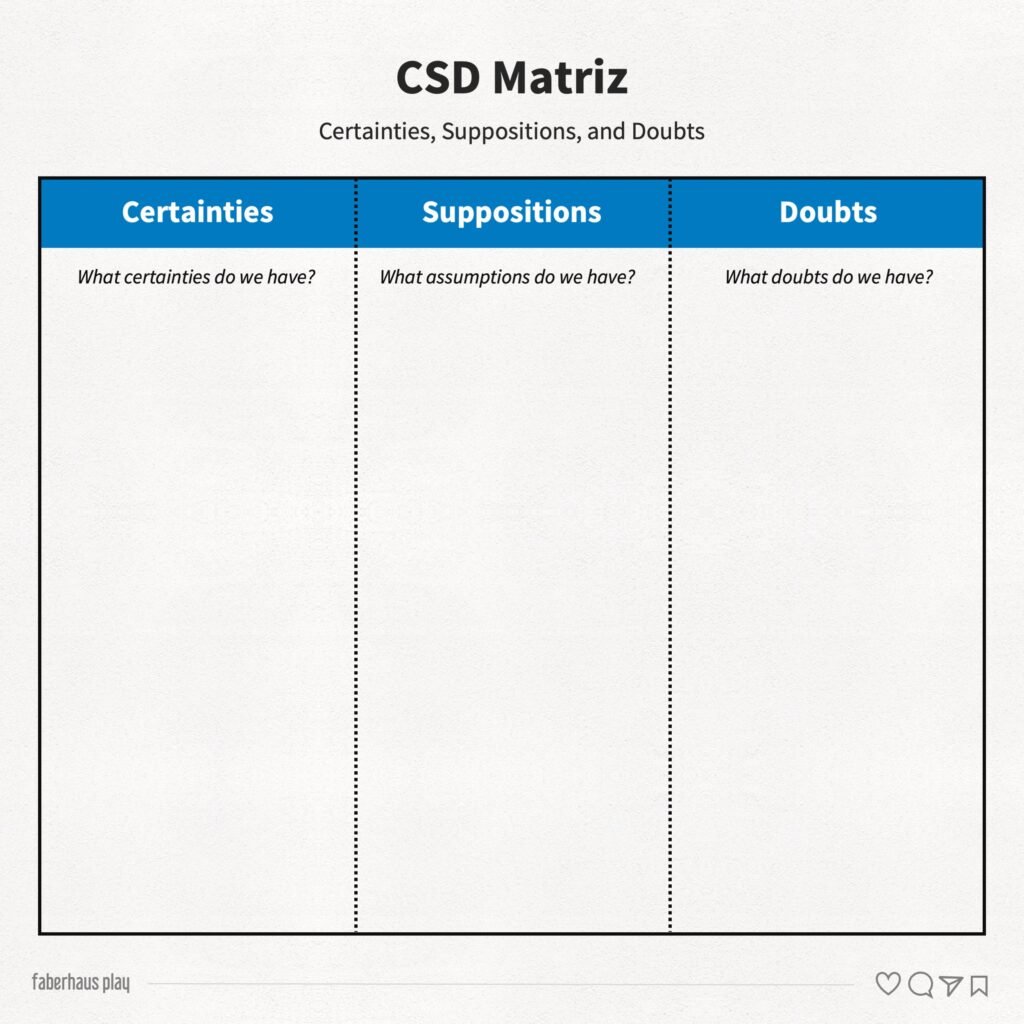
- Certainties
- Suppositions
- Doubts
In each column, the team writes what they already know, what they believe might be true, and what still needs to be investigated.

The notes can cover any aspect of the project, such as:
- Business goals
- User needs
- Technical constraints
- Product risks
- Stakeholder expectations
- Research questions
In practice, the CSD matrix becomes a snapshot of what the team already knows and what still needs to be discovered, and that is exactly why it is useful.
Most projects do not begin with total clarity.
They begin with partial information, different perspectives, hidden assumptions, and unanswered questions.
The CSD matrix helps make all that visible.
What the CSD matrix is usually used for
The CSD matrix is commonly used to map what the team knows about a project and align knowledge among team members.
Usually, each person writes individual notes on sticky notes, using one idea per sticky note.
Then everyone shares what they wrote and places each note in the appropriate column:
- Certainty
- Suppositions
- Doubt
This process helps the team reveal what is already clear, what is still uncertain, and what needs to be validated.
The more multidisciplinary the team is, the richer the matrix becomes.
A designer may bring questions about the user experience.
A product manager may bring assumptions about business value.
A developer may bring technical constraints.
A researcher may bring doubts about user behavior.
A stakeholder may bring expectations, risks, or strategic priorities.
Together, these perspectives create a broader and more useful understanding of the project.
For very large projects, the team can also create separate CSD matrices for specific themes, such as:
- Business
- Technology
- Users
- Operations
- Communication
- Service experience
This helps prevent the conversation from becoming too broad or confusing.
When the CSD matrix is usually used
The CSD matrix is very helpful at the very beginning of a project.
At that moment, it helps the team understand what is already known about the challenge and what deserves attention first.
This is especially useful because early alignment can influence:
- The first research activities
- The project framing
- The discovery plan
- The problem statement
- The first decisions the team needs to make
In my recent experience, I have used this matrix as the first activity in design sprint planning meetings for example.
It helps refine the challenge the team will work on.
By making certainties, suppositions, and doubts visible, the team can better identify the most relevant pain point to address first.
However, the matrix does not need to be used only at the start.
It can also be useful during the project to:
- Define next steps
- Review progress
- Update what has been learned
- Turn doubts into certainties
- Challenge old suppositions
- Keep the team aware of what is happening
In that sense, the CSD matrix can remain active throughout the project as a living picture of the team’s understanding.
Example step-by-step process
Step 1
Each person individually writes sticky notes about their certainties, suppositions, and doubts regarding the selected topic.
One idea per sticky note.
This keeps the information easier to organize and discuss.
Step 2
Each person presents their notes and places them on a board with three columns:
- Certainties
- Suppositions
- Doubts
This is where individual knowledge becomes shared knowledge.
Step 3
The group discusses the notes and selects up to three main points to work on.
These points, or a combination of them, can even become the challenge to be explored in a design sprint.
Why this matters for design and product teams
The CSD matrix is powerful because it exposes something many teams ignore:
Different people often start the same project with different versions of reality.
One person may treat something as obvious, and another may see it as risky.
Someone else may not even know it exists and that is where many project problems begin.
Not in execution, but in misalignment.
For design, UX, service design, and product teams, the CSD matrix helps create a shared starting point before jumping into solutions.
And this matters because good design does not start with screens. It starts with better questions.