Group and meeting facilitation is an essential practice that promotes collaboration, engagement, and collective problem-solving.
Effective facilitation helps teams:
- Stay focused on shared goals
- Create productive discussions
- Encourage participation
- Ensure people feel heard during the process
To achieve this, facilitators use techniques and structured methods that guide teams through conversations, decision-making, and collaboration.
In design and innovation environments, practices such as co-creation workshops and design sprints have become especially valuable because they help teams solve complex problems together.
Below are some examples where facilitation plays an important role.
Co-creation
Co-creation is a collaborative process where different stakeholders — such as team members, clients, users, and business areas — work together to create solutions, products, or services.
In this context, the facilitator helps:
- Guide communication
- Encourage creativity
- Structure collaboration
- Help the group reach alignment around ideas and solutions
The facilitator is not responsible for having all the answers, their role is to help the group think better together.
Design sprint
A design sprint is a methodology originally developed by Google Ventures to help teams solve complex problems in a short amount of time, usually within a week.
During a design sprint, the facilitator guides the team through structured activities such as:
- Problem mapping
- Ideation
- Prototyping
- Testing solutions
The facilitator plays a critical role in:
- Maintaining focus
- Managing time
- Organizing discussions
- Helping the team move toward decisions without losing momentum
Without facilitation, many workshops easily become:
- Endless discussions
- Unclear priorities
- Unproductive meetings
Why facilitation matters in modern work environments
As organizations become more collaborative and multidisciplinary, facilitation becomes increasingly important.
Today, many teams depend on:
- Cross-functional collaboration
- Shared decision-making
- Remote communication
- Collective alignment
And different people bring:
- Different goals
- Different communication styles
- Different expectations
- Different interpretations of the same problem
Facilitation helps create enough structure for collaboration to happen effectively.
The benefits of facilitation in the workplace
Some of the benefits of facilitation are:
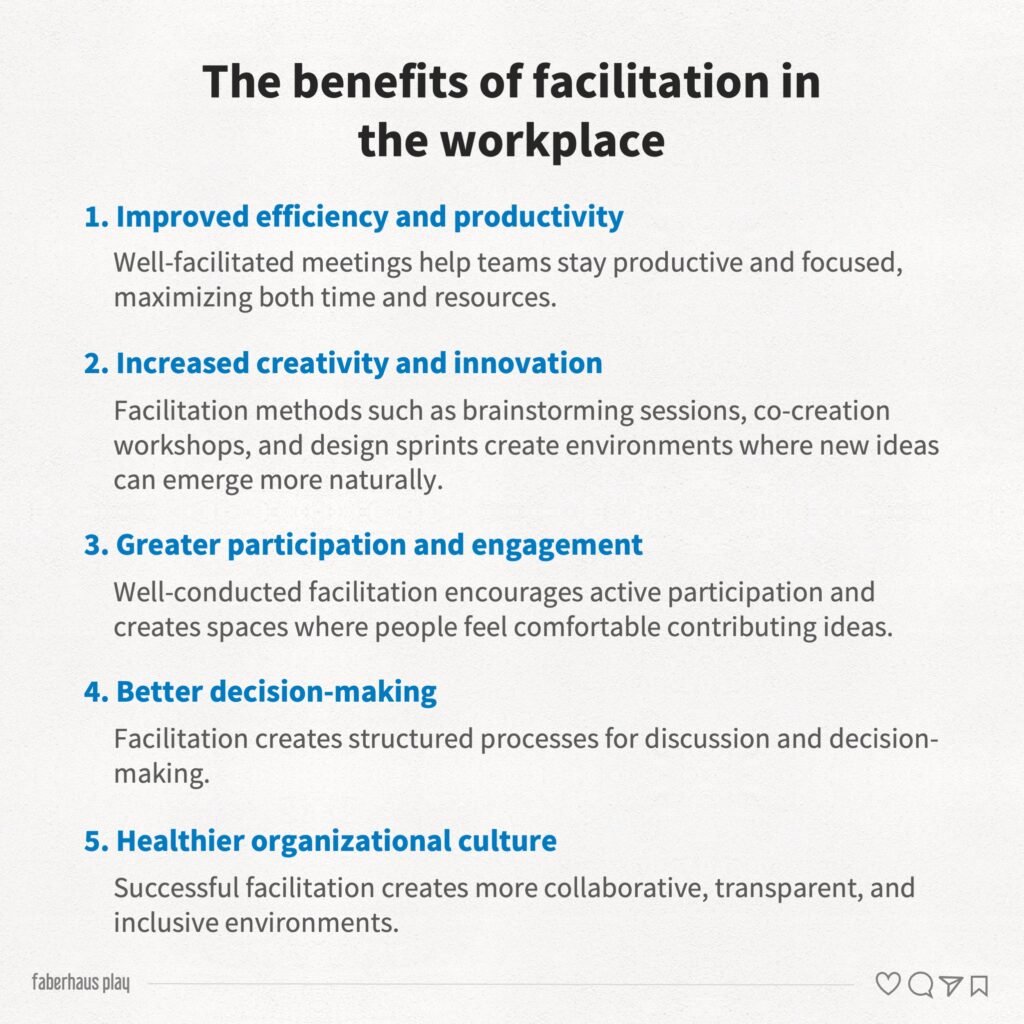
1. Improved efficiency and productivity
Well-facilitated meetings help teams stay productive and focused, maximizing both time and resources.
Good facilitation prevents:
- Unnecessary discussions
- Repetitive conversations
- Unclear outcomes
2. Increased creativity and innovation
Facilitation methods such as brainstorming sessions, co-creation workshops, and design sprints create environments where new ideas can emerge more naturally.
Collaboration often produces better solutions than isolated thinking.
Especially when different perspectives are involved.
3. Greater participation and engagement
Well-conducted facilitation encourages active participation and creates spaces where people feel comfortable contributing ideas.
This increases:
- Engagement
- Trust
- Collaboration
- Psychological safety inside teams
4. Better decision-making
Facilitation creates structured processes for discussion and decision-making.
Instead of decisions being driven only by hierarchy or louder voices, facilitation helps teams consider:
- Multiple perspectives
- Shared understanding
- Collective reasoning
5. Healthier organizational culture
Successful facilitation creates more collaborative, transparent, and inclusive environments.
And over time, this improves:
- Team relationships
- Trust
- Motivation
- Organizational climate
What does a facilitator do?
A facilitator is someone responsible for helping groups work through problems collaboratively during workshops, co-creation sessions, and group dynamics.
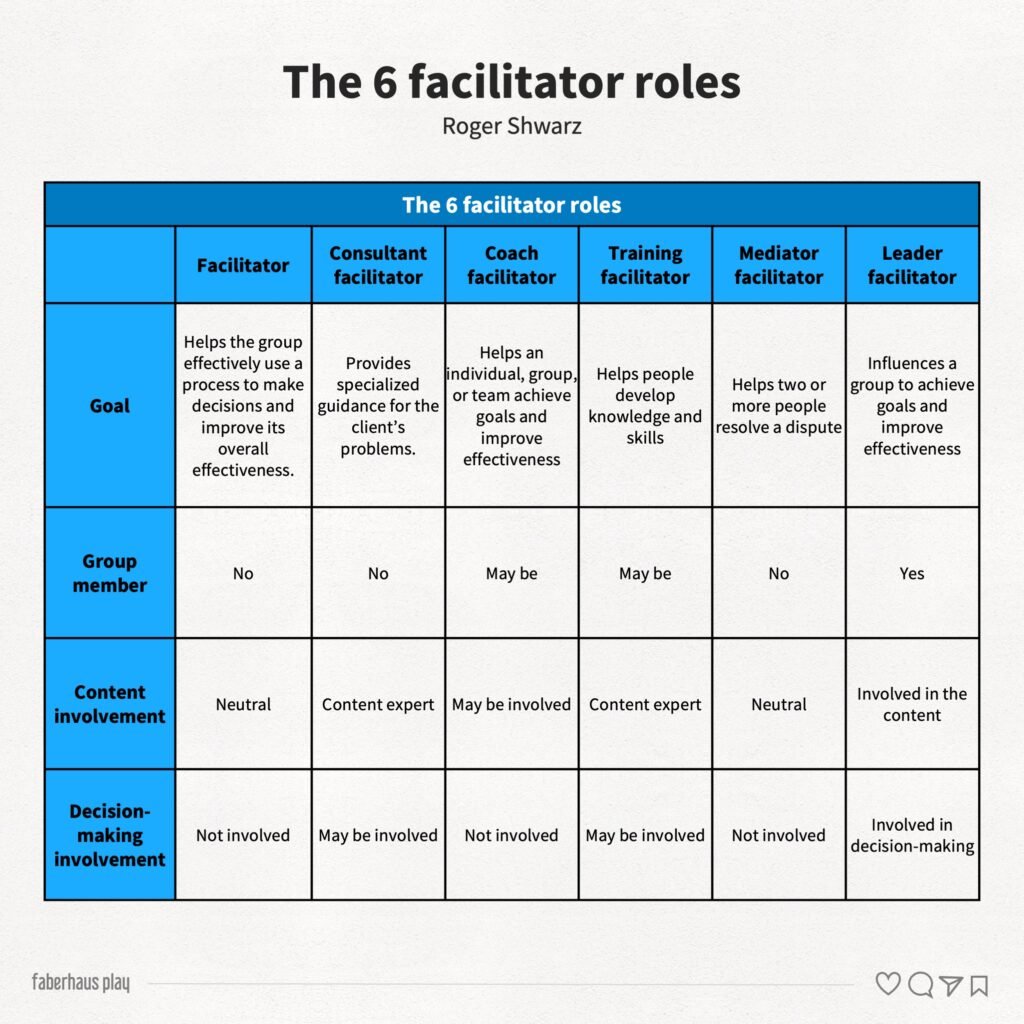
For this, facilitators could act like:
Facilitator: Helps the group effectively use a process to make decisions and improve its overall effectiveness.
Consultant facilitator: Provides specialized guidance for the client’s problems.
Coach facilitator: Helps an individual, group, or team achieve goals and improve effectiveness.
Training facilitator: Helps people develop knowledge and skills.
Mediator facilitator: Helps two or more people resolve a dispute.
Leader facilitator: Influences a group to achieve goals and improve effectiveness.
For all these situations the facilitator designs and guides the process while protecting three important aspects:
- Team performance
- Healthy interpersonal relationships
- Individual well-being during the work process
Their responsibility is not controlling the outcome; it’s improving the quality of the process.
The facilitator mindset
One of the most important aspects of facilitation is mindset.
Roger Schwarz, one of the most influential authors on facilitation, describes two contrasting approaches:
- Unilateral control
- Mutual learning
Unilateral control
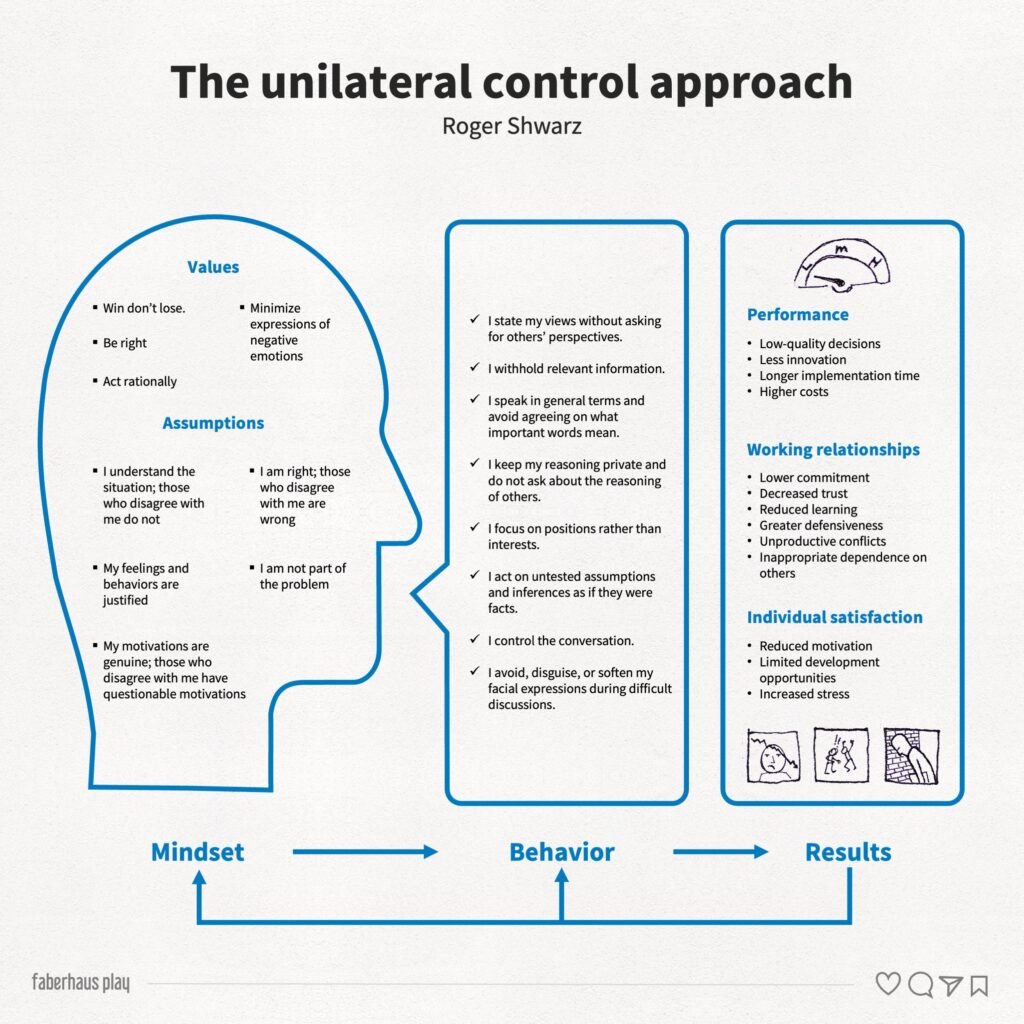
In unilateral control, people tend to believe:
- “I’m right.”
- “People who disagree are wrong.”
- “I understand the situation better than others.”
This approach often creates:
- Defensiveness
- Low trust
- Poor collaboration
- Low-quality decisions
- Less innovation
Unfortunately, many organizations still operate this way.
Mutual learning
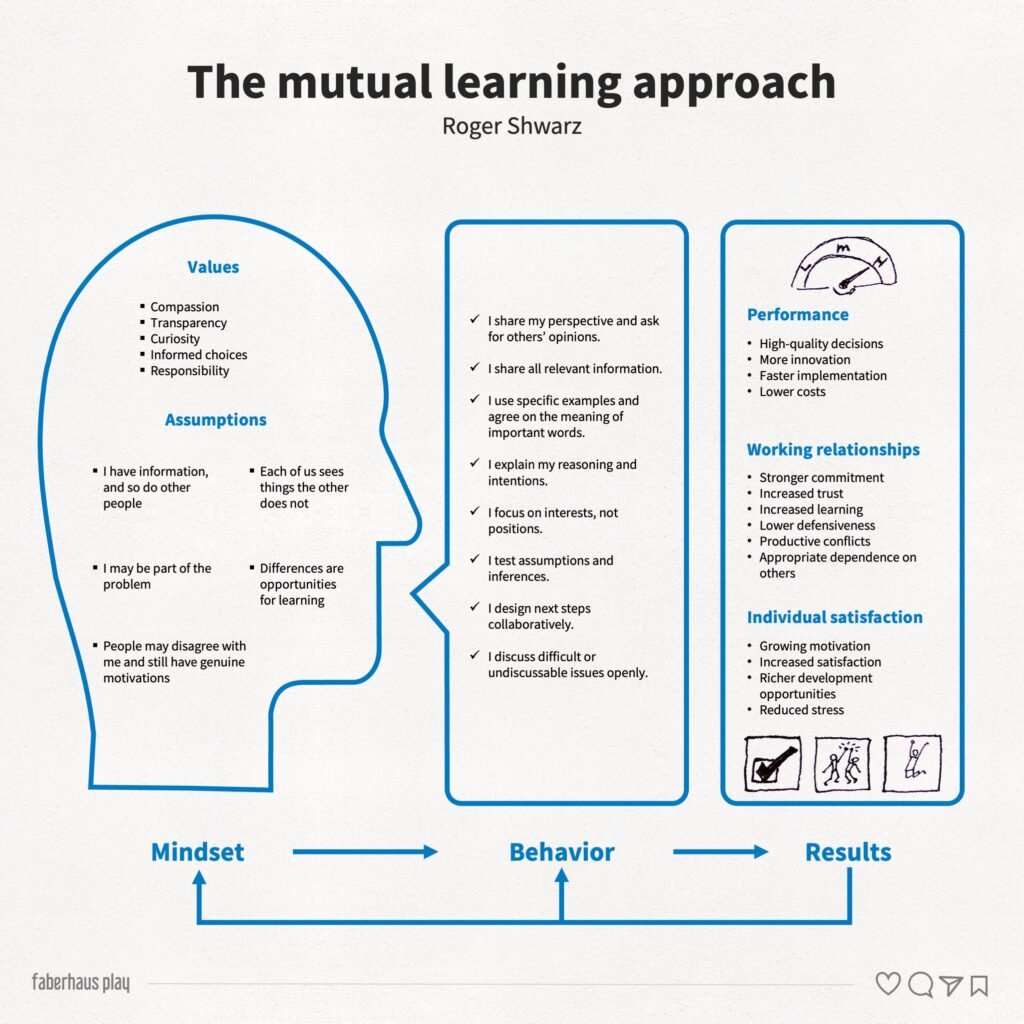
Mutual learning takes the opposite approach.
It assumes:
- People hold different pieces of information
- Disagreement can generate learning
- Collaboration improves decision quality
This mindset encourages:
- Transparency
- Curiosity
- Shared responsibility
- Collaborative problem-solving
So, it becomes a way of helping people think together more effectively and it the best mindset for facilitators.
Why facilitation is becoming more important
As technology automates more operational tasks, human work increasingly revolves around:
- Complex decisions
- Ambiguity
- Collaboration
- Negotiation
- Balancing different interests
Technical skills alone are no longer enough.
Emotional intelligence, communication, and collaborative thinking have become critical.
Facilitators help teams:
- Navigate complexity
- Reduce friction
- Manage conflicts
- Move discussions toward meaningful outcomes
And in a world filled with endless meetings, that skill becomes extremely valuable.
In UX, service design, innovation, and product development, for example, this skill is becoming increasingly important because modern problems are rarely solved by isolated individuals.
They are solved collaboratively.
And collaboration works much better when someone intentionally designs the process behind it.
References
Roger Schwarz. (2017). The skilled facilitator: A comprehensive resource for consultants, facilitators, coaches, and trainers (3rd ed.). New Jersey: John Wiley & Sons.