
The study of generations explores groups such as Baby boomers, Gen X, Millennials, Gen Z, and Gen Alpha and the behaviors commonly associated with them.
Over time, this type of analysis has become increasingly important for organizations trying to create products, services, and experiences that feel relevant to different audiences.
But there’s an important detail many people forget: Generational behavior is not strictly about age.

Someone born during the millennial generation may still display behaviors, values, and aspirations commonly associated with older or younger generations.
Culture, economic conditions, geography, education, and technology all influence how generations behave.
So, these groups should not be treated as rigid labels.
They are better understood as cultural tendencies or shared ongoings that help explain how different groups relate to:
- Work
- Technology
- Identity
- Relationships
- Consumption
- Etc.
Today, five generations are commonly discussed:
- Baby boomers
- Gen X
- Millennials (Gen Y)
- Gen Z
- Gen Alpha
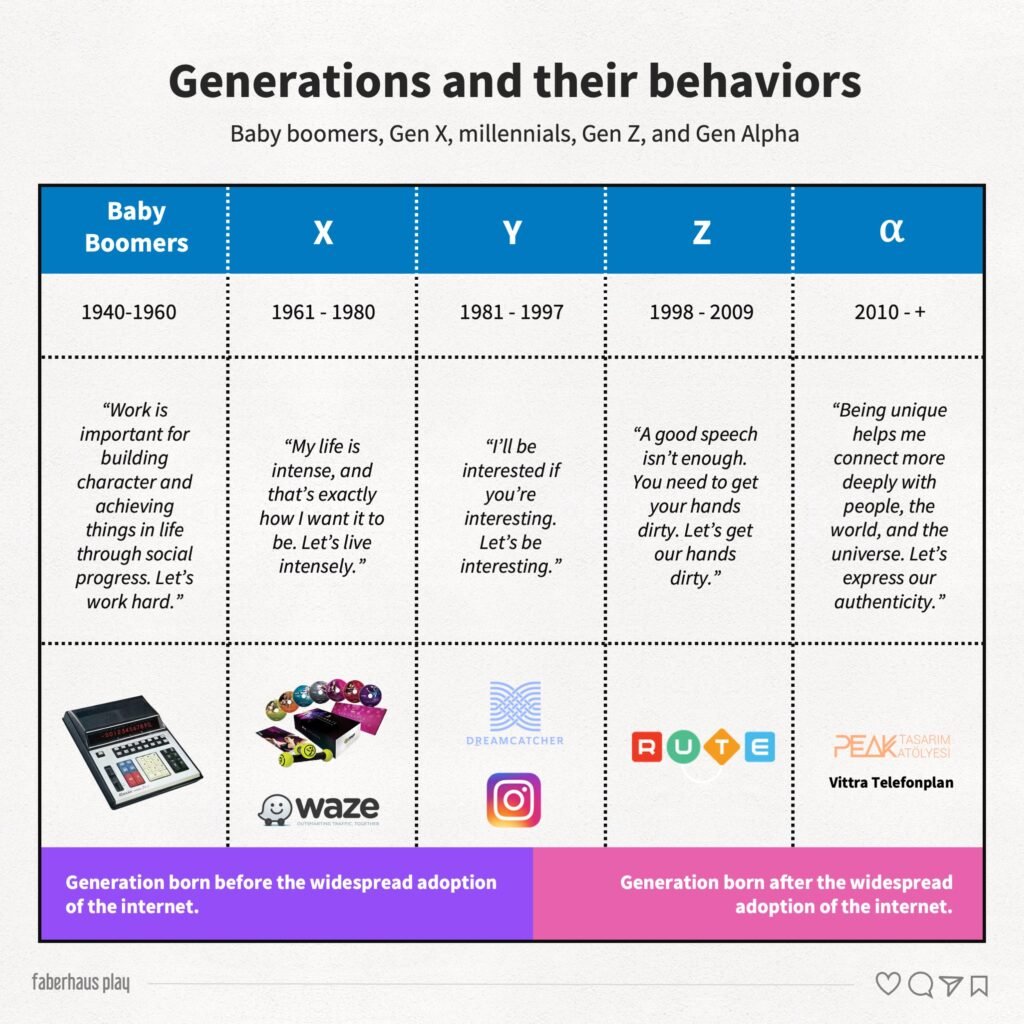
Baby boomers (1940–1960)
“Work is important for building character and achieving things in life through social progress. Let’s work hard.”
The term “baby boomers” originally referred to the large increase in births after World War II.
As soldiers returned home, many countries experienced rapid population growth and a strong sense of rebuilding.
Over time, the term evolved beyond demographics and became associated with a generation that experienced:
- Post-war reconstruction
- Economic optimism
- Social mobility
- The rise of counterculture movements
- Major cultural transformations during the 1960s and 1970s
This generation witnessed the Cold War but also experienced something new: the possibility of building personal prosperity outside of war.
Owning a car, buying a house, traveling internationally, and climbing the social ladder became realistic aspirations for many people.
In general, baby boomers are often associated with:
- Hard work
- Discipline
- Career stability
- Long-term growth
- Social advancement through effort
Gen X (1961–1980)
“My life is intense, and that’s exactly how I want it to be. Let’s live intensely.”
The name “Generation X” became popular through Douglas Coupland’s book Generation X: Tales for an Accelerated Culture.
Gen X inherited many of the ambitions created by baby boomers but grew up in a different cultural environment.
They were too young to experience major wars directly, yet old enough to witness:
- Globalization
- Rapid educational expansion
- Economic competition
- Growing pressure for personal success
This generation became strongly associated with:
- Self-improvement
- Ambition
- Career pressure
- Productivity culture
- Personal reinvention
It was also during this period that the “yuppie” lifestyle emerged: young professionals seeking rapid financial success and status.
In many ways, Gen X became the generation of intensity: always trying to improve, achieve more, and move faster.
Millennials / Gen Y (1981–1997)
“I’ll pay attention if you’re interesting. Let’s be interesting.”
Millennials grew up during the expansion of digital technology and the popularization of the internet.
Unlike previous generations, technology was not something distant or specialized anymore.
It became part of daily life.
Some millennials inherited the ambition of the yuppie culture and became leaders in the tech industry, building companies around social media, digital platforms, and online services.
The term “millennials” was popularized by sociologists Neil Howe and William Strauss.
This generation became comfortable sharing personal experiences online and expressing individuality publicly.
In general, millennials are often associated with:
- Self-expression
- Personal branding
- Unique experiences
- Visibility
- Individuality
- Relevance
Being “interesting” became a form of social currency.
Gen Z (1998–2009)
“A good speech is not enough. We need to get our hands dirty.”
Gen Z was born into a world already shaped by:
- Political instability
- Financial crises
- Digital connectivity
- Social media
This is the first fully digital generation.
They do not remember a world without the internet.
Because of that, technology is not seen as an innovation.
It’s simply infrastructure.
Gen Z tends to use digital tools naturally to:
- Learn faster
- Access information
- Organize communities
- Express opinions
- Challenge institutions
This generation is also frequently associated with:
- Diversity
- Social awareness
- Ethics
- Mental health conversations
- Activism
- Practical action
For Gen Z, intention alone is not enough.
Action matters.
Gen Alpha (2010–present)
“Being unique helps me connect more deeply with people, the world, and the universe. Let’s express our authenticity.”
Gen Alpha is still being formed, but many signs already point toward a generation deeply integrated with technology.
Unlike previous generations, they may no longer see digital technology as separate from human life.
For them:
- Everything is connected
- Everything is digital
- Identity exists simultaneously in physical and virtual spaces
They inherit many values amplified by Gen Z:
- Inclusion
- Authenticity
- Connectivity
- Fluid identities.
But they may push these ideas even further.
Generations beyond limitations ideas
Generational studies are not exact science.
People are more complex than labels.
Still, understanding generational tendencies can help designers, leaders, educators, and organizations create more contextualized experiences for different groups of people.
And perhaps the most important insight is this:
Every generation is shaped by the technologies, fears, opportunities, and cultural context of its time.
Understanding generations is, in many ways, understanding how society changes itself over time.
For designers, this matters because every interface, service, and experience exists inside a cultural context.
And the better we understand people, the better we design for them.
Not just visually.
But socially, emotionally, and behaviorally too.
References
Diip. Retrieved from Diip website