
For decades, many schools, companies, and hiring processes have operated under a similar assumption:
People who excel at logic, mathematics, and standardized testing are the smartest people in the room.
But what if that’s only one form of intelligence?

This question sits at the heart of the Theory of Multiple Intelligences developed by psychologist Howard Gardner.
Originally introduced in the 1980s through his book Frames of Mind, Gardner challenged the idea that human intelligence could be reduced to a single number.
Instead, he proposed that people possess different forms of intelligence, each representing distinct ways of understanding, interacting with, and navigating the world.
For me, this idea became particularly interesting when thinking about two challenges:
- how can we improve education?
- how can we build stronger and more diverse teams?
Because if intelligence comes in many forms, then talent does too.
The problem with a single definition of intelligence
Traditional IQ tests tend to focus heavily on logical and mathematical reasoning.
Those abilities are certainly important.
But are they enough to explain why:
- some people become exceptional leaders?
- some people can deeply understand others?
- some people create beautiful music?
- some people navigate unfamiliar cities effortlessly?
- some people tell unforgettable stories?
Probably not.
Gardner’s theory suggests that human capability is much broader than what standardized tests usually measure.
And that feels increasingly relevant in today’s world.
Modern organizations rarely succeed because everyone thinks the same way.
They succeed because different people contribute different strengths.
Multiple intelligences are not labels
One of the biggest misconceptions about this theory is treating it as a personality test.
It isn’t.
The purpose is not to place people into categories.
The purpose is to recognize that human potential can manifest itself in different ways.
Most people display a combination of several intelligences.
And even if someone has a natural predisposition toward one area, that does not mean they cannot develop others.
A person with little natural musical ability can become a talented musician through practice.
A person who struggles with public speaking can become a powerful communicator.
The theory is best understood as a lens for understanding strengths—not a limit on potential.
The nine intelligences proposed by Howard Gardner
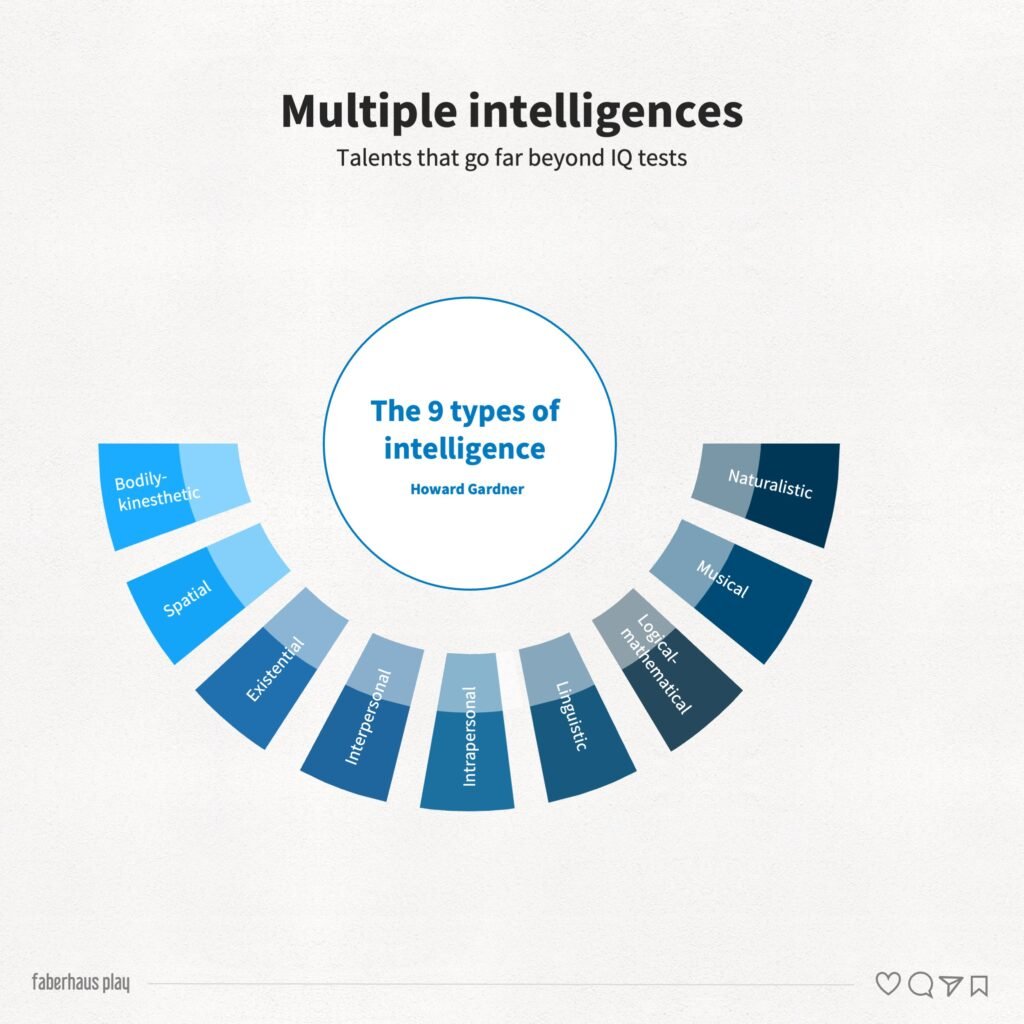
1. Bodily-kinesthetic intelligence
This intelligence involves coordinating mind and body effectively.
People with strong bodily-kinesthetic intelligence often excel at:
- movement
- physical expression
- coordination
- hands-on activities
Examples include:
- athletes
- dancers
- actors
- surgeons
- craftspeople
They think through action as much as through words.
2. Spatial intelligence
Spatial intelligence involves understanding and manipulating physical space.
People with this intelligence often:
- navigate unfamiliar places easily
- visualize objects mentally
- understand distances and relationships
- interpret maps and diagrams naturally
Examples include:
- architects
- designers
- pilots
- navigators
- urban planners
Interestingly, many UX and product designers rely heavily on spatial thinking when organizing information and designing experiences.
3. Existential intelligence
Added later by Gardner, existential intelligence relates to exploring fundamental questions about life, meaning, and existence.
People with strong existential intelligence often think deeply about:
- purpose
- ethics
- humanity
- identity
- the nature of reality
Examples may include:
- philosophers
- spiritual leaders
- educators
- writers
These individuals often help others make sense of complex questions.
4. Interpersonal intelligence
Interpersonal intelligence involves understanding other people.
This includes the ability to:
- listen deeply
- build relationships
- motivate others
- navigate social situations
- understand emotions
Examples include:
- leaders
- coaches
- facilitators
- teachers
- sales professionals
In many organizations, this intelligence is one of the strongest predictors of leadership effectiveness.
5. Intrapersonal intelligence
Intrapersonal intelligence focuses on self-awareness.
People with this intelligence understand:
- their emotions
- motivations
- strengths
- limitations
- reactions under pressure
They tend to make thoughtful decisions because they understand themselves well.
Examples include:
- reflective leaders
- coaches
- psychologists
- elite performers
Self-awareness is often underestimated as a professional skill.
But it is foundational to emotional intelligence and leadership.
6. Linguistic intelligence
Linguistic intelligence involves using language effectively.
People with strong linguistic intelligence often excel at:
- writing
- storytelling
- communication
- persuasion
- learning languages
Examples include:
- writers
- journalists
- teachers
- screenwriters
- copywriters
As someone who works with presentations and storytelling, I find this intelligence particularly fascinating because language shapes how people understand ideas.
7. Logical-mathematical intelligence
This is the intelligence most associated with traditional IQ tests.
It includes:
- logical reasoning
- pattern recognition
- quantitative analysis
- hypothesis testing
- problem-solving
Examples include:
- scientists
- engineers
- mathematicians
- programmers
- analysts
This intelligence is incredibly valuable.
The problem is not that it is important.
The problem is assuming it is the only one that matters.
8. Musical intelligence
Musical intelligence involves sensitivity to:
- rhythm
- pitch
- melody
- tone
- sound patterns
People with this intelligence often:
- recognize musical structures quickly
- reproduce sounds accurately
- compose or improvise naturally
Examples include:
- musicians
- composers
- singers
- conductors
- producers
Music is often one of the clearest examples of a highly specialized form of intelligence.
9. Naturalistic intelligence
Naturalistic intelligence involves understanding and interacting with nature.
People with this intelligence often:
- identify plants and animals easily
- notice environmental patterns
- recognize natural systems
- connect deeply with the natural world
Examples include:
- biologists
- veterinarians
- environmental scientists
- farmers
- chefs
This intelligence reminds us that human capability extends far beyond classrooms and offices.
What this means for leadership and teams
One reason I find this theory so useful is that it encourages us to think differently about talent.
Many organizations unintentionally reward only a narrow range of strengths.
The result?
They may overlook people who contribute tremendous value in different ways.
Great teams are rarely built from people with identical strengths.
They are built from complementary strengths.
A product team, for example, might benefit from:
- analytical thinkers
- strong communicators
- systems thinkers
- facilitators
- creative problem solvers
- empathetic researchers
Different intelligences often create better outcomes when combined.
What this means for design
Design itself is an interesting example of multiple intelligences working together.
A designer may rely on:
- spatial intelligence to organize information
- interpersonal intelligence to understand users
- linguistic intelligence to communicate ideas
- logical intelligence to structure solutions
- intrapersonal intelligence to reflect on decisions
Perhaps that is one reason design is such a multidisciplinary field.
It sits at the intersection of many different ways of thinking.
Recognizing differences and possibilities is the most important thing
Whether every aspect of Gardner’s theory is scientifically perfect remains a topic of debate among researchers.
But I believe its core message remains valuable:
Human talent is more diverse than most systems recognize.
Some people think through numbers.
Others think through stories.
Some understand systems.
Others understand people.
Some create through movement.
Others create through music.
The challenge is not deciding which intelligence is best.
The challenge is recognizing that intelligence itself is far more varied than we often assume.
And once we recognize that, we become much better at building teams, developing people, and understanding ourselves.
References
Howard Gardner. (1983). Frames of Mind: The Theory of Multiple Intelligences. New York: Basic Books.
Practical Psychology. Retrieved from
Practical Psychology YouTube channel
Universidade do Cotidiano. Retrieved from
Universidade do Cotidiano article

