
Most leaders have experienced some version of this situation.
You assemble a team of smart, experienced, capable people.
The individuals are talented.

The strategy is clear.
The resources are available.
And yet the team underperforms.
Deadlines slip.
Meetings become frustrating.
Decisions take too long.
People work hard but results never seem to match the potential of the group.
The problem, according to leadership consultant Patrick Lencioni, is that great teams are not built solely on talent.
They are built on trust, accountability, and collective commitment.
In The Five Dysfunctions of a Team, Lencioni argues that many groups never become true teams because they struggle with five predictable challenges.
And importantly: These challenges build on one another.
When the first one is missing, the others become much harder to overcome.
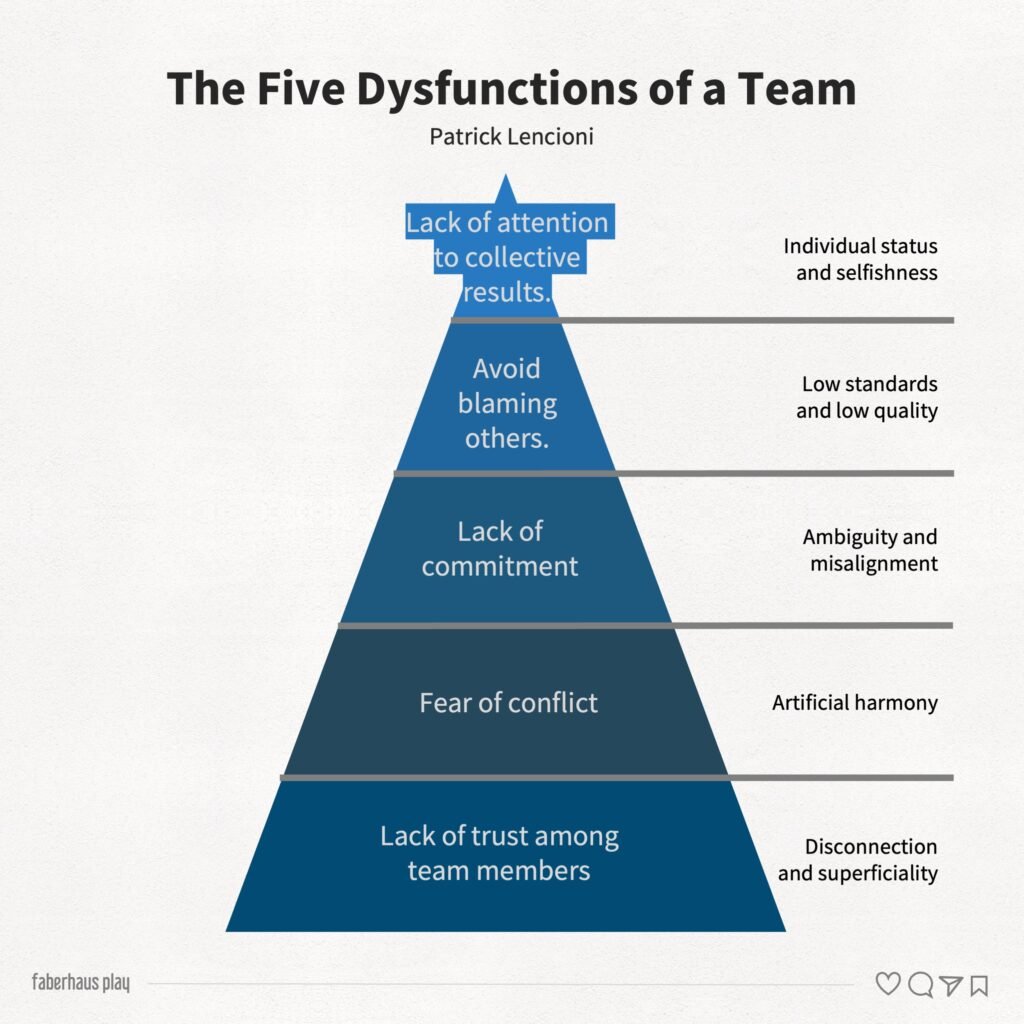
The first dysfunction: absence of trust
Everything starts with trust.
But not the kind of trust we often talk about in organizations.
Lencioni is referring to vulnerability-based trust.
The willingness to say:
- “I made a mistake.”
- “I don’t know.”
- “I need help.”
- “I was wrong.”
Many teams avoid these moments because people fear appearing weak.
Ironically, that fear creates distance.
Without vulnerability, people protect themselves.
And when everyone is protecting themselves, genuine collaboration becomes almost impossible.
As Lencioni writes:
Trust is the confidence among team members that their peers’ intentions are good.
The healthiest teams are not the ones where people never make mistakes.
They are the ones where people can admit mistakes without fear.
The second dysfunction: fear of conflict
Once trust is missing, another problem emerges.
People stop challenging one another.
At first this may seem positive.
Meetings feel polite.
Conversations remain civil.
Nobody argues.
But underneath that surface harmony, frustration begins to accumulate.
Because important issues remain unspoken.
Healthy teams understand something many organizations forget:
Conflict is not the enemy. Unresolved conflict is.
The best teams debate difficult issues openly.
They challenge ideas.
They disagree.
And then they move forward together.
Without trust, however, conflict often becomes either:
- avoided
- political
- passive-aggressive
- personal
None of those lead to better decisions.
The third dysfunction: lack of commitment
One of my favorite insights from the book is simple:
People support what they help create.
When team members feel heard, they are much more likely to commit to decisions.
Even when the final decision is not their preferred option.
The opposite is also true.
When people stay silent during discussions, they often leave meetings unconvinced.
And when they leave unconvinced, commitment suffers.
As Lencioni notes:
When people don’t voice their opinions and don’t feel heard, they don’t commit.
This explains why many teams struggle with execution.
The issue is often not the plan itself.
It’s the level of buy-in behind it.
The fourth dysfunction: avoidance of accountability
Commitment creates accountability.
Without commitment, accountability feels unfair.
Think about it.
Why would someone feel comfortable holding a colleague accountable for a decision they never truly supported?
Healthy teams create mutual accountability.
Not because managers force it.
Because members genuinely care about the success of the group.
They challenge behaviors that damage team performance.
They address problems early.
And they hold one another to shared standards.
Many organizations rely too heavily on managers to enforce accountability.
Strong teams distribute that responsibility among everyone.
The fifth dysfunction: inattention to collective results
The final dysfunction is perhaps the most dangerous.
When trust, conflict, commitment, and accountability break down, people naturally shift their attention elsewhere.
Instead of focusing on collective outcomes, they focus on:
- personal success
- individual recognition
- departmental goals
- internal politics
- status
- career advancement
The team stops acting like a team.
It becomes a collection of individuals pursuing separate objectives.
This is why Lencioni argues that the ultimate measure of a team is its results.
Not activity.
Not effort.
Not intentions.
Results.
As he puts it:
The ultimate test of a team is results.
Everything else exists to support that outcome.
What healthy teams do differently
According to Lencioni, successful teams consistently demonstrate five characteristics:
1. They trust one another
Members feel safe admitting mistakes, asking for help, and being vulnerable.
2. They engage in productive conflict
Difficult conversations happen openly rather than behind closed doors.
3. They commit to decisions
People move forward together, even when initial disagreement existed.
4. They hold one another accountable
Team members challenge behaviors that undermine collective goals.
5. They prioritize collective success
The team’s objectives come before individual agendas.
Simple.
Not easy.
But simple.
Why this matters for modern product and design teams
One reason I continue to recommend this book is that its lessons apply particularly well to cross-functional environments.
Product teams, design teams, engineering teams, and leadership groups often struggle with alignment.
Not because they lack intelligence.
But because they lack trust.
A team can have:
- exceptional designers
- brilliant engineers
- experienced product managers
- talented executives
And still fail.
Because performance is not only a function of individual capability.
It is also a function of team dynamics.
In fact, many organizational problems that appear strategic are actually relational.
The issue is not the roadmap.
The issue is the conversation.
Leadership’s role in team effectiveness
One quote from the book has always stayed with me.
A leader reflects on a destructive team member and says:
“The problem wasn’t his behavior. The problem was that I tolerated it.”
That insight is uncomfortable.
But important.
Leaders shape culture not only through what they encourage.
They also shape it through what they allow.
The behaviors leaders tolerate eventually become part of the team’s culture.
Which means leadership is not simply about setting direction.
It’s about creating the conditions where healthy team behaviors can emerge.
To teams working well the most important thing is managing the human factor
The Five Dysfunctions of a Team remains relevant because it focuses on something many organizations overlook.
Teams fail for human reasons.
Not technical ones.
Not procedural ones.
Human ones.
Trust.
Conflict.
Commitment.
Accountability.
Results.
The model itself is simple enough to fit on a single slide.
The challenge is living it consistently.
Because building a great team is not about hiring talented people.
It’s about creating an environment where talented people can work together effectively.
And that turns out to be much harder—and much more important—than most leaders realize.
References
Patrick Lencioni. (2002). The Five Dysfunctions of a Team: A Leadership Fable. San Francisco: Jossey-Bass.
Faberhaus article on team engagement

