Personas have been part of design and UX work for a long time.
They help teams remember a simple but important idea:
We are not designing for ourselves.

We are designing for people far from us with their own needs, limitations, habits, expectations, fears, and motivations.
But as research methods, data, and artificial intelligence evolve, the way we create and use personas also needs to evolve.
Today, it is useful to understand at least four different ways of representing users:
- Personas
- Proto-personas
- Extreme profiles
- Synthetic personas
Each one has a different role in the design process.
The problem begins when teams treat all of them as the same thing.
They are not.
What is a persona?
A persona is a fictional archetype that represents a specific group of people.
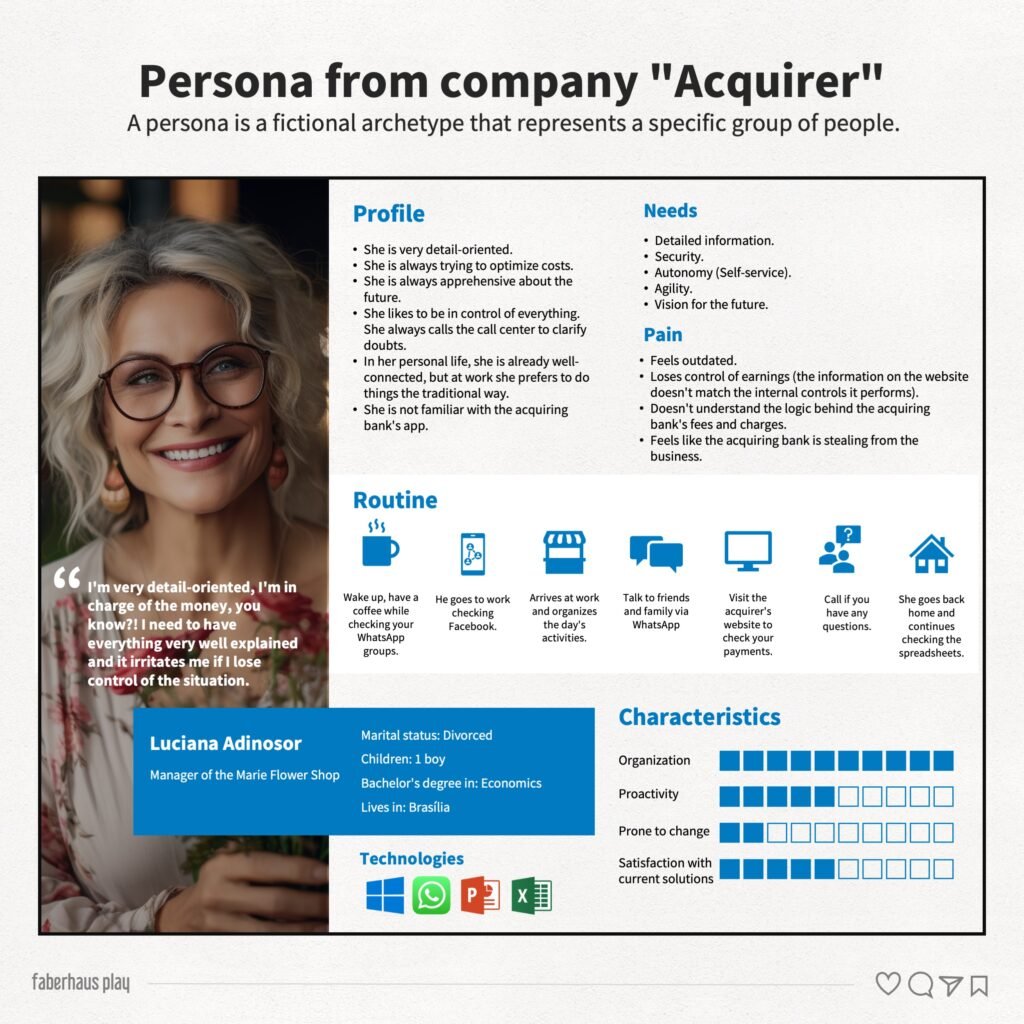
It is usually created from research and used to describe a group of customers or users who share similar characteristics, behaviors, needs, and goals.
A good persona helps teams stay focused on:
- user needs
- pain points
- motivations
- habits
- preferences
- context of use
- decision criteria
The main strength of a persona is depth.
It brings a richer qualitative understanding of the people we are designing for.
That is why personas can include details such as:
- job
- routine
- devices used
- digital habits
- mobility patterns
- frustrations
- goals
- barriers
- expectations
A persona can be useful at different moments of a project.
At the beginning, it helps teams understand who they are designing for.
During development, it helps guide decisions and prevent the team from losing sight of the user.
During improvement cycles, it can inspire new ideas and help evaluate whether the solution still makes sense for that audience.
The risk is treating the persona as decoration.
A persona is only useful when it influences decisions.
What is a proto-persona?
A proto-persona is a lighter version of a persona.
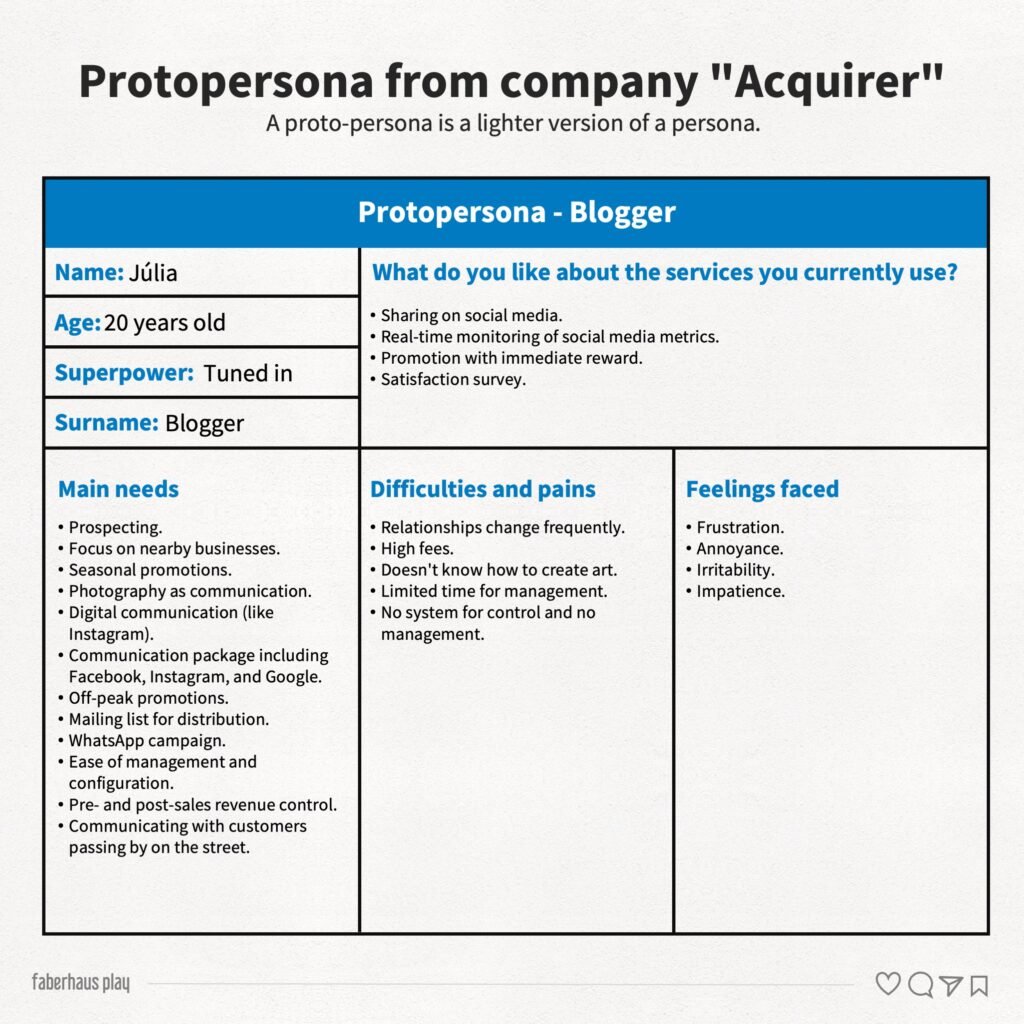
It usually contains less information and focuses mainly on:
- needs
- pain points
- goals
- assumptions
- behaviors
Details such as possessions, habits, and deep background information are usually less important at this stage.
Proto-personas are useful when the team needs an initial representation of the audience but does not yet have enough research to build a complete persona.
They are often used in:
- design sprints
- concept sprints
- early discovery
- workshops
- product framing sessions
A proto-persona can be created from quick interviews, stakeholder knowledge, early data, or team assumptions.
The important point is this:
A proto-persona is not the final truth about the user.
It is a starting hypothesis.
It can later be validated, refined, or transformed into a more complete persona.
What are extreme profiles?
Extreme profiles are exaggerated representations of very different behaviors within a target audience.
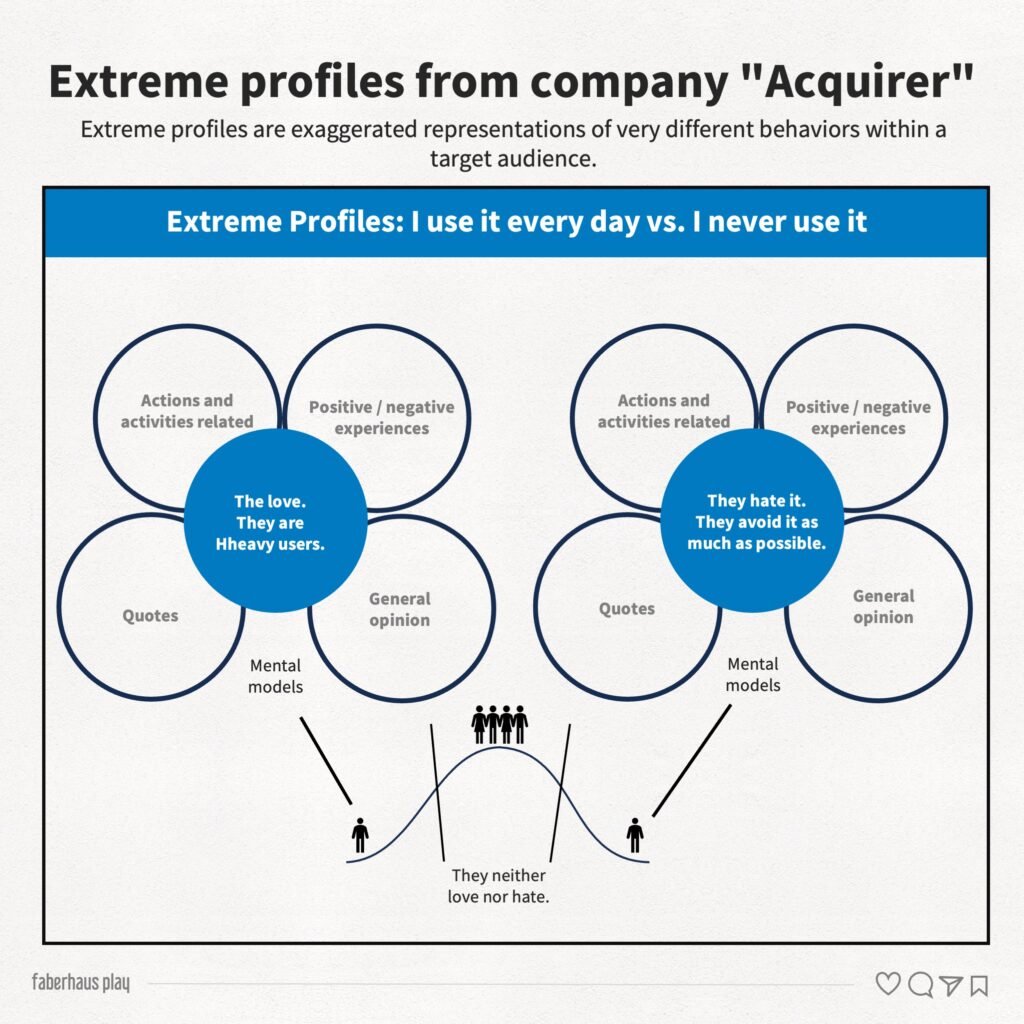
They are not focused only on purchasing power or demographics.
They are mainly focused on behavioral contrast.
For example, imagine a cinema service.
One extreme profile could be someone deeply passionate about cinema, who goes to premieres, watches behind-the-scenes content, and even dresses up for major releases.
The opposite extreme could be someone who does not care about cinema at all and only watches a movie when invited by others.
These profiles help teams understand the boundaries of the audience.
They are useful because extreme users often reveal needs, frustrations, and opportunities that average users may not express clearly.
If a service can address the needs of both extreme profiles, it will often serve many people between those two points better.
Extreme profiles are especially useful for:
- depth interviews
- service design
- innovation projects
- accessibility discussions
- behavioral exploration
- early discovery
They help teams avoid designing only for the average user.
Because average users rarely reveal the edges of the experience.
What are synthetic personas?
Synthetic personas are user representations generated or enriched by artificial intelligence.
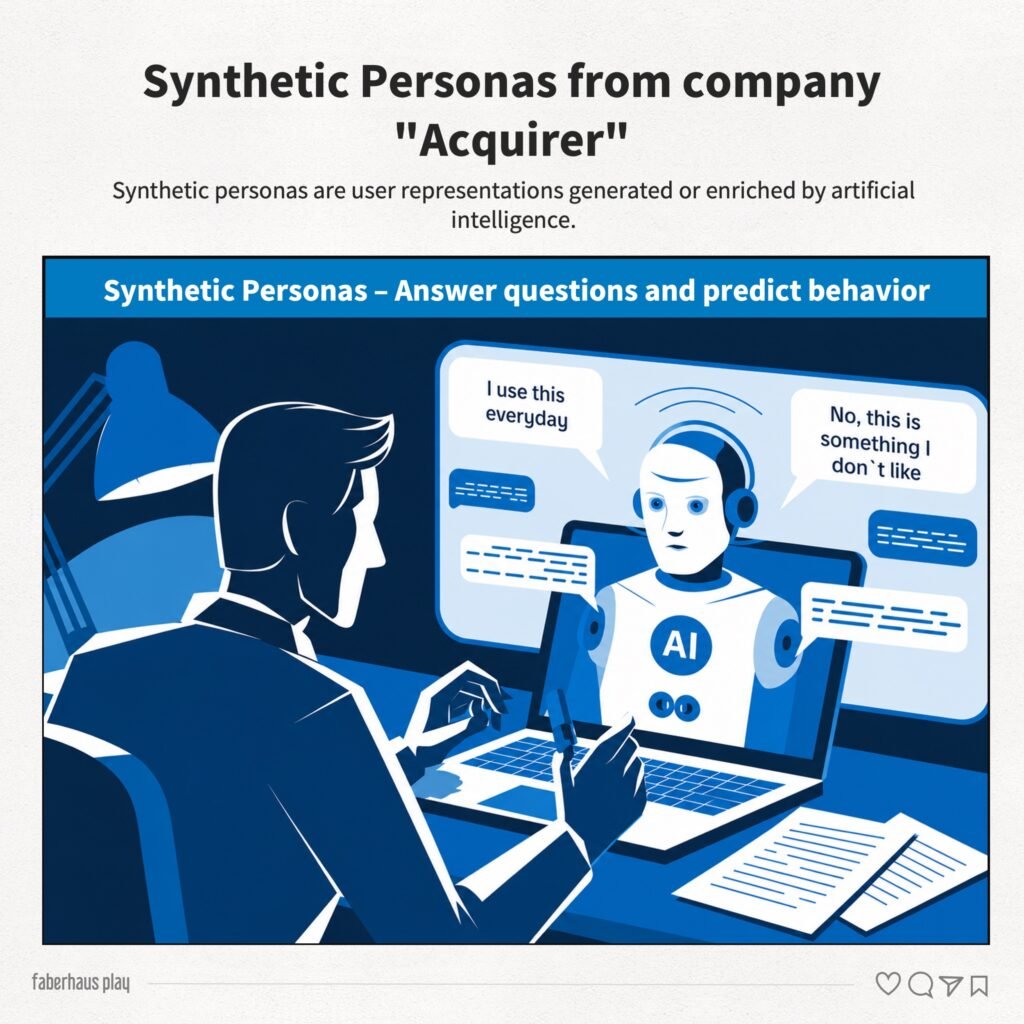
They can be created from existing data such as:
- interviews
- surveys
- analytics
- CRM data
- support tickets
- usage behavior
- public datasets
Instead of manually creating one or two personas, AI can analyze large volumes of information and generate multiple behavioral profiles based on patterns found in the data.
The basic idea is to create a virtual user representation derived from observed behavior.
For example, instead of manually creating a persona like:
Ana, 34, financial manager, looking for a faster way to control company expenses.
AI could analyze hundreds of interviews, support tickets, and navigation data to identify groups of users with similar motivations, behaviors, objections, and decision patterns.
This creates a new layer in the design process.
Not a replacement for research.
A support tool for synthesis, hypothesis generation, and exploration.
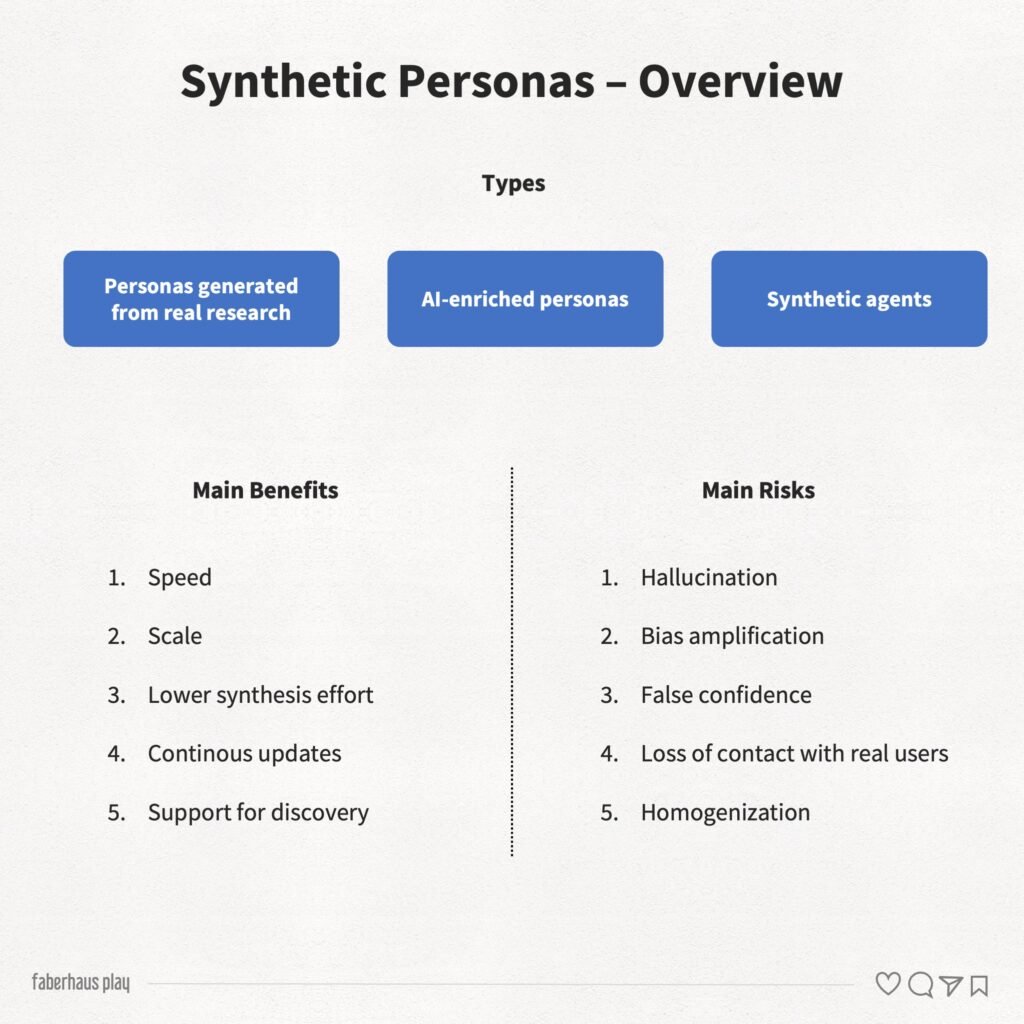
Three common types of synthetic personas
There are at least three useful ways to think about synthetic personas.
1. Personas generated from real research
This is the most reliable approach.
AI analyzes real data such as:
- interviews
- surveys
- analytics
- CRM records
- support tickets
Then it creates behavioral clusters and user profiles.
The quality of the synthetic persona depends directly on the quality of the source data.
Better input.
Better synthesis.
2. AI-enriched personas
In this case, the team already has a traditional persona created by researchers and designers.
AI helps enrich it by suggesting:
- possible motivations
- barriers
- language patterns
- behavioral hypotheses
- objections
- decision triggers
Here, AI works as a research assistant.
It does not replace the original persona.
It helps expand and explore it.
3. Synthetic agents
This is the most advanced stage.
The persona stops being only a document and becomes a conversational agent.
Instead of reading a static profile, the team can ask questions like:
How would you react to this checkout flow?
or
What would make you abandon this subscription?
The agent then responds by simulating that profile.
This is where much of the current innovation is happening.
The value is no longer only in documenting the persona.
The value is in interacting with a behavioral model.
Why synthetic personas are useful
Synthetic personas can bring important advantages to design and product teams.
Speed
Teams can generate initial profiles in minutes instead of weeks.
This can accelerate early discovery and help teams explore directions faster.
Scale
AI can analyze thousands of data points at once.
That is difficult to do manually with the same speed.
Lower synthesis effort
A significant amount of research time is spent organizing and interpreting information.
AI can support this work by identifying patterns, summarizing findings, and suggesting clusters.
Continuous updates
One of the biggest weaknesses of traditional personas is that they become outdated.
Synthetic personas can evolve as new data arrives.
In theory, they can become living representations of user behavior.
Support for discovery
Synthetic personas can help teams explore hypotheses before investing in larger research efforts.
They can be useful for:
- preparing interviews
- testing early ideas
- identifying initial patterns
- comparing behavioral segments
- generating research questions
This can make discovery faster and more structured.
The risks of synthetic personas
This is the most important part.
Synthetic personas can be useful, but they can also be dangerous when used carelessly.
Hallucination
AI can invent details that are not supported by the data.
The problem is that these invented details can sound convincing.
A synthetic persona may look professional, detailed, and realistic while still being wrong.
Bias amplification
If the source data is biased, the synthetic persona will also be biased.
Sometimes even more.
Bad data does not become good research just because AI processed it.
False confidence
This may be the biggest risk.
Teams may start treating synthetic personas as if they were real users.
They are not.
They are statistical simulations or AI-generated hypotheses.
Useful, but not evidence by themselves.
Loss of contact with real users
There is a real risk that teams may replace interviews, observation, and usability testing with simulations.
That would be a serious mistake.
Synthetic personas can support research.
They should not replace direct contact with people.
Homogenization
AI models often represent average behavior.
But design breakthroughs frequently come from understanding exceptions, edge cases, and emerging behaviors.
If teams rely only on synthetic averages, they may miss the most interesting insights.
How synthetic personas change the design process
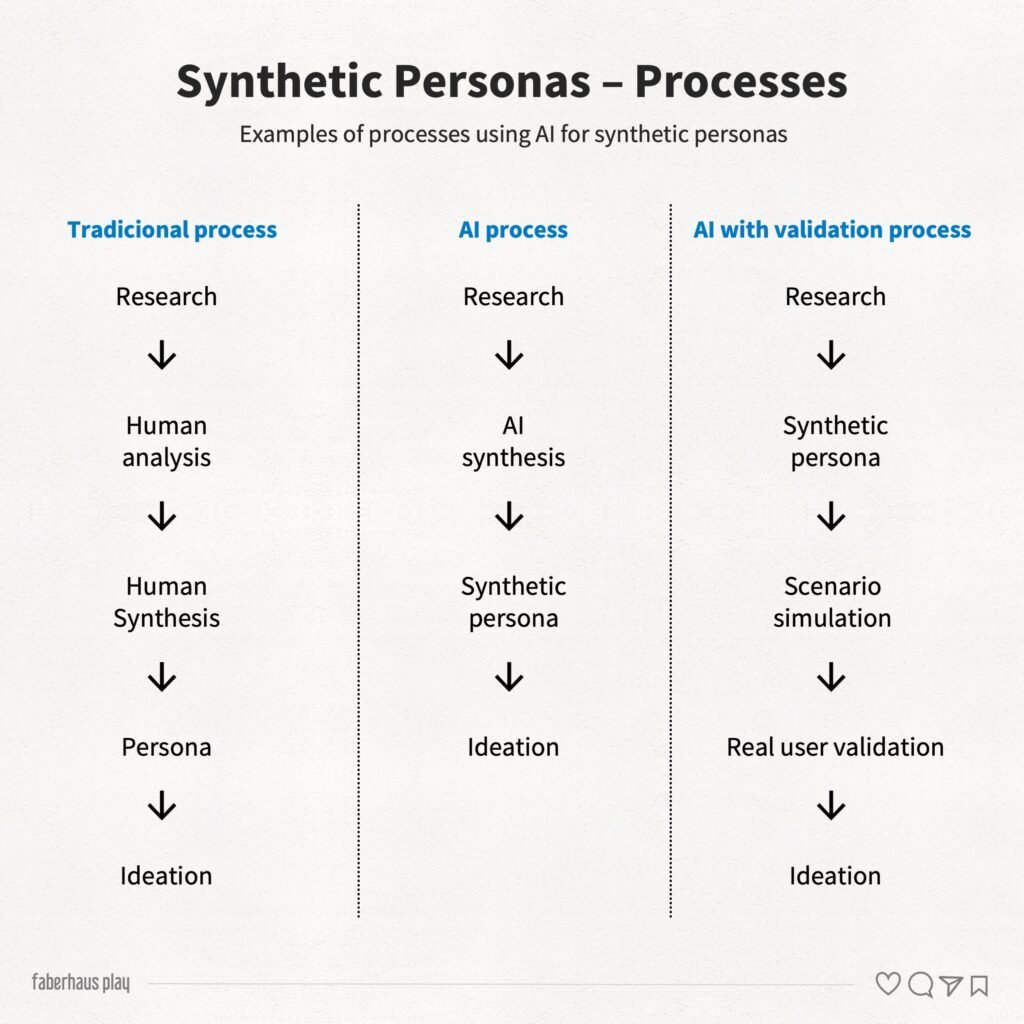
Traditionally, a simplified discovery flow might look like this:
Research → analysis → synthesis → persona → ideation
With AI, the flow can become faster:
Research → AI synthesis → synthetic persona → ideation
But an even better model is:
Research → synthetic personas → scenario simulation → real user validation
In this model, synthetic personas become an intermediate layer between hypothesis and validation.
They help teams think.
They do not make the final decision.
Synthetic personas should not replace research
The emerging consensus in UX is becoming clear:
Synthetic personas are valuable for accelerating analysis. But they should not replace research with real users.
They are useful for:
- exploring hypotheses
- preparing interviews
- identifying initial patterns
- organizing research findings
- simulating early scenarios
They should not be used to:
- validate critical decisions
- replace usability testing
- replace interviews
- replace ethnographic research
- replace direct observation
The difference is subtle, but essential.
Synthetic personas can help us ask better questions.
They should not make us stop asking real people.
What we may see next
The strongest trend is probably not the replacement of users.
It is the creation of synthetic panels.
Imagine a financial product team working with different user groups:
- 100 agents simulating new customers
- 100 agents simulating advanced users
- 100 agents simulating customers with debt
- 100 agents simulating small business owners
The team could quickly explore:
- onboarding flows
- pricing strategies
- navigation structures
- copy variations
- product concepts
Before moving into real research and testing.
This could reduce the cost of experimentation and help teams prioritize what deserves deeper validation.
But again, the value is not in pretending that synthetic users are real users.
The value is in using synthetic users to accelerate thinking before testing with real people.
The real role of personas in design
Personas, proto-personas, extreme profiles, and synthetic personas are not the same tool.
They serve different purposes:
- A persona helps deepen understanding.
- A proto-persona helps teams start quickly.
- An extreme profile helps reveal behavioral limits.
- A synthetic persona helps accelerate synthesis and simulate hypotheses.
The key is knowing when to use each one.
The danger is confusing representation with reality.
Every persona is a model.
And every model is incomplete.
The role of design is not to fall in love with the model.
It is to use the model to ask better questions, make better decisions, and stay closer to the people we are designing for.
References
Livework Brasil. Retrieved from http://www.liveworkstudio.com.br/
EISE Lab. Retrieved from http://eiselab.com.br/
Nielsen Norman Group. Retrieved from https://www.nngroup.com/videos/personas-101/
HR Reporter. Retrieved from https://www.hrreporter.com/focus-areas/automation-ai/canadian-employers-turning-to-ai-bots-for-job-interviews-report/392632