We are living in a time when almost every conversation about work, design, and technology eventually leads to artificial intelligence.
AI can write.
AI can generate images.

AI can summarize research.
AI can automate tasks.
AI can simulate conversations.
But there is one thing AI does not eliminate: Human needs.
If anything, the AI era makes human needs even more important.
Because the more technology becomes powerful, invisible, and present in our lives, the more important it becomes to understand what people are actually trying to protect, achieve, feel, and become.
This is why Maslow’s hierarchy of needs still matters.
Not as a perfect model.
But as a useful reminder that people do not interact with products, services, companies, or technologies only through logic.
They interact through needs.
What is Maslow’s hierarchy of needs?
Maslow’s hierarchy of needs is one of the most well-known models in psychology, management, education, and leadership.
Created by Abraham Maslow, the model organizes human needs into five broad categories:
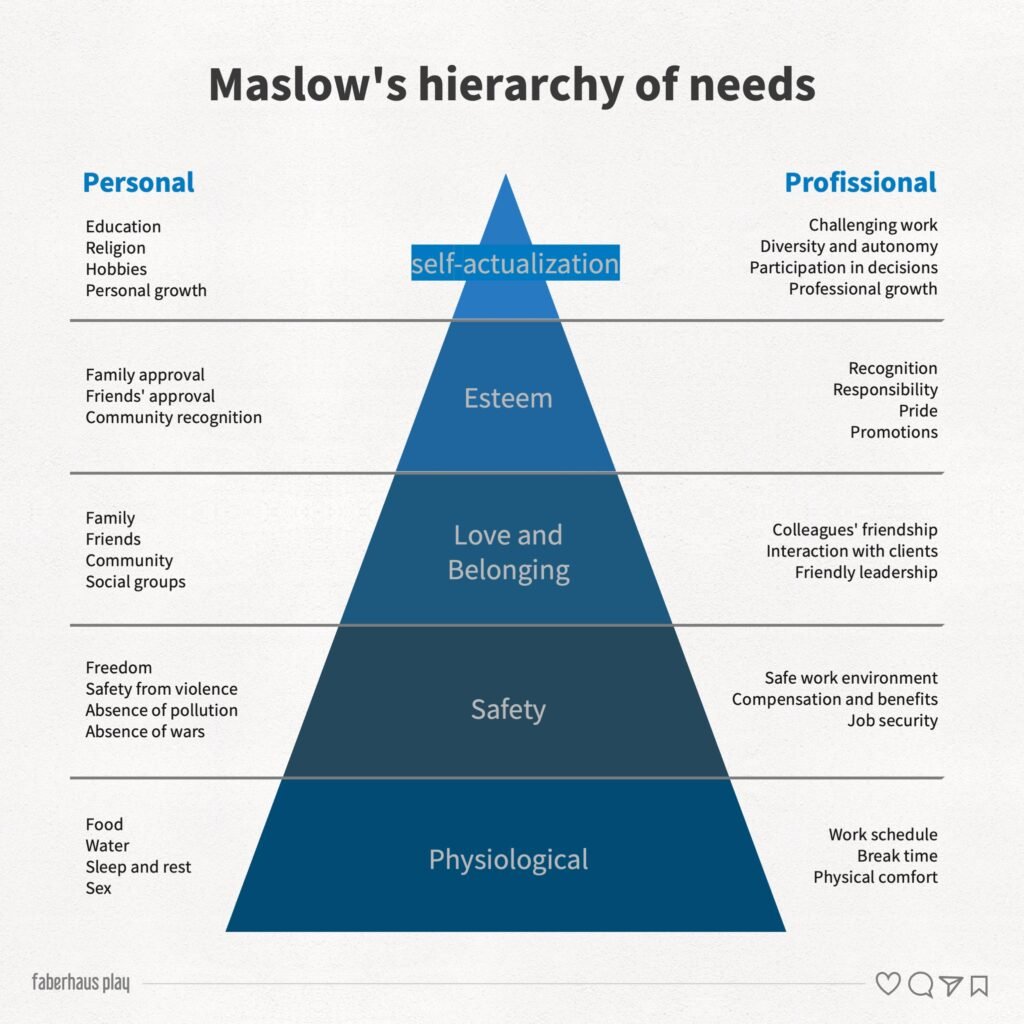
- physiological needs
- safety needs
- love and belonging needs
- esteem needs
- self-actualization needs
The model is usually represented as a pyramid, with basic survival needs at the bottom and personal growth needs at the top.
The traditional interpretation suggests that people need to satisfy lower-level needs before focusing on higher-level needs.
For example, someone who is hungry, exhausted, or unsafe will probably not be primarily focused on creativity, recognition, or personal fulfillment.
This idea became extremely influential because it gave leaders and organizations a simple way to think about human motivation.
But it also has limits.
Human life is rarely as linear as a pyramid.
People can search for belonging while facing insecurity.
They can pursue meaning while dealing with financial instability.
They can create, learn, and dream even when other needs are not fully satisfied.
So, the value of Maslow today is not treating the hierarchy as a rigid rule.
The value is using it as a lens.
Physiological needs: the body still matters
At the base of the pyramid are physiological needs.
These include basic requirements such as:
- food
- water
- sleep
- rest
- physical comfort
In personal life, these needs are obvious.
But in work and digital environments, they are often ignored.
A person who is exhausted will not produce their best thinking.
A team working without rest will not become more innovative simply because it has better tools.
A professional under constant overload will not solve complex problems just because AI makes some tasks faster.
In the AI era, this becomes even more relevant.
Automation may increase speed, but speed is not the same as sustainability.
If technology accelerates work without respecting human limits, it does not create progress.
It creates exhaustion faster.
For leaders and designers, this is a simple reminder: Human performance still depends on human bodies.
Safety needs: trust, stability, and control
Safety needs include:
- physical safety
- financial stability
- health
- employment security
- protection from threats
- predictability
In the workplace, this can appear as:
- fair compensation
- clear expectations
- psychological safety
- job stability
- transparent communication
In digital products, safety appears as:
- privacy
- security
- control over data
- clarity
- reliability
- protection from manipulation
This is one of the most important layers in the AI era.
People are asking new questions:
- what happens to my job?
- can I trust this system?
- where does my data go?
- is this recommendation fair?
- am I being monitored?
- can I understand how this decision was made?
AI creates enormous value, but it also creates uncertainty.
And uncertainty directly affects the need for safety.
That means responsible design is no longer only about usability.
It is also about trust.
A product can be efficient and still feel unsafe.
A system can be intelligent and still feel opaque.
A service can be automated and still feel hostile.
Safety is not only a technical requirement.
It is an emotional condition for adoption.
Love and belonging: technology does not replace connection
Human beings need relationships.
We need:
- family
- friends
- communities
- social groups
- belonging
- acceptance
At work, this appears through:
- team relationships
- collaboration
- friendly leadership
- interaction with clients
- a sense of belonging
This matters deeply in modern organizations.
Remote work, automation, AI assistants, and asynchronous communication can make work more efficient.
But they can also make work feel more isolated.
The challenge is not choosing between technology and human connection.
The challenge is designing systems where technology supports connection instead of replacing it.
In product and service design, belonging can appear in subtle ways:
- onboarding that makes people feel welcomed
- communities that create participation
- language that respects users
- support experiences that feel human
- collaboration tools that reduce distance
People do not only want functional products.
They want to feel that they belong somewhere.
Even in digital environments.
Esteem needs: recognition in a world of automation
Esteem needs are related to:
- confidence
- autonomy
- respect
- recognition
- status
- responsibility
- achievement
In personal life, esteem may come from family, friends, or community recognition.
At work, it appears through:
- promotions
- responsibility
- autonomy
- recognition
- pride in what we do
This layer becomes especially interesting in the AI era.
If AI can produce faster, write better drafts, generate images, analyze data, and automate tasks, many professionals may begin to ask:
What is my value now?
That is not only a productivity question.
It is an esteem question.
People want to feel useful.
They want to feel competent.
They want to feel that their contribution matters.
Leaders should pay attention to this.
AI adoption is not only a technical implementation challenge.
It is also a human identity challenge.
When introducing AI into teams, organizations need to communicate not only what will become faster, but also how people will continue to grow, contribute, and be recognized.
Otherwise, automation may create resistance not because people dislike technology, but because they feel their value is being threatened.
Self-actualization: growth, meaning, and human potential
At the top of Maslow’s model is self-actualization.
This is the need related to:
- personal growth
- creativity
- learning
- purpose
- autonomy
- realizing one’s potential
In work, this may appear as:
- challenging projects
- participation in decisions
- autonomy
- growth opportunities
- meaningful contribution
This is where AI can become genuinely powerful.
When used well, AI can remove repetitive tasks and create more space for:
- thinking
- creativity
- strategy
- experimentation
- learning
- exploration
But this is not automatic.
If AI is used only to increase volume, people may become more productive but less fulfilled.
If AI is used to expand human capability, it can support self-actualization.
That distinction matters.
The best use of AI is not replacing human potential.
It is amplifying it.
Why Maslow is still useful for design
Maslow’s hierarchy is not perfect.
Human needs do not always follow a clean sequence.
Different cultures, contexts, and life conditions can change how needs appear.
But the model remains useful because it forces designers and leaders to ask better questions.
For example:
Physiological
Is this experience respecting people’s time, energy, and attention?
Safety
Does this product feel trustworthy, secure, and transparent?
Belonging
Does this service make people feel included or excluded?
Esteem
Does this experience give people confidence, autonomy, and recognition?
Self-actualization
Does this product help people grow, create, learn, or become more capable?
These questions are especially important in UX, service design, product strategy, and leadership.
Because good design is not only about what people can do.
It is also about what people need while doing it.
Needs are not old-fashioned
It is easy to look at classic theories and consider them outdated.
Maslow’s model is old.
The world has changed.
Work has changed.
Technology has changed.
But human needs have not disappeared.
People still need rest.
They still need safety.
They still need belonging.
They still need recognition.
They still need meaning.
AI changes the tools.
It changes the speed.
It changes the way work is organized.
But it does not remove the human layer underneath every decision, product, service, and organization.
That is why Maslow still matters.
Not because the pyramid explains everything.
It does not.
But because it reminds us of something many teams forget:
Before designing for users, customers, employees, or markets, we are designing for human beings. And human beings still have needs.
Reference
Human Relations and Administration. Retrieved from http://relacoeshumanaseadm.blogspot.com.br/2014/06/teoria-de-maslow.html