
Many professionals spend years working hard, learning new skills, and taking on new responsibilities.
Yet when asked a simple question: “What do you want for your career?”, many struggle to answer.
Not because they lack ambition.
But because they have never stopped to design their careers intentionally.
Instead, they react to opportunities as they appear:
- a promotion
- a new manager
- a new company
- a new project
- an unexpected opportunity
Sometimes this works.
Often it doesn’t.
That’s why I believe one of the most valuable professional tools is the Individual Development Plan (IDP), known in many organizations as a Personal Development Plan (PDP).
Not because it predicts the future.
But because it helps us become active participants in our careers rather than passive observers.
Your career is a design problem
One of the reasons I like development plans is that they follow a mindset very similar to design.
Good designers rarely start by asking:
“What should I build today?“
Instead, they ask:
“What outcome am I trying to achieve?“
Career development works the same way.
Before choosing:
- courses
- certifications
- books
- jobs
- mentors
We should first define where we want to go.
Without a destination, almost any path seems reasonable.
The problem is that progress becomes difficult to measure.
The 70-20-10 framework
One of the most influential models for career development is the 70-20-10 framework.
It suggests that professional growth typically comes from three sources.
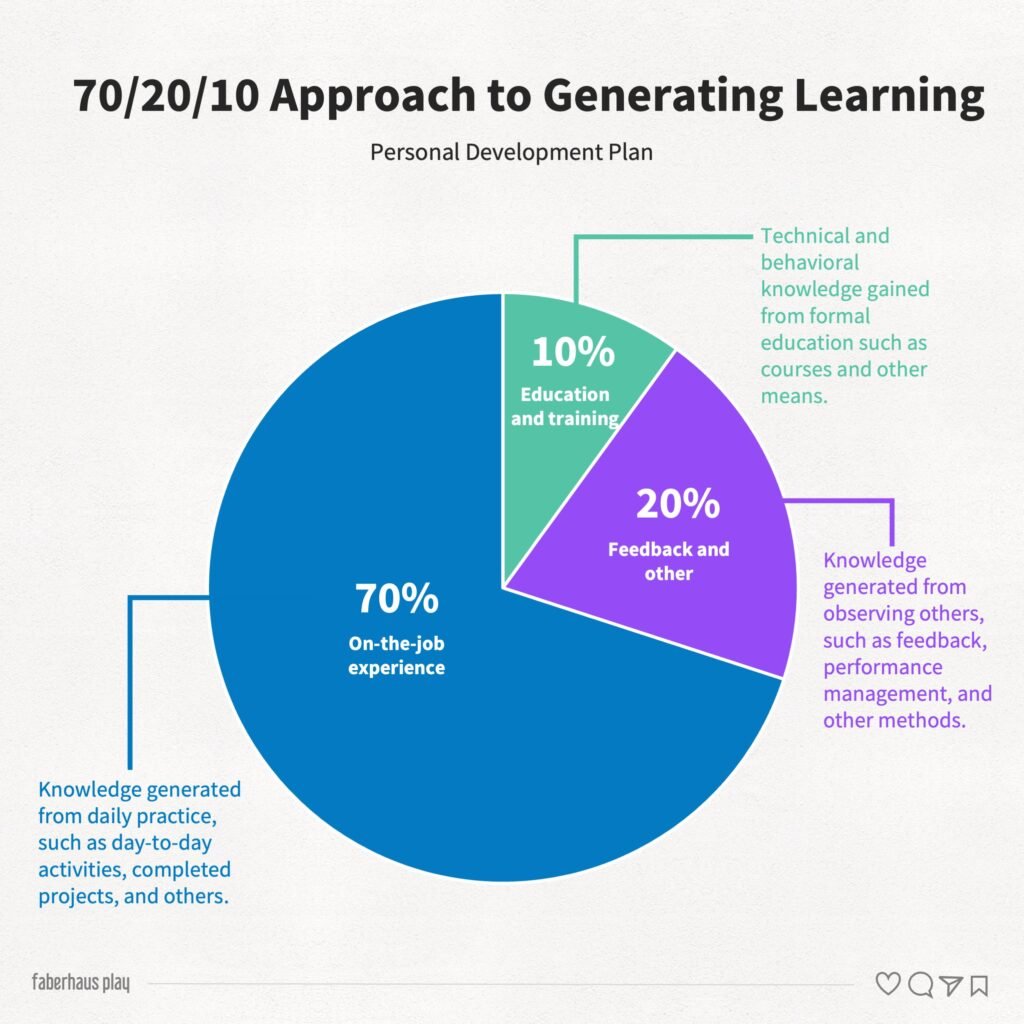
70%: On-the-job experience
Most learning happens while doing the work itself.
This includes:
- projects
- challenges
- mistakes
- problem-solving
- leadership experiences
- day-to-day responsibilities
This is why stretching assignments are often more valuable than additional training.
Experience creates context.
And context accelerates learning.
20%: Feedback and relationships
The second source of growth comes from other people.
This includes:
- coaching
- mentoring
- feedback
- peer learning
- networking
- leadership guidance
Sometimes a single piece of feedback can create more growth than months of formal training.
The challenge is being open enough to hear it.
10%: Formal education
Courses, certifications, books, workshops, and training programs still matter.
But they usually play a supporting role.
Knowledge is important.
Application is what transforms knowledge into capability.
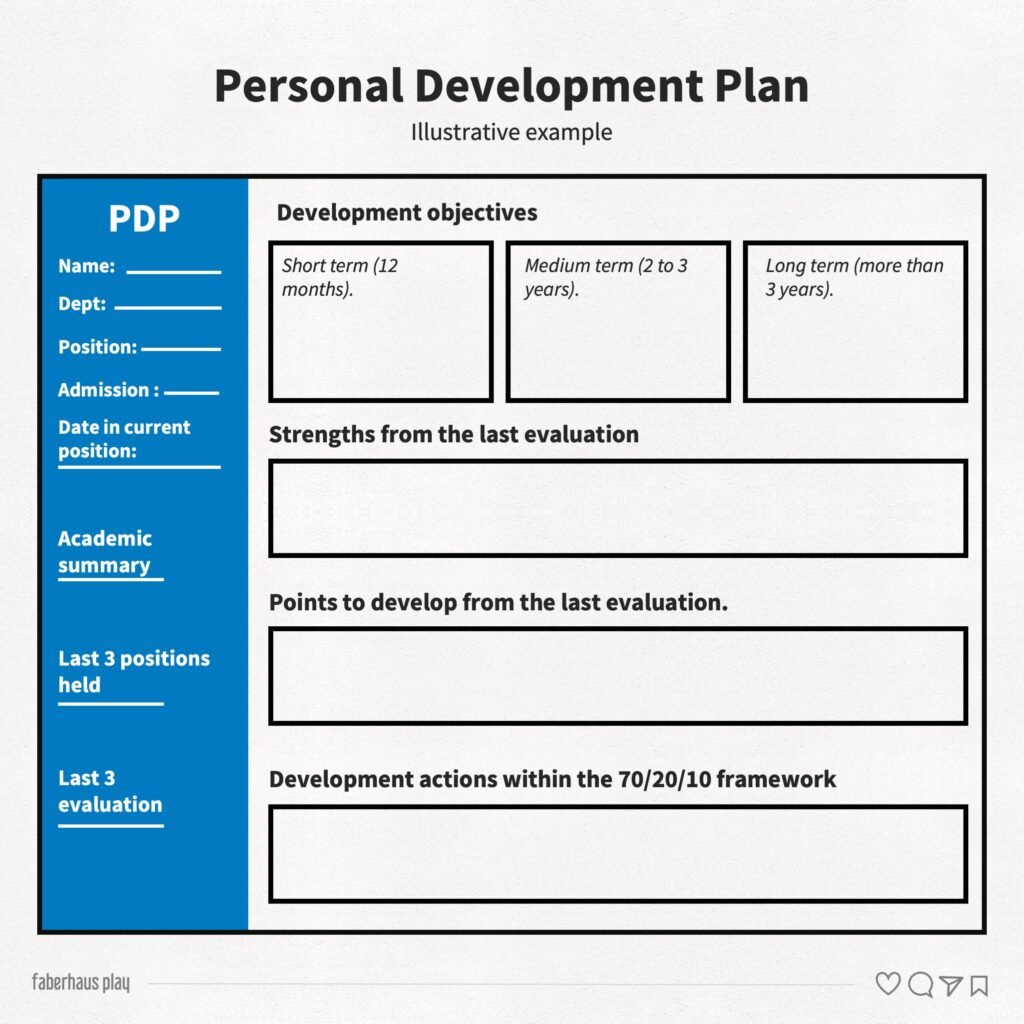
Building your own development plan
There are countless templates available.
But most effective development plans answer five simple questions.
1. Where do I want to go?
What is your long-term objective?
What role are you trying to reach?
What type of work do you want to do?
What kind of impact do you want to have?
Without clarity, development becomes random.
2. What are my strengths?
What skills, experiences, and capabilities already support that journey?
This is often overlooked.
People focus so much on weaknesses that they forget to leverage what already works.
3. What gaps need to be closed?
What capabilities are still missing?
These might include:
- technical skills
- leadership abilities
- communication
- strategic thinking
- business knowledge
- stakeholder management
The goal is not perfection.
The goal is identifying the few capabilities that matter most.
4. What actions will move me forward?
Once the gaps are clear, create a roadmap.
Think in terms of:
- short-term goals
- medium-term goals
- long-term goals
Career growth rarely happens overnight.
But it becomes much more likely when actions are intentional.
5. How will I learn?
This is where the 70-20-10 model becomes useful.
For every development objective, ask:
- what experiences can help me learn?
- who can help me grow?
- what formal education would be useful?
This creates a more balanced approach to development.
Why leaders should care about development plans
Career development is personal.
No manager can own someone else’s career.
But leadership can play an important role.
The best leaders help people:
- gain perspective
- identify blind spots
- explore opportunities
- understand their potential
One useful framework for this conversation is the 9-Box Grid.
The purpose of the 9-Box Grid
The 9-Box Grid is often used by organizations to evaluate talent based on two dimensions:
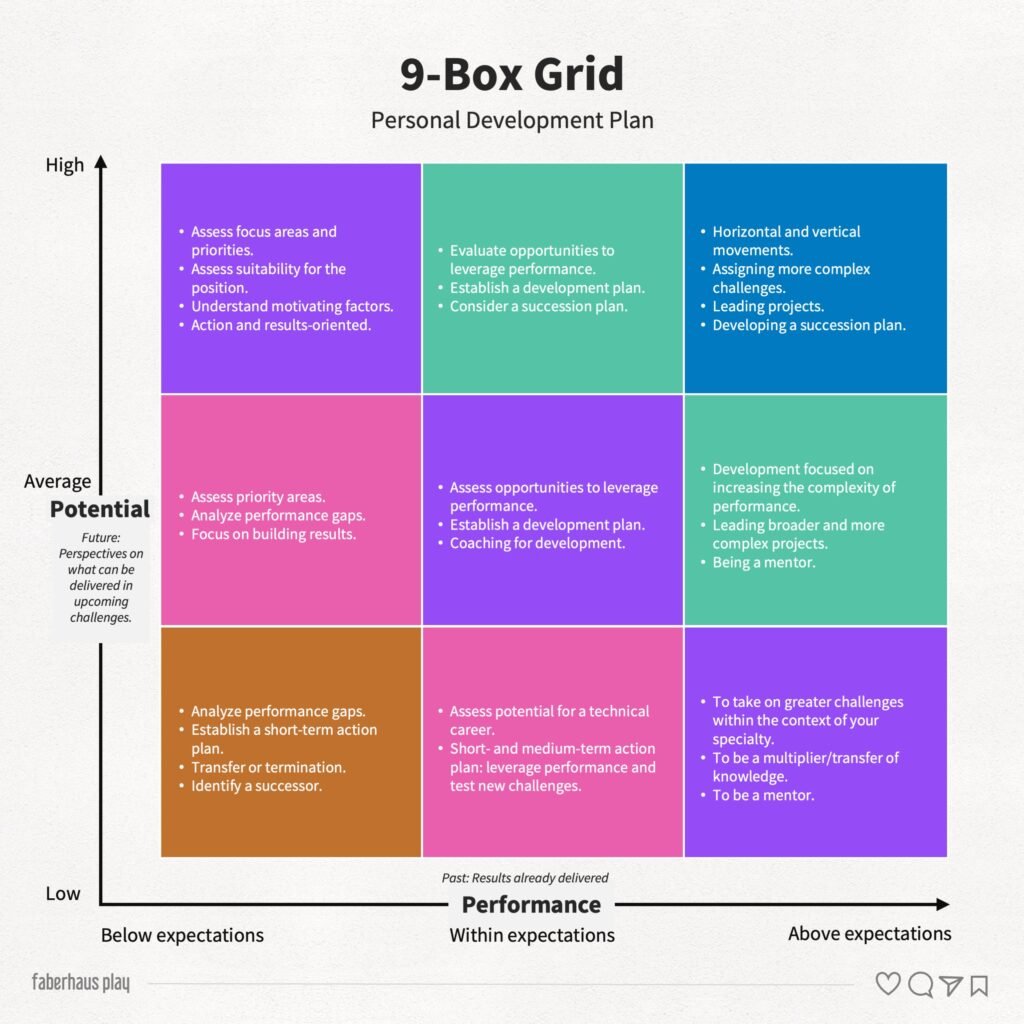
Performance
Performance reflects past results.
It answers questions such as:
- what has this person delivered?
- how consistently do they perform?
- what impact have they created?
Performance looks backward.
Potential
Potential reflects future capability.
It explores questions such as:
- can this person handle greater complexity?
- can they grow into larger responsibilities?
- can they create value in new contexts?
Potential looks forward.
When combined, these two dimensions create nine possible talent profiles.
The goal is not labeling people.
The goal is creating better development conversations.
Why the 9-Box is useful
One of the biggest mistakes organizations make is assuming performance and potential are the same thing.
They are not.
Some professionals consistently deliver excellent results but prefer to deepen expertise rather than move into larger leadership roles.
Others have significant growth potential but have not yet reached their full performance level.
Understanding the difference allows leaders to provide more meaningful support.
And it helps professionals make more informed career decisions.
The real purpose of development tools
The most important thing to remember is that neither the Individual Development Plan nor the 9-Box Grid exists to judge people.
They exist to support growth.
Used correctly, they help answer questions like:
- what should I learn next?
- what experiences should I seek?
- what strengths should I leverage?
- what opportunities should I pursue?
Those questions matter far more than the templates themselves.
Plan the direction nor the certainty
Many people wait for their company to manage their career.
Some wait for a manager.
Others wait for an opportunity.
But careers rarely improve through waiting.
They improve through intentional action.
The purpose of an Individual Development Plan is not creating certainty.
It’s creating direction.
And in a world where work changes constantly, having direction may be one of the most valuable advantages a professional can have.
References
Marcelo Nóbrega. Retrieved from
Marcelo Nóbrega LinkedIn profile
Center for Creative Leadership (CCL)
Ram Charan, Stephen Drotter, & James Noel. (2018). The Leadership Pipeline: Developing Leaders as a Competitive Advantage. GMT Editores.