When people think about design, UX design, service design, or digital products, they usually look for contemporary frameworks.
They study:
- Design thinking
- Product discovery
- Service design
- Jobs to be done
- Behavioral psychology
- Growth strategies
All valuable subjects.

But one of the most important books for understanding modern design was written long before smartphones, apps, and digital platforms existed.
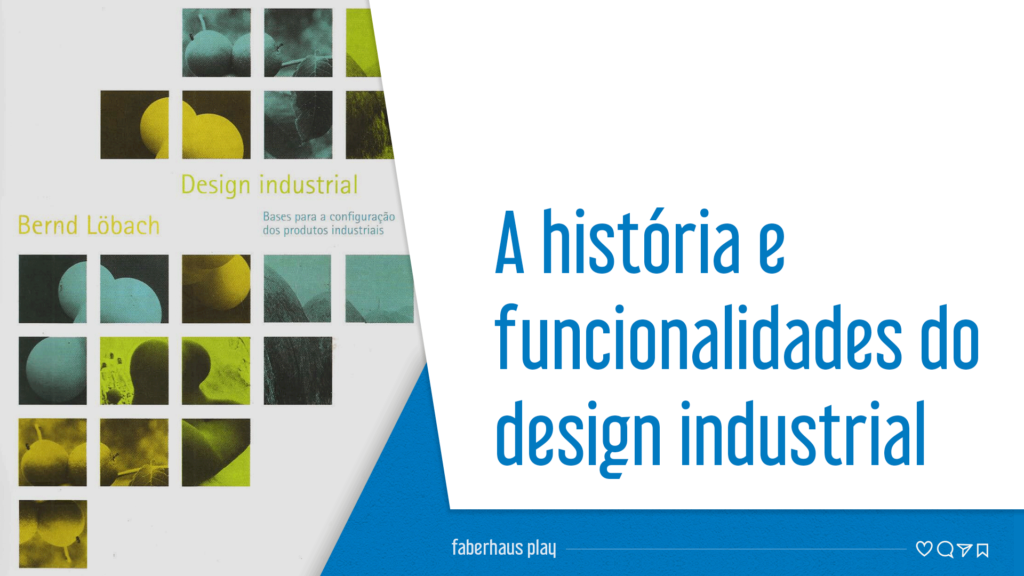
I’m talking about Industrial Design by Bernd Löbach.
Although the book focuses primarily on industrial products, many of its ideas remain surprisingly relevant for anyone working with digital products today.
Because beneath changing technologies, one thing remains the same: Design is still about understanding people and solving problems.
Design beyond decoration
One of the central ideas presented by Löbach is that design should not be understood primarily as an artistic activity.
Design is fundamentally a problem-solving discipline.
As Löbach writes:
“Design is an idea, a project, or a plan for solving a specific problem.“
This sounds simple, but it changes how we think about design.
If design is fundamentally about solving problems, then aesthetics becomes only one part of the equation.
A beautiful product that fails to solve a real problem has not a good design.
Likewise, a simple solution that effectively solves a meaningful problem may represent an excellent design.
This distinction remains critical today.
Especially in digital environments where visual trends often receive more attention than actual user needs.
Every product begins with a human need
Another key contribution from Löbach’s work is his focus on human needs.
According to his perspective, products exist because people experience some form of deficiency, tension, or unmet need.
Design begins when we identify those needs and search for ways to satisfy them.
This idea may sound obvious today.
But it is the foundation of modern design and UX.
When we conduct:
- User interviews
- Field research
- Usability testing
- Journey mapping
We are essentially trying to understand the same thing: What need exists, and how can we help people satisfy it?
So, the technologies could continuously change, but the principle of design no.
The three functions of every product
One of the most useful frameworks in Löbach’s book is his classification of product functions.
He argues that products operate on three different levels:
Practical function
The practical function relates to utility and physical use.
Can people use the product effectively?
Does it solve the intended problem?
Is it safe, efficient, and ergonomic?
In digital design, this corresponds to:
- Usability
- Accessibility
- Efficiency
- Task completion
- Ease of use
Many UX teams spend most of their time here, and for good reason.
If the product doesn’t work, nothing else matters.
Aesthetic function
The aesthetic function relates to sensory perception.
This includes:
- Form
- Color
- Texture
- Composition
- Visual harmony
In digital products, aesthetic function influences:
- Visual design
- Emotional response
- Perceived quality
- Trust
- Overall experience
People don’t simply use products, they experience them.
And aesthetics strongly shapes that experience.
Symbolic function
Perhaps the most interesting function is the symbolic one.
Products communicate meaning.
They express:
- Identity
- Status
- Belonging
- Values
- Aspirations
Think about:
- Apple products
- Luxury watches
- Premium cars
- Exclusive communities
People are often buying more than functionality, they’re buying meaning.
The same happens with digital products.
Certain tools communicate professionalism.
Others communicate creativity.
Others communicate innovation.
Design shapes those perceptions.
Design happens inside the mind
One of the most fascinating parts of Löbach’s work is his explanation of perception.
Designers do not actually design experiences directly.
They design artifacts.
What users experience is something different.
A product first passes through:
- Perception
- Cognition
- Memory
- Interpretation
Only then does experience emerge.
In other words:
Product → Perception → Interpretation → Experience
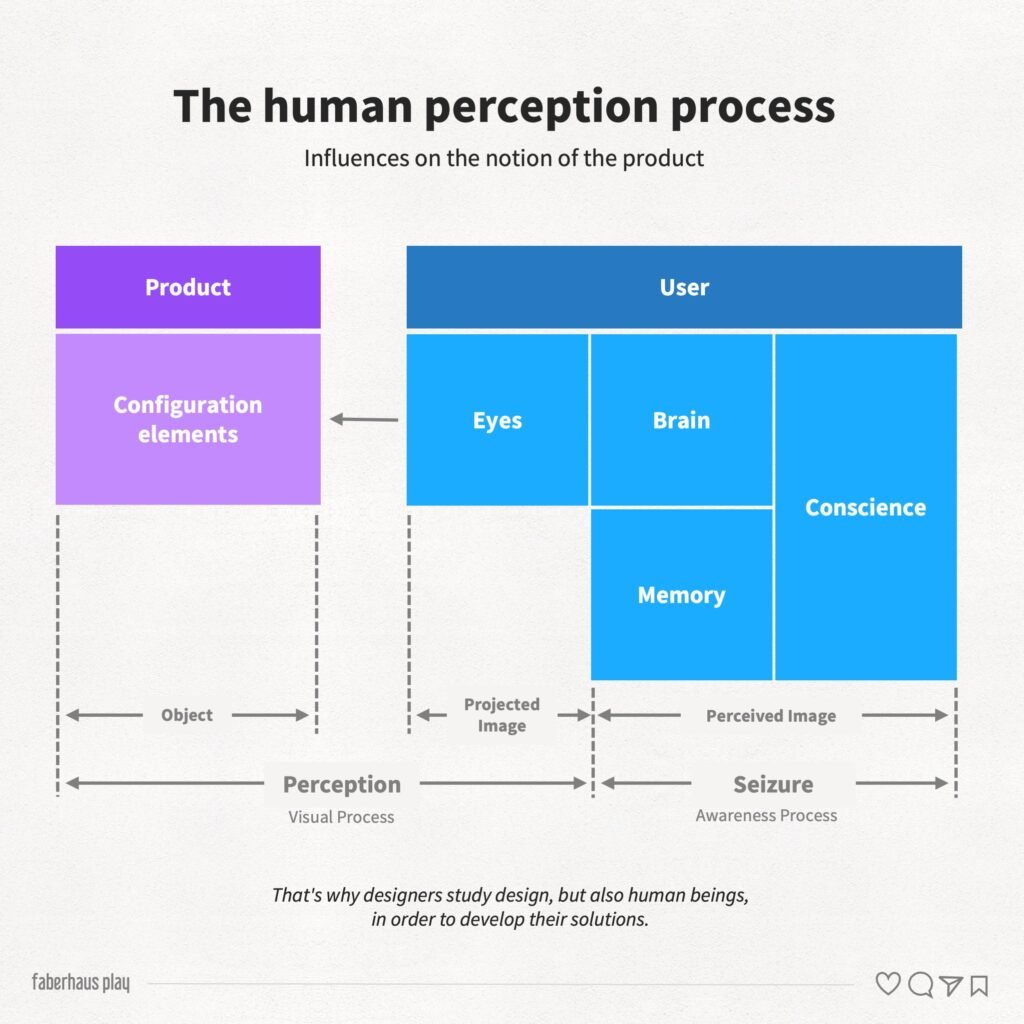
This is remarkably close to how modern UX professionals think about interaction design.
The product itself is only the starting point.
What matters is how people understand, interpret, and experience it.
That is why understanding psychology, behavior, and cognition is just as important as understanding technology.
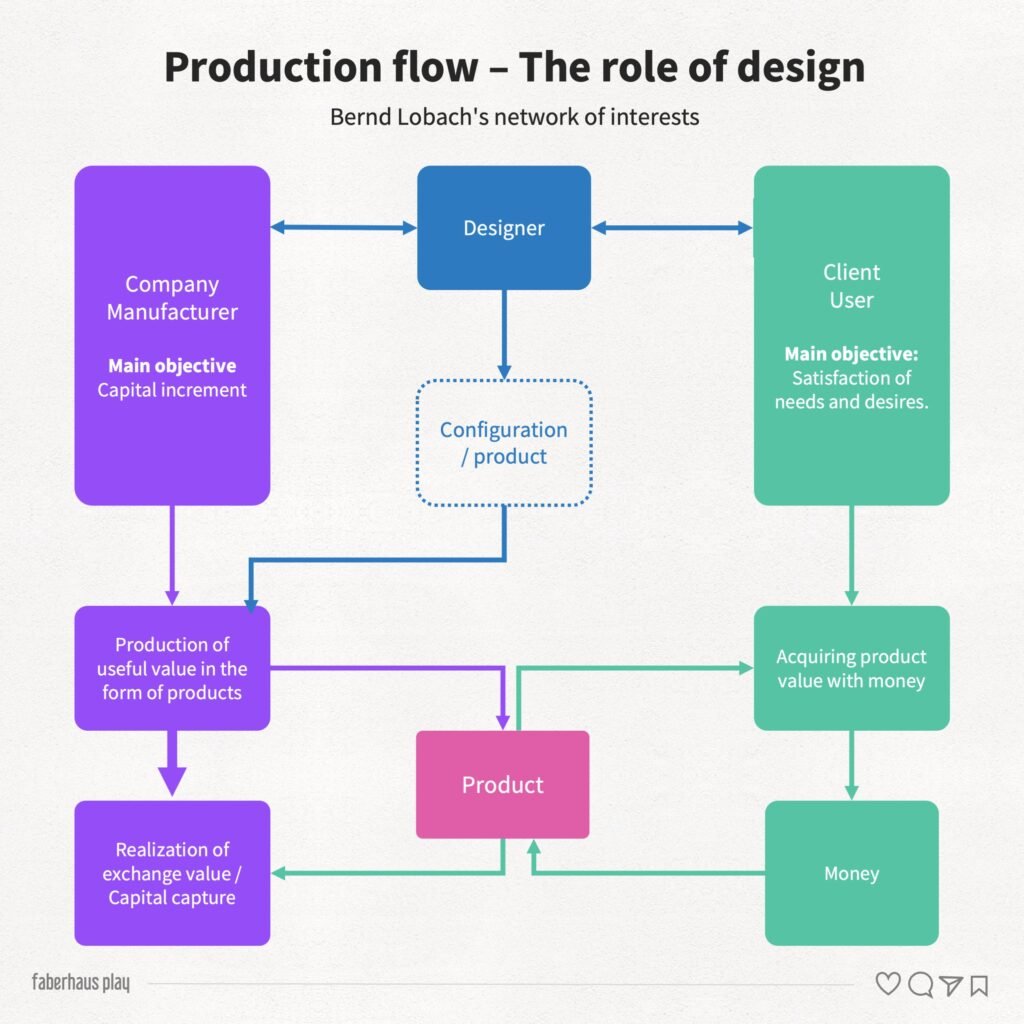
The designer as a bridge
Löbach also describes the designer as a mediator between three forces:
- Human needs
- Industrial production
- Business objectives
This perspective remains incredibly relevant today.
Modern designers constantly navigate tensions between:
- Users
- Technology
- Business goals
Good design rarely happens by optimizing only one of those dimensions.
The designer’s role is to create balance.
To translate human needs into solutions that are technically feasible and economically viable and that challenge has not changed.
Whether we are designing a chair or a mobile application.
Why this matters for digital design
Although Industrial Design was written with physical products in mind, many of its principles continue to guide modern digital design.
Today’s products may be:
- Mobile apps
- Websites
- Platforms
- Software
- Digital services
But they still require us to:
- Identify human needs
- Understand behavior
- Create useful solutions
- Shape perception
- Generate value
- Balance business objectives with user outcomes
The materials changed.
The principles remained surprisingly consistent.
The design yesterday, today and tomorrow
Many design books focus on tools, methods, and trends.
Those are useful.
But foundational books help us understand why design exists in the first place.
Bernd Löbach’s work reminds us that design is much more than aesthetics.
It is a structured process for transforming human needs into meaningful solutions.
And whether we are designing industrial products, digital services, or AI-powered experiences, that mission remains exactly the same.
Technology evolves.
Human needs evolve more slowly.
That is why some design principles remain relevant for decades.
And why a book about industrial design still has so much to teach modern designers.
Reference
Bernd Löbach. (2000). Industrial Design. Rio de Janeiro: Blücher.