One of the biggest communication mistakes we make is assuming that everyone processes information the same way we do.
They don’t.
Some people want facts.

Some want relationships.
Some want efficiency.
Some want recognition.
And when we communicate without considering those differences, misunderstandings happen.
Not because people are unintelligent.
But because people interpret the world through different behavioral preferences.
This is the idea behind the Social Styles Model.
It’s a framework designed to help us understand observable behavioral patterns and adapt our communication accordingly.
The value of this model is not putting people into boxes.
It’s learning how to communicate more effectively with different kinds of people.
Communication is not one-size-fits-all
Many people think communication is about speaking clearly.
That’s only part of the equation.
Effective communication also requires understanding how the other person prefers to receive information.
The same message can generate completely different reactions depending on:
- how it is delivered
- who receives it
- what that person values
This is particularly important in:
- leadership
- product management
- design
- sales
- consulting
- facilitation
- stakeholder management
The more diverse the audience, the more valuable communication flexibility becomes.
And flexibility is exactly what the Social Styles model helps develop.
What are social styles?
Social Styles are observable behavioral tendencies.
They focus on how people interact with others rather than why they behave that way.
Unlike personality models that explore internal motivations, Social Styles focus on behaviors that can be seen directly.
The model is based on two dimensions.
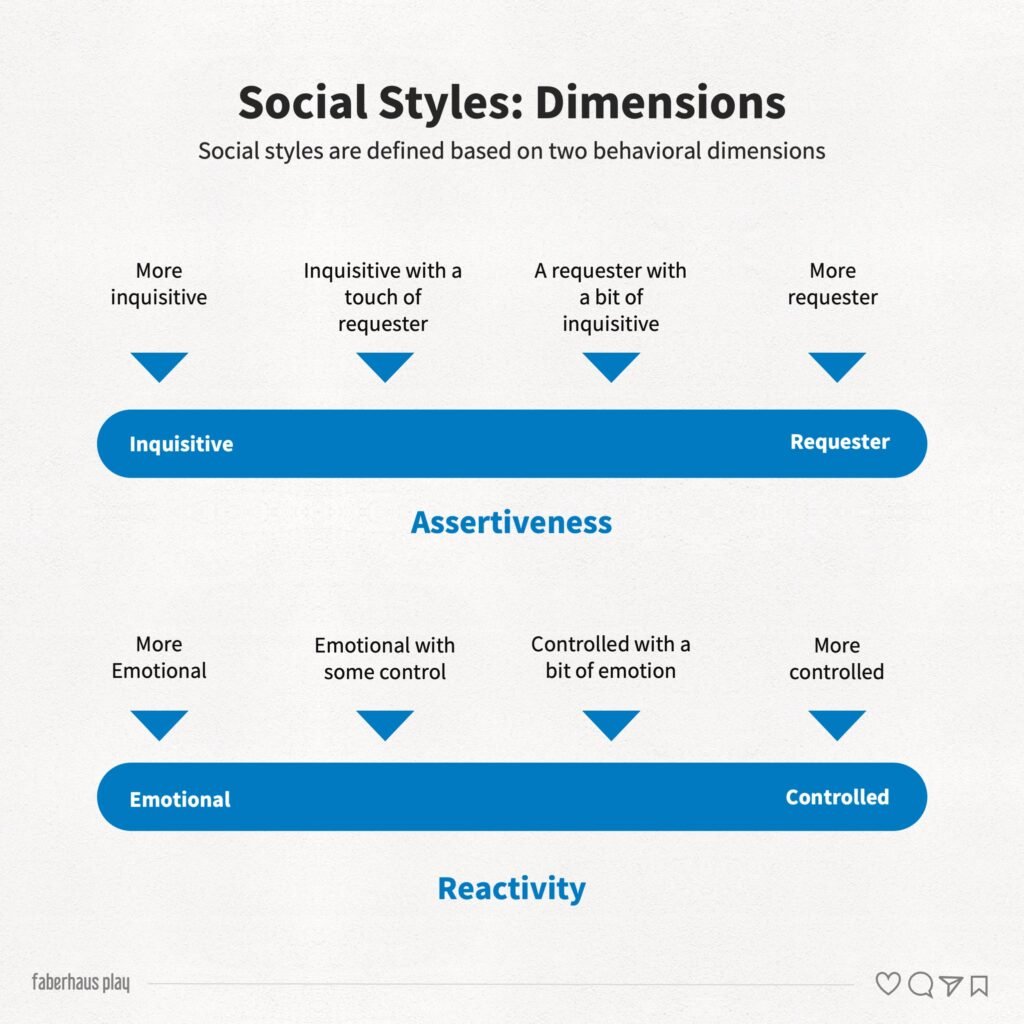
Assertiveness
Assertiveness measures how people tend to communicate.
On one side are people who ask more questions.
On the other are people who make more statements and direct requests.
In simple terms:
- Lower assertiveness → more questioning
- Higher assertiveness → more directing
Responsiveness
Responsiveness measures how openly people display emotions.
Some people naturally control emotional expression.
Others communicate emotions more openly.
In simple terms:
- Lower responsiveness → more controlled
- Higher responsiveness → more expressive
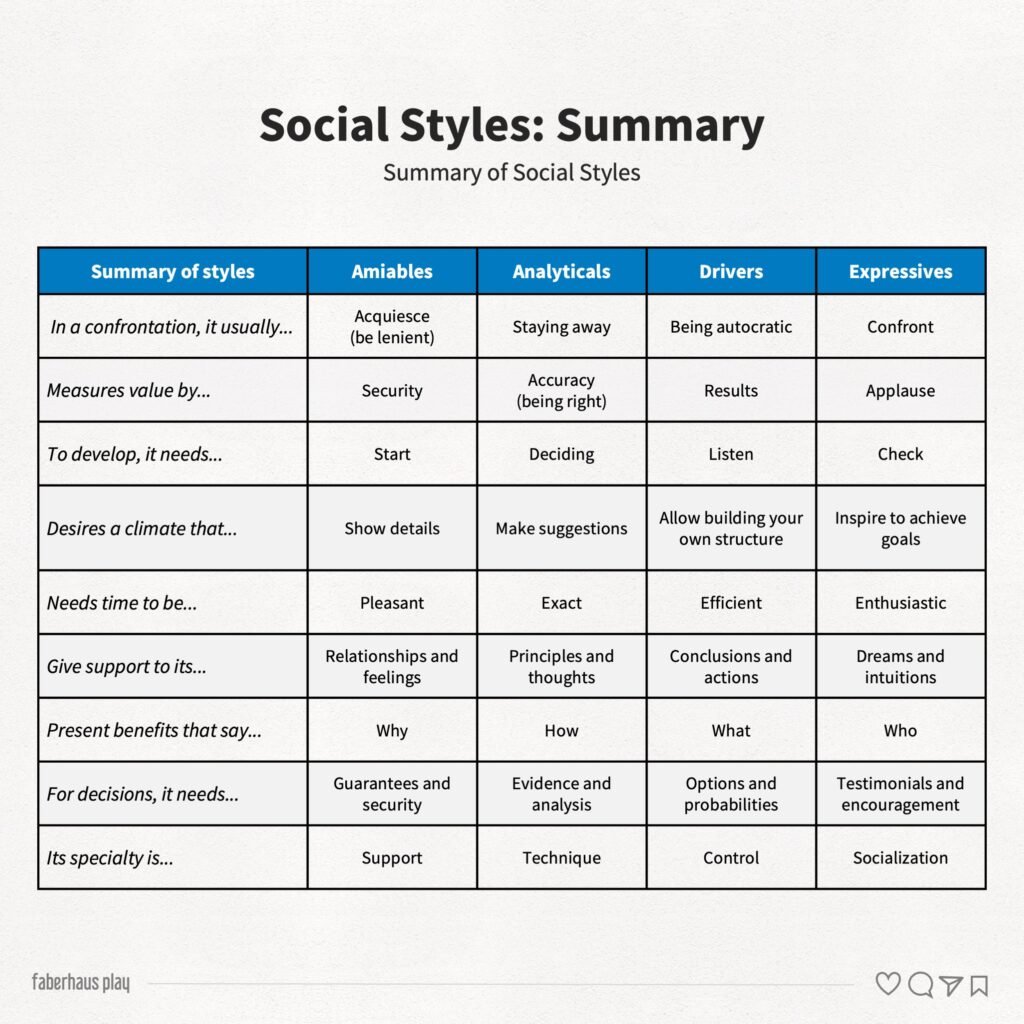
When these two dimensions intersect, they create four observable social styles.
The four social styles
The four social styles are:
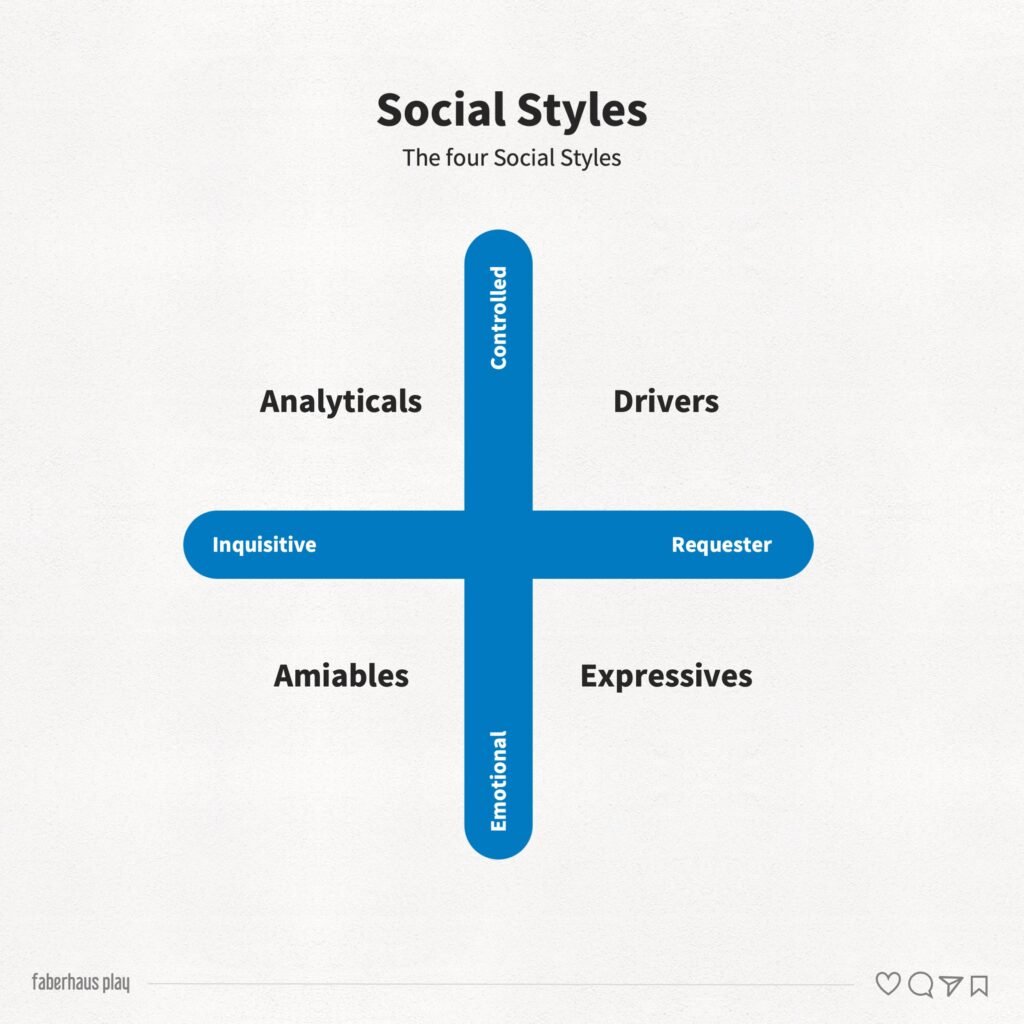
Amiables
Amiables are relationship-oriented and highly supportive.
They genuinely enjoy helping others and creating positive environments.
People often describe them as:
- patient
- loyal
- cooperative
- pleasant
- supportive
They usually prefer harmony over confrontation.
Because of this, they may avoid difficult conversations longer than they should.
Their greatest need is security.
When they feel safe, they perform extremely well.
Under pressure
Amiables may become passive, avoid conflict, or struggle to express disagreement clearly.
How to communicate with them
- be supportive
- build trust
- avoid unnecessary pressure
- give reassurance
- demonstrate commitment
Analyticals
Analyticals are logic-oriented and detail-focused.
They tend to evaluate situations carefully before making decisions.
People often describe them as:
- thoughtful
- systematic
- reflective
- precise
- methodical
They are often the people asking difficult questions during meetings.
Not because they want to challenge others.
Because they want to reduce uncertainty.
Their greatest need is being correct.
Under pressure
Analyticals may become overly critical, skeptical, sarcastic, or excessively focused on problems.
How to communicate with them
- use facts
- bring evidence
- be specific
- avoid exaggeration
- allow time for analysis
Drivers
Drivers are task-oriented and focused on results.
They value:
- efficiency
- speed
- action
- outcomes
People often describe them as:
- decisive
- ambitious
- competitive
- direct
- determined
Drivers tend to push projects forward.
They are often comfortable making decisions with incomplete information.
Their greatest need is maintaining control.
Under pressure
Drivers may become impatient, aggressive, blunt, or overly demanding.
How to communicate with them
- be direct
- be concise
- focus on solutions
- respect their time
- get to the point quickly
Expressives
Expressives are energetic, enthusiastic, and highly people-oriented.
They enjoy:
- interaction
- creativity
- storytelling
- visibility
- new possibilities
People often describe them as:
- charismatic
- optimistic
- energetic
- persuasive
- engaging
They often bring energy and momentum to teams.
Their greatest need is recognition.
Under pressure
Expressives may become emotional, dramatic, impulsive, or unpredictable.
How to communicate with them
- be enthusiastic
- explore possibilities
- encourage participation
- recognize contributions
- avoid shutting down ideas too quickly
Why this matters for leadership
The most powerful lesson from Social Styles is not identifying your own style.
It’s learning how to adapt.
Many communication problems happen because people communicate in ways that make sense to themselves rather than to their audience.
For example:
A Driver may think an Amiable is indecisive.
An Amiable may think a Driver is aggressive.
An Analytical may think an Expressive is superficial.
An Expressive may think an Analytical is overly critical.
Neither side is necessarily wrong.
They are simply operating from different behavioral preferences.
The more we understand these differences, the easier it becomes to collaborate.
The goal is versatility, not acting
One common misconception is that adapting communication means becoming fake.
It doesn’t.
Versatility is not pretending to be someone else.
It is adjusting how you communicate so your message can be understood more effectively.
You remain yourself.
You simply become more intentional.
The best communicators don’t use one communication style.
They use the style that best serves the situation.
Why this matters for designers and product leaders
If you work in design, product, or service design, you’re constantly communicating with people who see the world differently.
You interact with:
- executives
- engineers
- researchers
- marketers
- customers
- stakeholders
And each group values different things.
Understanding social styles helps you:
- facilitate workshops
- manage stakeholders
- conduct interviews
- present ideas
- influence decisions
- lead multidisciplinary teams
Because at senior levels, success depends less on having the best ideas and more on helping different people understand them.
Focus on communication, not labeling
One of the most important professional skills is not just communication.
It’s communication adaptability.
The ability to recognize what another person needs and adjust your approach accordingly.
The Social Styles model offers a practical way to develop that skill.
Not by labeling people.
But by helping us understand that different people communicate differently.
And once we understand that collaboration becomes much easier.
References
Dorsey, C. Retrieved from https://www.youtube.com/watch?v=0m_sY7C4n60
Tracom Group. Retrieved from https://www.tracomgroup.com
Small World Alliance. Retrieved from http://www.smallworldalliance.com/documents/SocialStyles-Assessment.pdf